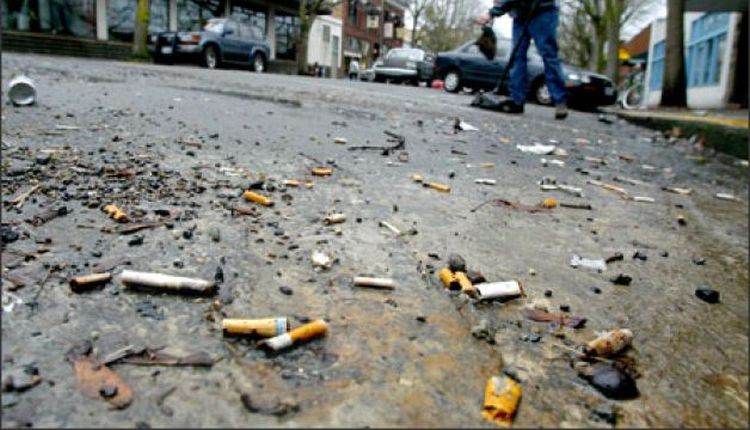
Two objectives are sought: on the one hand, and insofar as it is related to the protection of the environment, it establishes sanctions for those who throw cigarette butts in areas not intended for the disposal of this waste. It also makes it mandatory to install specific ashtrays on the outskirts of establishments where there is significant movement of people, such as shopping malls, banks, hospitals, restaurants, bowling alleys or bus stops, as well as public and private offices.
In our country and according to the data extracted from the last INE household survey, 20% of the adult population of our country consumes tobacco. This represents approximately 500,000 people who identify themselves as smokers, with the health and environmental consequences that this implies. If we consider that an average smoker consumes up to ten cigarettes a day, 5,000,000 cigarette butts are generated per day in our country, of which two out of three are thrown into the environment.
“The project supposes to take another step in what makes the integral waste management promoted from Law No. 19,829, especially considering the general interest committed in the conservation of the environment”, Sartori expresses in the explanatory statement.
On the other hand, the anti-smoking measures are deepened, by proposing the expansion of the scope of the prohibition established in Law No. 18,256, adding as protected space those intended for use by minors, such as public squares. with games, zoos and fauna and flora reserves, amusement parks and attractions, as well as spaces dedicated to sports activities, among others.
The objective, according to Sartori, is to position Uruguay among the pioneers in the region in the management of butt residues in the city, added to the achievements already obtained in the fight against smoking.
According to the white senator, the fine is not the objective of the law, but what is sought with it is to discourage and persuade people not to throw this type of waste in the streets and dispose of it in the appropriate containers for it. .
“This will not be achieved only through the approval of the proposed rule, but will require joint work with the Departmental Governments (at all levels), and the generation of environmental awareness in society, but it is a sign of impulse from the Legislative Power”, assured the senator.
As established in the project, the control of conduct and the imposition of sanctions —which can range from 1 to 10 UR for people, and from 10 to 100 for establishments included in the norm that do not place the colilleros— will be left to charge of the Ministry of the Environment and the proceeds of the fines applied for violation of this rule, will be allocated to the FONAGRES created by article 45 of Law No. 19,829, intended for recycling.
Likewise, the project contemplates that public or private institutions interested in the environmental management of cigarettes, butts and/or cigarette filters, can make agreements with the establishments where the butts are located, for the collection and recycling of these wastes.
Bill to penalize those who do not throw cigarette butts in specific places




Latest Posts

Government evaluates contracting insurance against rise in oil prices
The Dominican Government is holding talks with investment banks to

Caixa resumes financing for properties above R$2.25 million
Caixa Econômica Federal announced this Tuesday (3) the resumption of
American convicted of trying to produce child pornography with a minor in Cuba
On February 11, a federal jury convicted Earl Richard Clouser,

In Coppelia they no longer sell ice cream, only dry wine
Havana/On the corner of 23rd and L, where for decades


Latest from Blog

Government evaluates contracting insurance against rise in oil prices
The Dominican Government is holding talks with investment banks to acquire financial insurance that will mitigate the impact on the public finances of possible increases in crude oil, given the recent increase

Caixa resumes financing for properties above R$2.25 million
Caixa Econômica Federal announced this Tuesday (3) the resumption of financing for the purchase of residential properties above R$2.25 million with resources from the savings account. The modality, framed in the Real
American convicted of trying to produce child pornography with a minor in Cuba
On February 11, a federal jury convicted Earl Richard Clouser, 55, of Burnham, Pennsylvania, for attempting to produce child sexual abuse material with a 15-year-old teenager in Cuba. According to the United

In Coppelia they no longer sell ice cream, only dry wine
Havana/On the corner of 23rd and L, where for decades Havana waited in line to enjoy a five-scoop salad, this Tuesday the only possible taste was the bitter aftertaste of frustration. The

Venezuela announces new oil sales contracts for the United States market
“PDVSA has signed supply contracts with companies marketing oil and derivatives destined for the United States market,” the state-run company reported without identifying the companies or offering more details of the contracts.