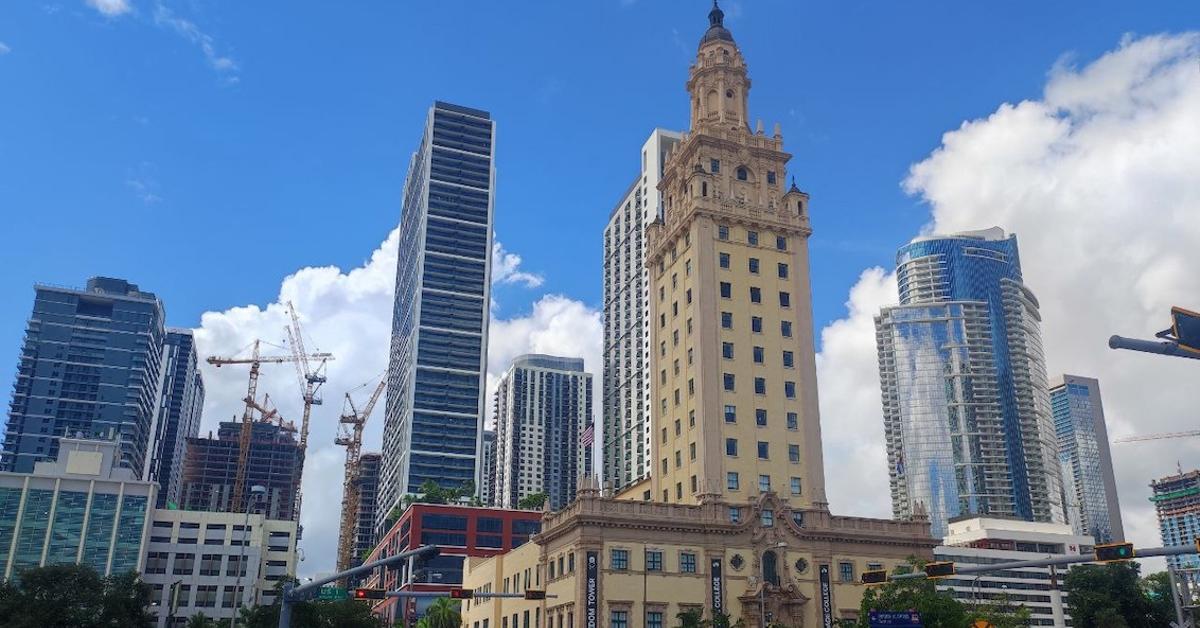
Miami/A robot that makes food deliveries in front of the imposing facade. Around skyscrapers and cranes dominate the landscape. Miami has changed since in 1925 the building that houses the Torre de la Libertad, a structure that opened its doors of Cuban refugees and now reopens as a museum of an exodus that has not stopped in six decades.
Zenaida and Manuel arrived on Saturday afternoon before the gate where, each and without then meeting, they were being children. The news of the reopening of the Torre de la Libertad, last week, reached the ears of these two septuagenarians who, with a white dress she and an impeccably ironed shirt, decided to return to the place where “they gave me the first hug when I got here,” Zenaida tells 14ymedio. “They delivered some powdered milk bags that were a blessing,” adds Manuel.
Located in Biscayne Boulevard, the Torre de la Libertad was subjected to a deep renewal that lasted two years and cost 25 million dollars. The project included significant structural repairs but, above all, a rethinking of its collections in which a lot of audiovisual material, voices, testimonies and the possibility of interacting with part of the samples have been added, creating a museum tailored to each visitor.
With a long sigh, Zenaida and Manuel begin the tour. About twenty people have gathered for a journey that will be guided by a specialist and will end with a tasty cut or a champagne glass, according to tastes. In October, the tower will open to regular accesses but, for the moment, these groups that travel their wide halls enjoy a more intimate and serene experience.
/ 14ymedio
Closed since 2023 and declared 15 years before National Historical Monument, the building retains many of the architectural elements of its initial function as the headquarters and printing of the newspaper The Miami News. The majority of visitors on Saturday opt for the stairs instead of the elevator and flow into a large column and large window room. Zenaida and Manuel squeeze their hands, the place is familiar to them but it is very changed.
“She was very small, but I remember that my mother was very distressed,” she recalls, from Manzanillo and that she arrived in the United States in 1965. Meanwhile, the guide shows several replicas of the tower placed throughout the room and that function as informative stations with videos and holographs that review the most important moments of the property. “My aunt helped her to fix a tooth here,” adds Zenaida.
The group is diverse. There are a couple of tourists who seem to have dropped from a cruise of those who arrive every week to the port of Miami, several Americans and many Cubans, most over 65 years. The city to which Manuel reached in 1963 “did not look like any of this, this is another world,” reflects the exile from Luyanó, in Havana. There are also some refugees who have joined the tour with their children, who have probably never stepped on the island and have English as their main language.
“Look, look, looks like your grandmother,” says a woman dressed in green who has arrived accompanied by a teenager who looks away from her mobile to observe one of the photos. In the image, a very thin woman and with a sadness rictus looks directly at the lens. The young man responds with a brief “ok” and immerses himself in a video of Tik Tok. The group moves to another room with books full of illustrations about Florida, its original inhabitants and the multiple cultures that have shaped the Miami that many today call the city of the sun or the capital of Latin America.
On one of the walls, a text clarifies that being at a “crossroads” is to be in a “connective node that acts as a meeting point.” That has become the city that in the official Cuban propaganda remains the target of the most virulent adjectives and the most angry accusations. The escape island has nourished and shaped a city in which all kinds of accents are now heard, cassava with mojo and arepas, fried ripe bananas and tacos are eaten.
“We were going to have all this in Havana,” the woman dressed in green rivers to take off the teenager from the screen. Through the window you see a huge skyscraper that occupies a good part of the landscape. The guide hurries the passage and enters another room with a large screen where a video with faces and testimonies of exile is displayed. The past in black and white, the present color.

/ 14ymedio
In the following rooms the objects accumulate. There are suitcases, bags, travel documents, children’s clothes and a doll, they also succeed photographs of balseros. Dozens of Cubans crowded on a straightening boat and others climbed to a truck converted in boat. Shirts, a wedding dress, books and a fan are also seen. The few belongings that the exiles could take out. Most only came with what he had been on his body.
“My father took everything away, the apartment building I rented, the pharmacy and the cars,” says this newspaper Manuel. “My mother had to leave to the married ring because at Havana airport they told him that he couldn’t get it.” Happy businessman in Cuba, Manuel’s father arrived without a penny to the United States. “He had to start from scratch, but he had smell for business so in less than ten years he already run several car repair workshops,” he says.
The most emotional moment for the couple is the room that recreates the registration office of the emergency center for Cuban refugees that was founded in the 1960s in the tower. In the premises they were busy processing and documenting exiles and providing medical and dental services. The chairs arranged in a row, the posters in English and Spanish and the old phone in a corner bring a wave of emotions to Zenaida.
“It was also, there were many women with children,” he says. “My family was given a few dollars to start, with that we could rent an apartment that was a thorough, there was hardly any space for us to all be inside.” In a few years they moved to Kansas City where shortly after their father began a development and printing business. “We made good money and when we had enough to buy a house we returned to Miami, because this was the place we liked and reminded us of Cuba.”
Zenaida and Manuel have never returned to the island. “We have gradually taking out the family that remained there, the last we brought went to a granddaughter with their two children.” Manzanillo and Luyanó arrive from stories. “My family’s house is an office that they use to recruit young people for military service,” she says. “The place where I lived my childhood in Havana collapsed,” he laments.
/ 14ymedio
In a museum room, a Singer sewing machine attracts the group’s eyes. Even the teenager leaves Tik Tok trying to decipher what the object that, within a showcase, seems so important. The sewing was a source of employment for many of the Cuban emigrants who arrived in the United States. “My mother paid us studies doing everything on her machine and ended up opening an elegant dresses store,” says another old woman to the comments of the guide.
A wide wall full of faces proposes another emotional experience. Visitors can choose to hear the testimony of any of the hundreds of people who look at them from the walls. The voice of the writer Luis Felipe Rojas speaks of living without fear and the importance of telling the truth. The exiled, strongly repressed in Cuba for his work as an independent journalist, argues that his children will be better human beings because they have grown up in an environment in which they do not have to simulate or pretend an ideology.
Zenaida has red eyes and Manuel walks slowly. The tour is over and she opts for a coffee, while he enjoys the champagne. Outside it starts to rain.