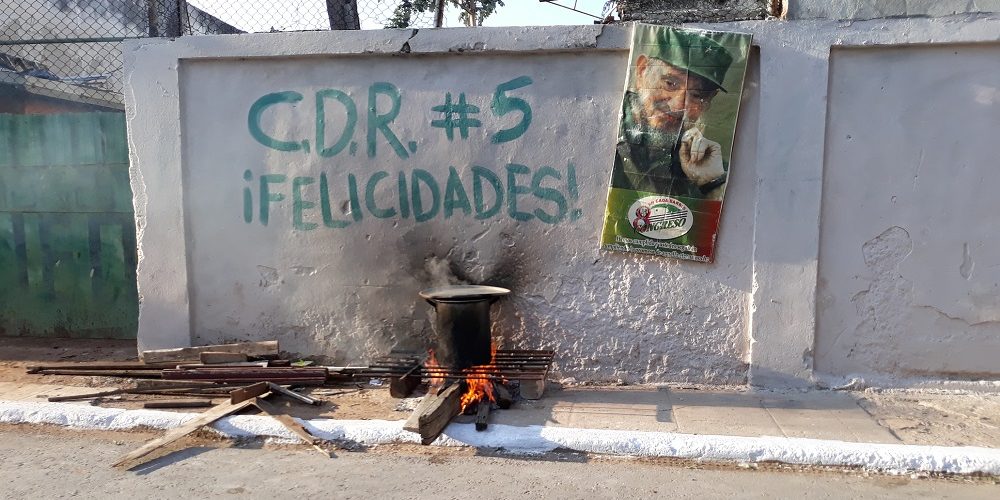
The CDRs were once presented as the basis of the community organization, but today they are seen by many as an anachronistic structure.
Miami, United States – “The flower died, everything ended. The CDRs do not exist because they have nothing a long time ago. Even before there were posters that said ‘here lies the CDR number such’, and not even those posters are seen,” says the holguinero Carlos Valdés when referring to the decline of the defense committees of the revolution (CDR), officially identified as the largest organization of mass of Cuba They would turn 65.
The CDRs were once presented as the basis of surveillance and community organization, however, today they are seen by many as an anachronistic structure and a bureaucratic skeleton without utility.
What was previously an activity center in the neighborhood, today is the target of general indifference, an accelerated situation by the economic crisis, apathy and a disconnection with the new generations that do not understand the reason for being of the CDRs.
Nostalgia is, curiously, the first pretext when talking about the past of the CDR. Ernesto Pérez, neighbor of the distribution Alcides Pino, recalls a time of collective celebration that today seems unlikely. “September 28 were a fiestón. They gave you beer, they gave you food and meat to make the warmth. But the party is over because they do not give food to celebrate it. Instead of celebrating insurance there will be a blackout, like every day.”
Memories go Beyond food. Arelis González, in the cast El Llano, details the resources of a celebration that allegedly strengthened the links between neighbors. “Money was collected and we had to go looking for the meats, they gave you a bonus to buy the beer, we adorned the whole block and had soda and sweets for the children”
The contrast with the current situation is remarkable. Scarcity, The high cost of life and official year -on -year inflation of 14.75% in July 2025 continue to diminish the already under purchase power.
The crisis has supplanted any possibility of community celebration, as noted by Marta Rodríguez, of the cast Ramon Quintana. “You go hungry because everything is very expensive. For years in my block nothing is celebrated. There is no party because the president of the CDR says that they do not give him resources. Last year he tries to celebrate on September 28 with the help of the neighbors, but no one could give a grain of rice, if we do not have food for us as we are going to give food to celebrate.”
The cederist’s commitment went beyond the annual parties. Ricardo Fuentes recalls an era of active participation that today is a remote past.
“In the CDR before there was until voluntary work. I went to clean beans over there by the hills. The CDR asked you for everything: the blood donation, the guard, the price … and every year, they gave you a party on September 28, but that has long been over.”
While popular memory keeps the memory of the warmth and beer alive, the official propaganda remains anchored in the founding epic.
Conceived on September 28, 1960 as “the largest mass organization in the country, with millions of fundamental members and fundamental tasks in national defense and neighborhood life”, its function has been discarded in practice.
The September 28 celebration succumbs and what remains is a structure seen as inoperative. “Cdr today? The word that comes to mind is ‘a ghost’. Because it is supposed to be there, but nobody sees it: nobody feels it, and only appears to scare yourself with which you have to pay the quotation. Nothing does nothing more,” says the holguinera Marisela Torres.
For many, the only current activity of the CDR is precisely the collection of the monthly contribution among its members. Jesús Cisneros, like so many holguineros, questions The fate of those funds. “The price of the price seems to be swallowed.
This appreciation is not just from the Holguineros. Officially an internal crisis is admitted, recognizing an insufficient functioning of its basic organizations and incomplete command structures, which reduces its ability to solve fundamental issues of the neighborhood, leading to the perception of ineffectiveness in the attention of daily problems
Gerardo Hernández Nordelo, Your national coordinator Since September 2020, he has publicly recognized these deficiencies.
“It is a priority for the National Secretariat of the CDR, the attention to the 69 municipalities that have their incomplete secretaries, with unfavorable situations, not having reservations or any picture with the possibility of being promoted”
At the neighborhood level, the problem is customized. Ismaray López Domínguez describes the leadership of her CDR as a formal and convenient fact. “The president of my committee is a lady and she accepted the position because no one else wanted to be president of CDR. They took the lady for tiredness. There is no conviction or anything, that is a decision of her so that they do not bother her with some businesses she has.”
The surveillance function, the original basis of the organization, has also been lost. Some, like Isabel Batista del Cast Harlem, remember her as a civic duty.
“You know the number of guards I made in the Cdr. I remember perfectly: I was eleven to twelve, from twelve to two, from two to four … what times those. Now, no guard is made in the CDR.”
Other holguineros, however, have a less friendly memory about this subject. Yanelis Cruz Martínez reminds the yield guards as A control mechanism social.
“The CDR guards became more to monitor than to take care of. I do not forget that the president of my CDR had a libertic where I pointed to what time came the boy’s boyfriend from the front and what time he left. To take care of the thieves and the robberies it did not work, it was better for gossip and brete.”
However, the decisive blow against the CDR seems to be generational. Young people see organization as an ancient relic difficult to decipher. “A young man tells ‘CDR’ and asks you: ‘cdr? And what is that?’. For them, the CDR is a thing of the old ones,” says Pedro Sarmiento.
This set of ideas and realities about the CDR remembers the so -called “Dead Horse theory.” The concept describes persistence without results in maintaining a structure that has lost its purpose and effectiveness, manifesting itself in the contrast between the official desire to maintain the organization at all costs and the growing disinterest, citizen apathy and the inability of the CDRs to adapt to the new Cuban reality.
“The CDR and history are. Very few remember that existed. There is nothing. And since there is nothing, nothing is done,” says the Raquel Domínguez holguinera who argues that the image of the CDR is of total decline as a forgotten object. “It went from being an instrument of control to be a museum piece, A living fossil From another era ”says Domínguez
The question about the future of the CDR finds an answer in the indifference that would cause their disappearance. “If one day they announce,” says Jorge Luis Fernández, “that the CDRs were eliminated, nobody would realize, because you can’t bury something that has been dead for years.”