Havana/Over more than six decades, the Cuban regime has developed a recognizable pattern to manage – and narrate – the presence of its troops outside the national territory. It is not just a military strategy, but a political and communication method that combines denial, concealment, euphemisms and, when there is no other option, a late epic aimed at recomposing the official story. Grenada, Angola, Ukraine and now Venezuela allow us to follow that thread with uncomfortable clarity.
The script usually begins with denial. In 2019, when Washington once again put the spotlight on Cuban influence in Caracas, the then deputy director general of the United States of the Ministry of Foreign Affairs, Johana Tablada, was blunt: “There are no Cuban troops in Venezuela.” And he finished with a phrase that resonates today as a propaganda museum piece: “You cannot withdraw non-existent troops from Venezuela.” According to their version, Cuba only kept civilian collaborators in the country, mainly from the health sector, within the framework of legitimate bilateral agreements.
Troops don’t exist until they die. And when they die, they exist only as symbols
Tablada’s phrase summarizes better than any editorial the logic of Cuban power when it comes to its adventures around the world. Troops don’t exist until they die. And when they die, they exist only as symbols, never as evidence of an interventionist policy that the regime refuses to face head-on.
Seven years after those emphatic statements, the Cuban Government itself declared national mourning for the death of 32 Cubans “in combative actions” during the US operation to capture Nicolás Maduro. The official statement spoke of missions accomplished “at the request of counterpart bodies of the South American country,” recognized that the deceased belonged to the Revolutionary Armed Forces and the Ministry of the Interior, and described their actions as “heroic.” What was denied for years suddenly became honored with flags at half-mast and slogans of “honor and glory.”
This abrupt transition between nonexistence and glorification is not new. In October 1983, when the United States invaded Granada, the Cuban official discourse assured that the nationals present there were simple civil builders building an airport for tourism. However, those “workers” turned out to be trained and armed military engineers, some of them offering resistance to the American troops. The propaganda then spoke of hundreds of dead and immolated combatants hugging the flag. The reality, known days later, was different: around 24 Cubans deceasedwhile the others disobeyed orders to fight until the end. The regime declared national mourning, repatriated the bodies and buried the real version of the events next to them.
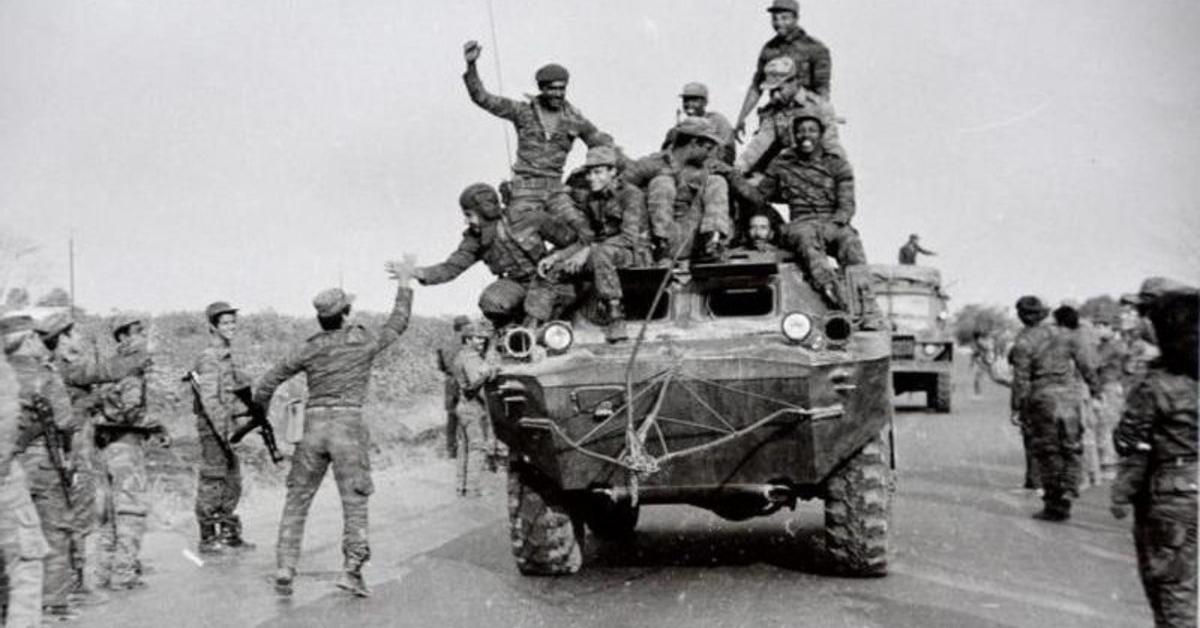
Angola represents the most elaborate case of historical justification. For 16 years, between 1975 and 1991, Cuba maintained a massive military presence in that African country under the argument of “paying the historical debt with Africa” and combating the apartheid. The official narrative spoke of internationalism, solidarity and epic. The numbers of casualties, however, were treated with extreme secrecy. It was not until the end of the 1980s that a list of 2,016 deaths in Angola was recognized, figure later adjusted to 2,077 by Raúl Castro himself. Even today, doubts persist about the accuracy of those numbers, fueled by collective burials, lists without details and decades of official silence. Heroism was exalted; the human dimension of the cost, minimized.
Faced with reports that thousands of Cubans were fighting alongside Russian forces, Havana opted for an intermediate formula
In Ukraine, the pattern mutates again, but does not disappear. Faced with reports that thousands of Cubans were fighting alongside Russian forces, Havana opted for an intermediate formula: admit the presence of nationals in the conflictbut detach yourself from them completely. According to the Foreign Ministry, Cuba “does not participate” in the war and the Cubans involved would have been recruited by organizations with no ties to the State or would act “on their own.” A policy of “zero tolerance for mercenarism” was invoked, while recognizing that many of those detained for attempting to travel to Russia had military training and ties to the Armed Forces. Once again, the State washed its hands when the narrative of noble cooperation was no longer credible.
Venezuela closes the circle and exposes the contradiction in its crudest form. For years, the Cuban regime denied any military role in protecting Chavismo. Now, after Maduro’s capture, he recognizes deaths, security missions and direct combat, but avoids specifying functions, hierarchies or responsibilities. The official version speaks of American “state terrorism” and heroic sacrifice, while US President Donald Trump describes a lightning operation with little effective resistance. The contrast between both stories is not only striking but also reveals Cuban military inefficiency in the face of Washington’s military and technological power.
In all these scenarios the same sequence is repeated. First, deny. Then, disguise the military presence under functional labels – builders, collaborators, technicians or even doctors. Later, if the facts prevail, disengage from those involved or involve them in a defensive epic that dilutes political responsibilities. The mourning, the tributes and the slogans come later, when it is no longer possible to sustain the initial fiction.
Many relatives of those killed in foreign conflicts have chosen silence throughout these six decades. Some out of conviction and closeness to the official discourse of immolation and sacrifice, others out of fear. However, with the dead in Venezuela the scenario is very different from that which surrounded the combatants in Angola or the “builders” in Granada. Social networks are being the channel for names, photos and other biographical details of the deceased to begin to circulate.
What has changed is not the official method, but the internal context and the international reaction. In Angola, the Cold War offered a robust ideological alibi. In Grenada, the Caribbean was still a terrain of direct confrontation between blocs. In Ukraine and Venezuela, the world is different, more interconnected, more skeptical and less willing to accept versions without evidence. But Havana insists on speaking to the present with the language of the past.