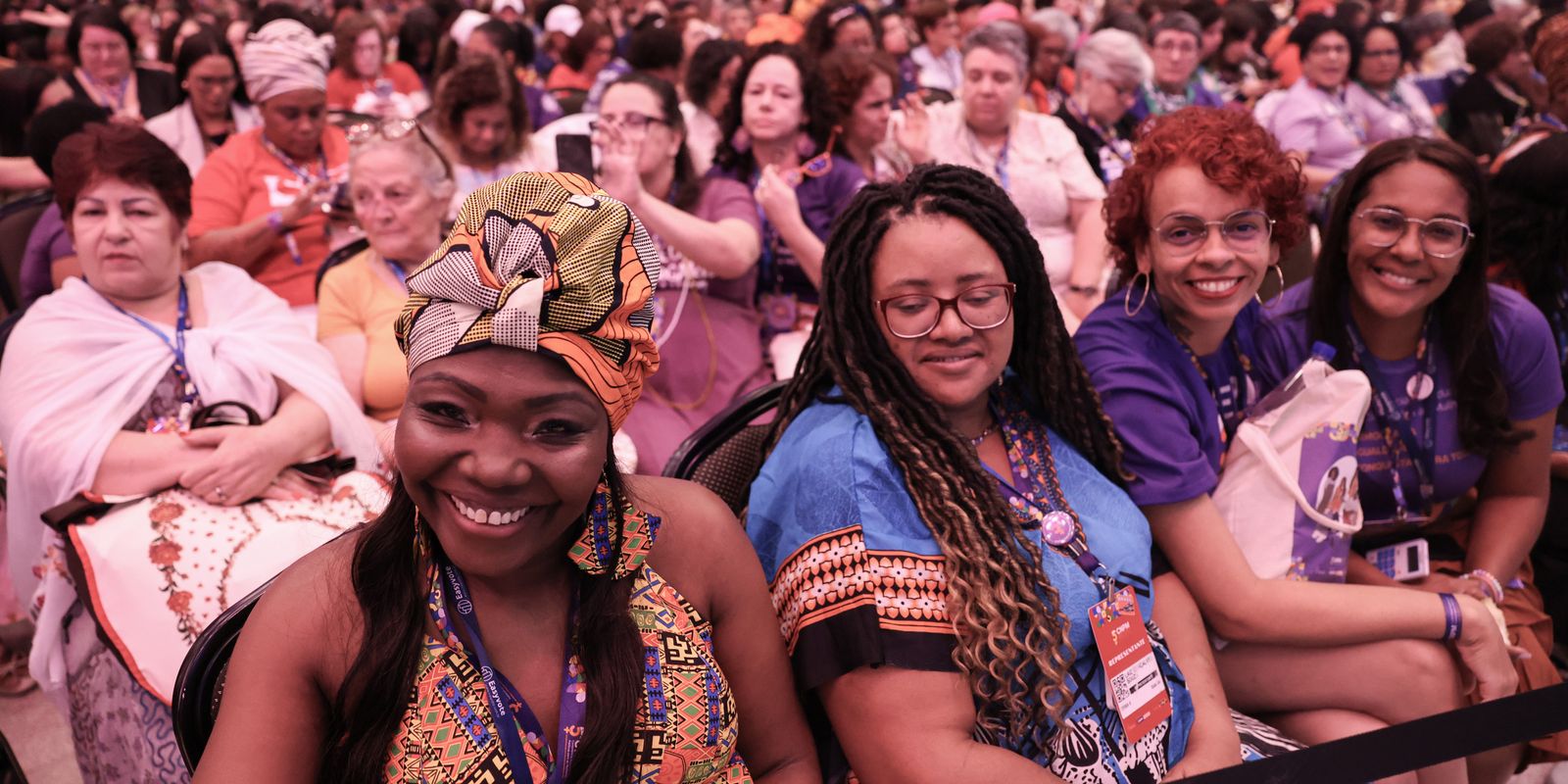
In the final plenary of the 5th National Conference on Women’s Policies (5th CNPM), on the afternoon of Wednesday (1st) in Brasilia, the participants approved the final report with the proposals divided into 15 themes. The document that symbolizes social participation will compose the guidelines of the new National Policies Plan for women in order to improve actions aimed at more than 100 million women in Brazil, throughout their diversity. 
The proposals are the result of the debates held in the stages prior to the National Conference, in the municipal and state instances and in the free conferences.
These include the promotion of gender equality, reducing the working hours with the end of the 6×1 scale; salary equality and decent conditions for all women. The final plenary also approved 33 motions, with 98% of favorable votes, says the Ministry of Women.
“The struggle never ends! We need to build, not only Brazil, but Latin America, the Caribbean – a world of peace, a world where Palestine is free, a world without war. A world in which women feel free and where there is no violence against them,” said women Minister Marcia Lopes.
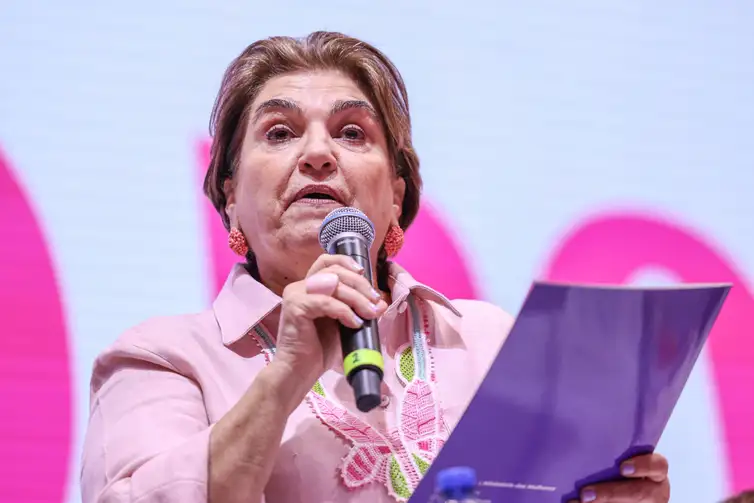
Minister of Women, Márcia Lopes, speaks at the 5th National Conference on Policies for Women – Photo José Cruz/Agência Brasil
Datamulheres
The Ministry of Women created, on Wednesday (1st), the Platform Datamulheres, a digital tool for information about the socioeconomic reality of Brazilian women, developed by the Brazil Equality Observatory, in partnership with Dataprev, a technology company linked to the Ministry of Management and Innovation in Services.
The initiative will serve to guide the work of public managers and public managers of the three federative levels (federal, state and municipal), researchers, observatories, study centers and academic institutions that produce analysis of gender inequalities, as well as secretariats and policy organisms for women.
Datamulhos is part of data from the Ministries of Justice and Public Safety, Work and Employment, the Ministry of Health, the Brazilian Institute of Geography and Statistics (IBGE), as well as the Superior Electoral Court (TSE).
Strengthening Public Management
The minister also signed yesterday, the last day of the meeting, the public notice that foresees the transfer of R $ 10 million for vehicle donation, with the objective of strengthening the performance of municipal policy secretariats and bodies for women across the country.
Through the announcement, cities with up to 100,000 inhabitants have secretariats or policy bodies for women, with women’s rights councils, will be contemplated. These bodies of participation and social control, representing the public power and civil society, act in the formulation, supervision and proposition of public policies.
“I have said: it is not Brasilia, it is not the federal government that will break, that will build everything we need in relation to policies for women,” said Marcia.
Booklet
The minister also launched two booklets, in partnership with the National Association of Transvestites and Transsexuals, UN Women and UN Human Rights.
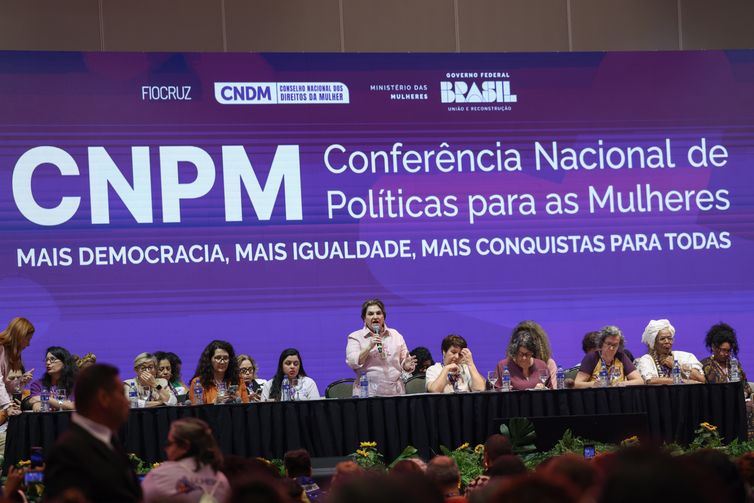
The Minister of Women, Márcia Lopes, participates in the 5th National Conference on Policies for Women – Photo José Cruz/Agência Brasil
The guide “All women: dignity, citizenship and human rights for transvestites and trans women”Presents the legal foundations of the prohibition of discrimination against transvestites and trans women, the parameters of human rights to protect them from this discrimination and highlights the main recent achievements and recommendations of international human rights mechanisms applicable to Brazil.
“It is urgent to ensure political participation, social recognition and access to public policies in an equitable way. In a scenario marked by exclusion and violence, valuing their presence, listening to their voices and guaranteeing their rights are fundamental steps to a more just, diverse and truly democratic society,” says the publication.
Just over a month from COP30 [a Conferência das Nações Unidas sobre as Mudanças Climáticas de 2025] In Belém, the minister also launched the booklet “Women in climate actions: political participation in the construction of a decent and fair future”With information on the impacts of climate change on women.
The initial text of the Guide shows who, in fact, plays a central role in building solutions to face the climate crisis.
“Women and girls are persevering in social cohesion, sustaining the tissue of community resilience and leading socioeconomic thinking to a new sustainability paradigm. Whether in family farming and agroecology, community management, prevention and management of risk and disasters or defense of territories and biodiversity, they are protagonists of mitigation, adaptation and the preservation of the base of life.” the document.
More actions
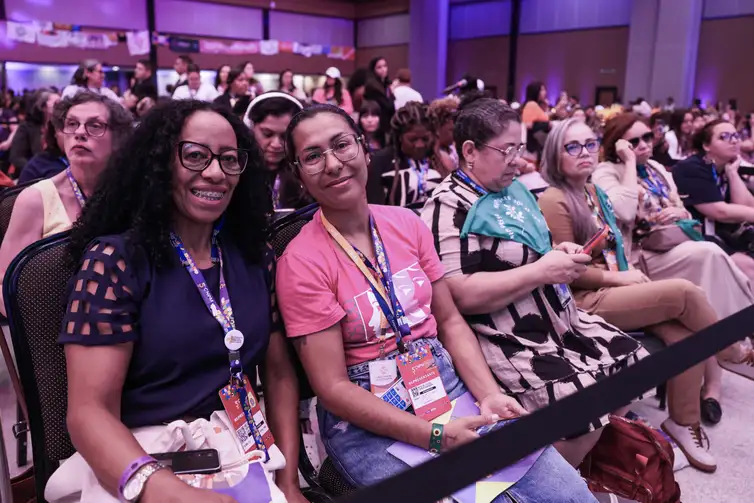
Women discuss proposals at the 5th National Conference on Policies for Women – Photo José Cruz/Agência Brasil
Márcia Lopes signed the Ordinance of the Policies Management Strengthening Program for women and three Technical Cooperation Agreements (ACTs): with the Post Office, to carry out actions to confront violence against women and disseminate Ligue 180; with the Ministry of Labor and Employment (MTE), to promote actions to support the professional qualification of women victims of violence; And with the Ministry of Justice and Public Security (MJSP), the National Council of the Public Prosecution Service (CNMP), the Attorney General’s Office (PGE), the National Council of Justice (CNJ) and the Federal Public Defender’s Office (DPU), in the agenda to confront political violence against women.