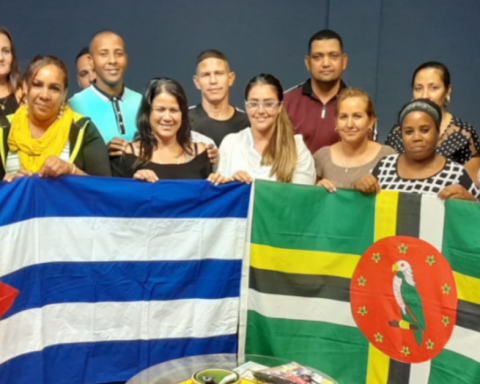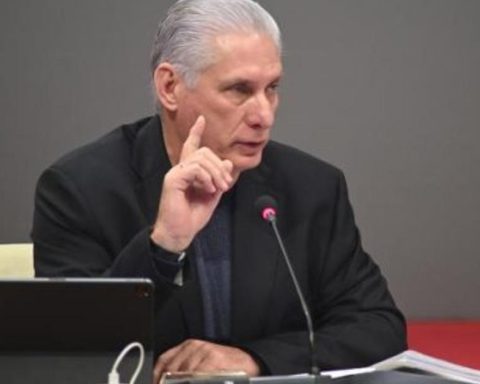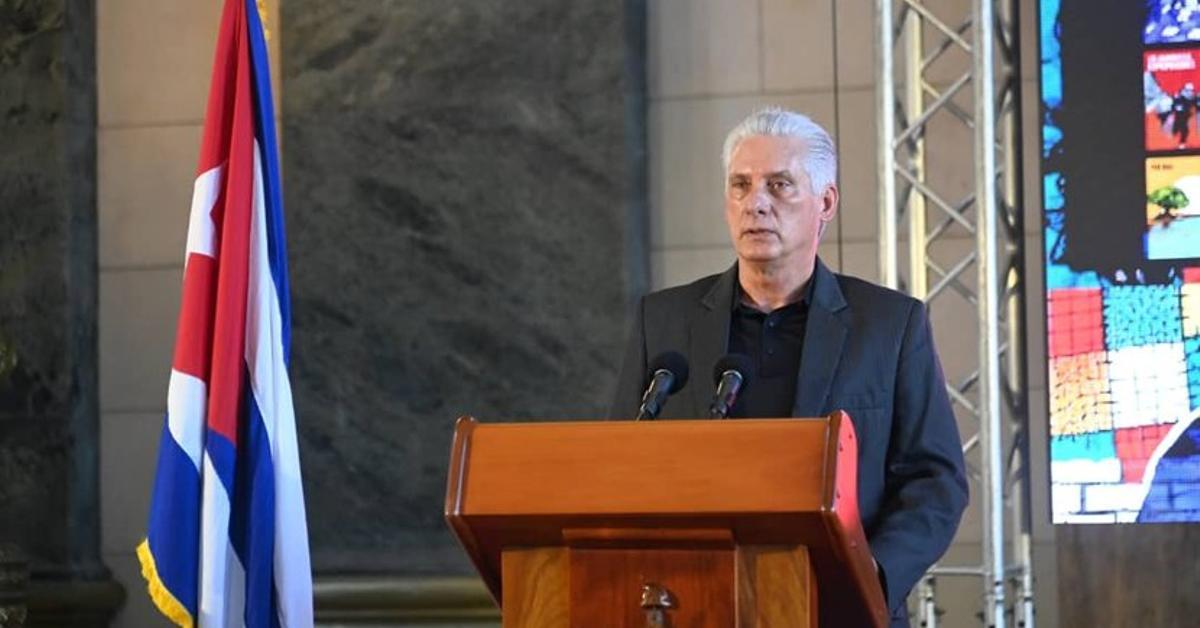
Havana/Havana once again dressed in cultural solemnity this Wednesday to celebrate a gesture that, beyond paper and ink, had a clear political charge. From the National Capitol, Miguel Díaz-Canel began the Mexican project in Cuba 25 for 25an initiative by President Claudia Sheinbaum that provides for the free distribution of 2.5 million books to young people between 15 and 30 years old in fourteen Latin American countries, including the Island.
While the first box of books was opened in Mexico City, in Havana the event was moderated by Abel Prieto Jiménez, president of the Casa de las Américas and one of the most recognizable faces of official cultural policy. True to his style, Prieto turned the editorial launch into a geopolitical forum: he celebrated that Cuba and Mexico “hand out books” while “others hand out bombs,” and he took the opportunity to attack the United States and the militarization of the Caribbean.
The Mexican ambassador, Miguel Díaz Reynoso, described the collection 25 for 25 as a “modest gift” for a “people educated in reading” and stressed that it is a commitment to Latin American cultural memory. The selection includes important names such as Gabriel García Márquez, Eduardo Galeano, Juan Gelman, Mario Benedetti, Juan Carlos Onetti, Andrés Caicedo, Roberto Fernández Retamar, among others.
However, despite the fact that Paco Ignacio Taibo II himself, director of the Economic Culture Fund, has defended that the so-called Boom generation was the conceptual axis of the project, it is difficult to explain the exclusion of essential names such as Mario Vargas Llosa, Nobel Prize winner in Literature and central figure of that movement. In the Cuban case, the omission is even more revealing, since top-level authors such as Alejo Carpentier, José Lezama Lima, Guillermo Cabrera Infante or Reinaldo Arenas do not appear, absences that not only impoverish the literary panorama of the region, but also reinforce the perception of a canon carefully filtered by ideological affinities rather than by strictly literary criteria.
Official figures reveal a dramatic decline in the production of printed books, making it clear that reading is not a priority for the Government
On the other hand, the selection of titles within the catalog itself does not withstand a demanding examination either. For Gabriel García Márquez, for example, it was chosen Operation Charlottea minor and markedly circumstantial text, rather than one of his fundamental narrative works; while Eduardo Galeano’s was included The wonderful brief life of Ernesto Guevarareinforcing a predictable and militant thematic line.
The highlight of the Cuban celebration came with Díaz-Canel’s extensive speech, where the president thanked Mexico, Sheinbaum and, in a special way, Taibo II. The Cuban president defended the printed book against digital culture, evoked the 1961 Literacy Campaign, the National Printing Press and, of course, Fidel Castro, remembering his famous slogan: “We do not tell the people: believe! We tell them: read!”
The economic crisis that Cuba is going through has also extended to the publishing field, where official figures reveal a dramatic decline in the production of printed books, making it clear that reading is not a priority for the Government. According to data from the Cuban Statistical Yearbook 2024, compiled by the National Office of Statistics and Information (Onei), the printing of copies fell hard in the last reported cycle. While in 2023 around six million copies of books were printed, in 2024 that figure plummeted to 1,355,500, a decrease of more than 75% in just one year, a reflection not only of the shortage of paper but of the general lack of material and financial resources that affects publishers, printing presses and state libraries.
Díaz-Canel presented the project as a “bridge of paper and ink” destined to dispute youth time with social networks, video games and what he pronounced as “hate-visual products” (he meant: audiovisuals). The president assured that free books eliminates one of the main barriers to access to reading in the poorest countries in the region. For Cuba, suffocated by the collapse of the publishing industry and increasingly empty libraries, the arrival of thousands of free copies is, without a doubt, a good patch.
A part of the Mexican Generation Z has expressed disaffection and criticism towards a government agenda that they perceive to be distant from their real emergencies.
However, the official enthusiasm contrasts with the criticism that the project has generated in Mexico, an aspect absent in the celebratory narrative of the Havana event. Intellectuals, writers and sectors of civil society have questioned the low presence of women in the selection of titles, as well as the predominance of already established authors, many of them deceased, which – according to critics – reproduces a male canon and leaves out contemporary voices.
The role of controversial figures in promoting the project has also been debated, in particular Taibo II, whose presence reignites discussions about the political use of culture and the identification between literature and ideological militancy. Added to this is the doubt about whether the mass distribution of books, without solid educational support programs, can really modify the reading habits of young people.
Another aspect of questioning in Mexico points to the priorities of public spending. In a context marked by violence, educational precariousness and deficits in health and employment, opposition sectors wonder if a high-profile cultural program does not also function as a symbolic operation, rather than as a comprehensive public policy, especially when part of Generation Z – which it is formally aimed at – has expressed disaffection and criticism towards a government agenda that they perceive to be distant from their real urgencies, from access to decent employment and housing to security and effective participation in decision-making.
None of that appeared in the Capitol. There, the project was presented as an act of historical justice towards Cuba and as a natural continuity of the political alliance between Havana and the Mexican Government. Díaz-Canel insisted that books should not remain in display cases, but rather circulate, be discussed and “used up,” although he avoided any reference to the internal restrictions that weigh on freedom of thought, access to the internet or the circulation of ideas that do not fit into the official discourse.