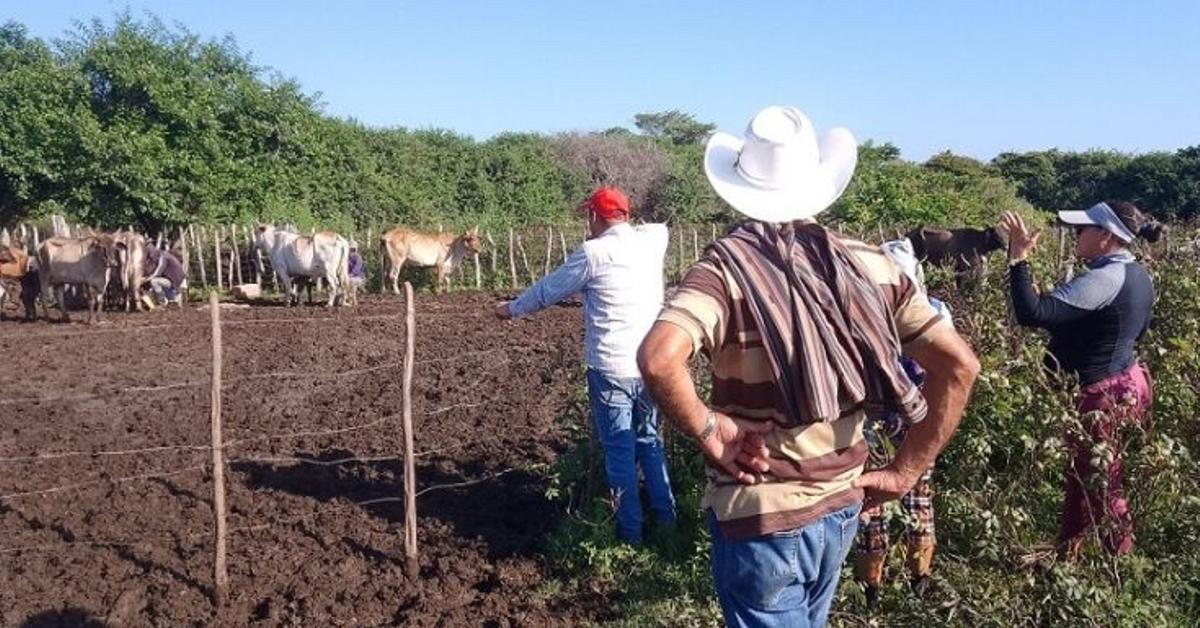
Havana/“It’s still raining and we’re still without power,” is how a rancher associated with the Mártires de Barbados Basic Cooperative Production Unit (Ubpc) summarizes the situation, in Florida, Camagüey. For 20 days the electricity supply in the area was cut off, due to the fall of several poles. Added to the lack of energy are now threats from the authorities due to the producers’ refusal to deliver milk under such conditions.
“They have threatened us with taking a census of the animals and land we have if we don’t continue giving milk and cheese,” complains one of the affected farmers. About 25 families are trying to weather the storm of heavy rainfall and a long blackout that has hit them since last September 24. “We are all suffering but the cows are experiencing the worst because it is very difficult for us to get water to them,” explains the farmer under anonymity.
Last Saturday, a couple of producers, Amarilys and Gustavo, had also told their despair to 14ymedio in view of the energy cut. Since then, “neither the power has returned nor do the authorities want to understand the situation we are experiencing,” the woman now explains. On Sunday, several ranchers joined forces and announced that they were refusing to supply the contracted milk and cheese. The official response was immediate: “They told us that they are going to send inspectors to count every animal we have on the farms.”
“Neither the power has returned nor do the authorities want to understand the situation we are experiencing”
The farmers know what a census means. “There is no one who can come out of that well because they do it with anger,” Amarilys reflects. “The auditors come in everywhere, they tell you everything and you always come out with a fine or a confiscation.” The woman believes that “all this can be resolved in another way, with the help of institutions, not with threats.”
Last year, a land and livestock control exercise in Camagüey put the 29,552 landowners in the province under the microscope. The authorities announced the detection of frequent “properties or constructions built on vacant lands marked as illegal, people occupying land, without authorization.” In Florida, that inspection is remembered as a “tremendous head-slasher,” says the producer.
On the other hand, the demands for energy service to be restored have been met with the precariousness of the local electricity company. “They tell us that they cannot work with these rains that have continued to fall, nor with the mud on the roads,” explains the woman from Camagüey. “But they also say that there are other priorities and that we are not on the list of strategic entities.” However, he assures that the producers associated with that Ubpc, some owners and other usufructuaries of land, are “those who deliver the most cane” to the Carlos Manuel de Céspedes mill.
“They say that there are other priorities and that we are not on the list of strategic entities”
Producers in the area are, right now, engaged in the so-called cold campaign in which they mainly plant root vegetables, vegetables, grains and fruit trees distributed among 3,200 hectares of land managed by state companies, cooperatives and other entities. Without electricity, the process of planting fields and milking is extremely difficult.
“My husband had to go to another town to carry a couple of lamps to be able to tend to the animals in the early morning because the milk has to be delivered at five in the morning and that requires milking at least two hours before,” says Amarilys. Other farmers in the area don’t even do that. “There are older people who cannot cover those distances and it is difficult for them to even get water to drink.”