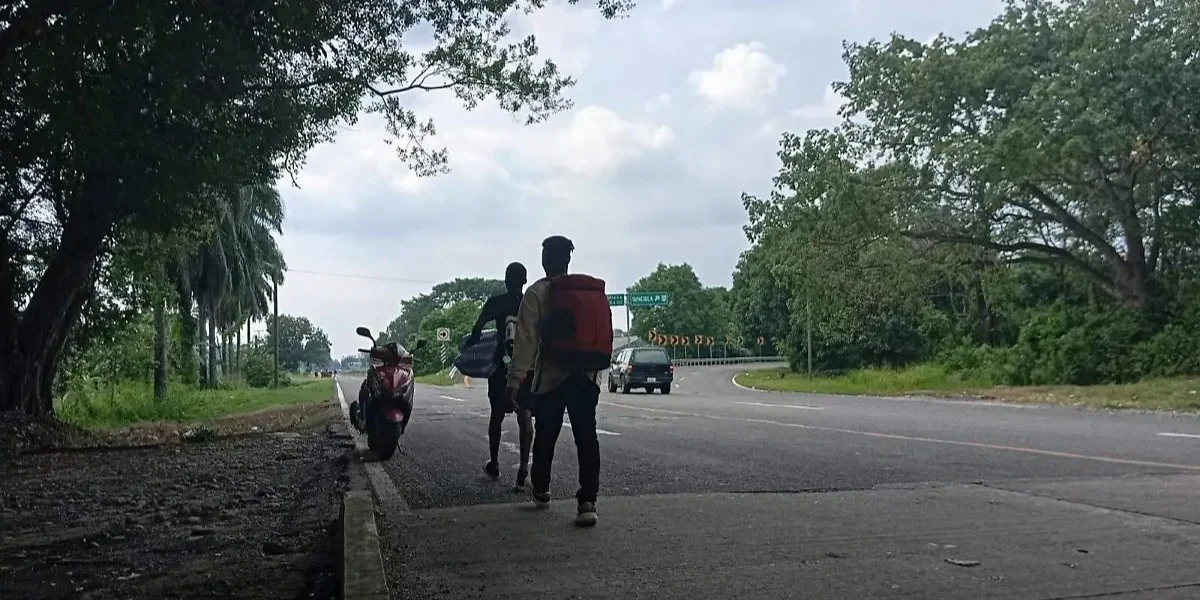
According to local press reports, the groups are advancing along a coastal highway with their sights set on initially reaching Mexico City.
CDMX, Mexico. – Cuban migrants resumed their journey from Tapachula, Mexico, to the north of the country in small groups and along alternate routes, after the departure of a new caravan was frustrated on October 30, according to local media. South Journal.
According to that medium, the groups advance along a coastal highway with their sights set on reaching Mexico City—and, from there, to states such as Coahuila (Saltillo) or Nuevo León—while avoiding immigration checkpoints.
On October 30, a caravan of around 600 migrants was scheduled to start, but “only six people went to Bicentenario Park, so the departure did not materialize,” he reported. Southern Journal.
Cuban Douglas Brian Velázquez explained to that medium that the mobilization was not organized due to distrust of the authorities, after so far in 2025 “at least seven previous caravans have been disintegrated”, and due to the physical consequences of the previous walks.
In the absence of a caravan, during November the undocumented immigrants chose to advance on their own and avoid checkpoints, mainly at the El Hueyate immigration booth and the Cerro Gordo customs office, in Huixtla, the report stated. Near Huixtla they have been observed walking from the municipal seat to the sector known as “La Arrocera”; Upon reaching the area of the old meat processing plant, the groups detour towards the K line of the railroad to avoid the controls, “just as the Central Americans who were looking for the American dream did at the beginning of this century,” the newspaper noted.
The testimony of Lorena, a Honduran migrant who travels the same routes, illustrates what Cubans have also done: “We are evading the authorities again, we have no choice, since they did not give us papers or support. In this year’s caravans we were only deceived, because upon arriving in Escuintla or Pijijiapan they disintegrated us and we returned to Tapachula.”
According to South Journalthe start of operations is expected in corridors where the migrant population usually travels—Viva México, Huehuetán Estación and Huixtla—in order to reinforce surveillance in the face of the rebound in irregular migration.
On October 1, about 1,200 migrants left on foot before dawn from Tapachulastate of Chiapas, bound for Mexico City to press for the streamlining of procedures and access to job opportunities.
The majority of the group was of Cuban nationality, according to the American agency Associated Press (AP)which noted that, unlike caravans in previous years aimed at reaching the United States, this one sought to “accelerate their asylum processes and leave southern Mexico, where there are few job opportunities.”
On that occasion, AP documented testimonies of Cubans stranded for months in Tapachula awaiting resolutions. Cuban Losiel Sánchez said that he arrived in November 2024 with the expectation of getting an appointment on the application CBP Onebut was forced to remain in Mexico after US President Donald Trump ended that program.
Given the cancellation, Sánchez chose to request asylum in Mexico, with no response until now, and reported having been scammed by an alleged lawyer. “Everything is expensive and not enough to cover the rent,” he said. “There is no work, they don’t want to give you work if you don’t have papers… That’s why we are looking for Mexico City to see if they give us another alternative.”
Cuban Anery Sosa, 32, also said that she has been in Tapachula for a year, that her documents were stolen and that she just gave birth to a Mexican girl, which makes it difficult for her to work: “The plan is to stay here in Mexico,” she told the AP.
Many Cuban migrants in Mexico remain in irregular status due to administrative slowness, which restricts their access to formal employment, health and education and exposes them to crimes such as extortion, fraud and assault. On previous occasions, the Mexican authorities have allowed people to walk for a few days and then offer documentary support or transportation in order to dissolve the groups, without leaving any record of whether there was effective regularization.
At the end of September, the president of Mexico, Claudia Sheinbaum, advertisement that his administration would provide humanitarian follow-up to that caravan, with facilities for regularization in Mexico or voluntary return to Cuba. “This has allowed us since we arrived [al gobierno] “No caravan will arrive at the northern border, and that will be the case now,” he declared in his morning conference.