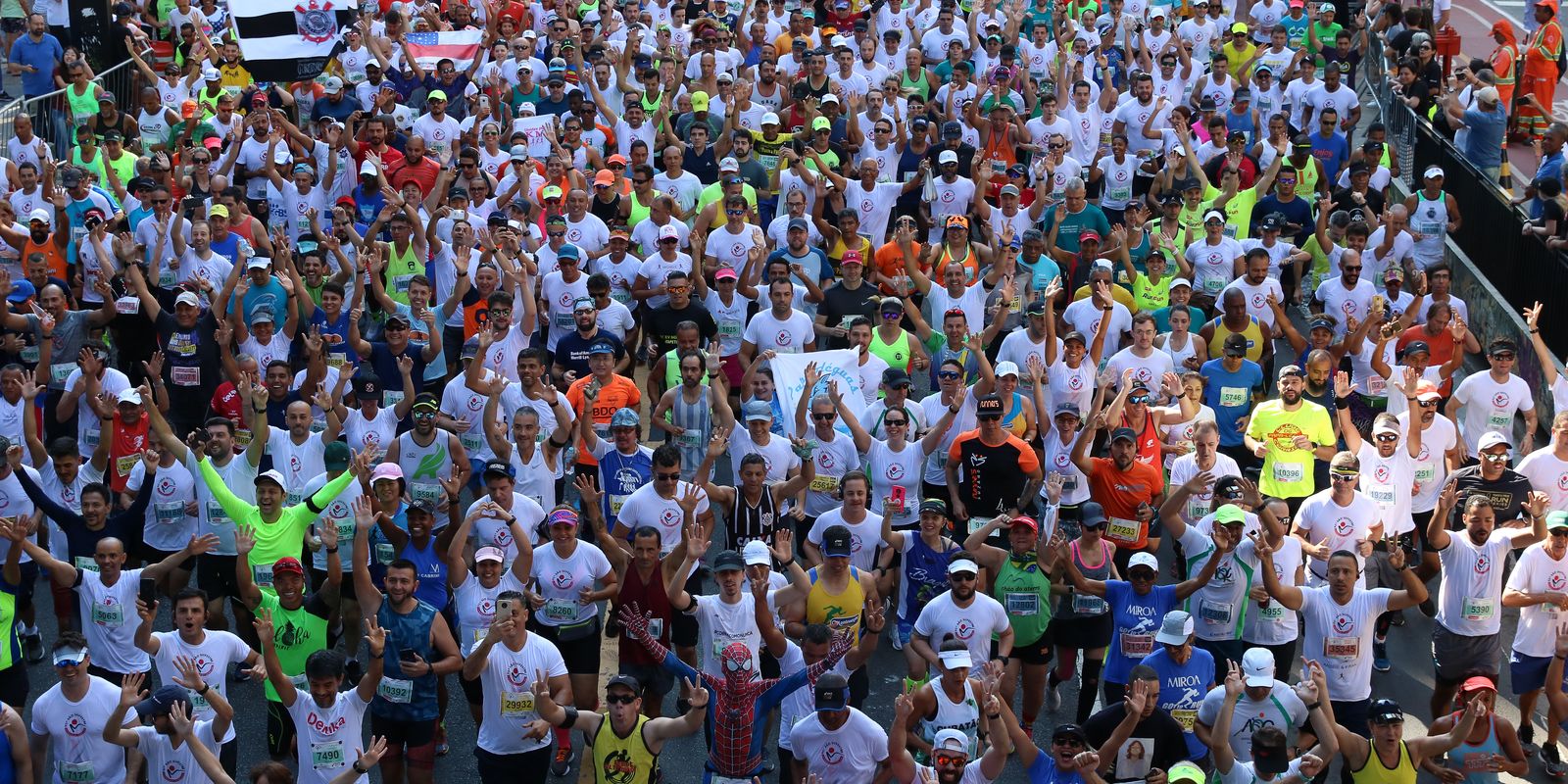
On a trip to Paris, journalist Cásper Líbero was amazed by a race held at night. Determined to promote something similar in Brazil, he devised a test that should always take place on the last day of the year. And so, on the night of December 31, 1925, the first São Silvestre Race in history was held. She was named in honor of the saint of the day.
“São Silvestre was the idea of journalist, businessman and lawyer Cásper Líbero. He was walking through Paris in 1924 and saw a race in which the runners held torches, creating a super beautiful effect at night, with all that vibration. He liked it, got excited and brought the idea to Brazil, to São Paulo. And in 1925 he created the first edition of the São Silvestre race. At the time, in fact, São Silvestre was spelled with a Y. It was That’s where our race was born, which today is completing its 100th edition”, says Eric Castelheiro, executive director of the São Silvestre International Race, in an interview with the program’s report Reporting Pathsfrom the TV Brasilbroadcaster of Brazilian Communication Company – EBC.
Initially held at the turn of the year, the first edition had 60 entrants, but only 48 of them participated in the start, which took place at Parque Trianon, on Avenida Paulista, at 11:40 pm. They covered 8,800 meters through the streets of São Paulo and the race ended up being won by Alfredo Gomes, who completed the route in 23m19s.
“Alfredo Gomes was a black athlete. In 1924, a year before the first edition of São Silvestre, he was already successful because he was representing Brazil at the Paris Olympic Games. He was the first black person to represent the country”, explains Castelheiro.
Since then, São Silvestre has become the most traditional and well-known race in the country and only stopped being held in 2020, due to the Covid-19 pandemic. Last year, the race completed 100 years of its history, but it is only in this year 2025 that it reaches its 100th edition, reaching a record number of participants with more than 50 thousand registered runners.
Heroes
In its first editions, only Brazilian athletes participated in the event. However, from 1927 onwards, the registration of foreigners who lived in Brazil was allowed, which meant that the Italian Heitor Blasi, based in São Paulo, won the 1927 and 1929 editions. Blasi was the only foreigner to win the race in the so-called national phase of the race, which lasted until 1944.
From 1945, with the end of the Second World War, the race began to include the participation of foreign athletes, but initially only for athletes from South America. It was only two years later that it became truly global, beginning a period of 34 years without victories by Brazilian athletes, which was only overcome in 1980, with the victory of José João da Silva from Pernambuco. Women only started competing in 1975, a race that was won by the German Christa Valensieck.
Tears and screams
In an interview with the program Reporting Pathsfrom the EBCbusinessman and former athlete José João da Silva recalled that day when he broke the taboo. “The people started to cry, to scream. Osmar (de Oliveira, my doctor) started to scream and cry. It was [a quebra] of a taboo. The first Brazilian to win”, he says. “I was the blessed one, let’s put it that way. I arrived and achieved this milestone. This victory was a big milestone”, he recalls.
He, who started working very early, as a child, in the fields of Pernambuco, had no idea what that victory at São Silvestre would mean for his life. “The country stopped. It was like a World Cup. The people wanted to invade and were contained by the police. I didn’t know how big [dessa vitória]. Then we get a little [assim]it makes you want to cry. It’s very impactful. Your life changes completely”, he recalls.
A Brazilian like José João da Silva who wins this race ends up becoming a kind of hero for the population, highlights the race director. “These athletes [brasileiros]who are in such a representative event and which has so much reach and history, end up becoming idols”, he assures.
“An athlete in a street race is running everywhere all the time. So, he ends up being that human superhero. He looks like a superhero, but he’s also human just like you. So I think that ends up bringing a lot of identification”, he guarantees.
Record
That’s what happened to Marilson Gomes dos Santosthe Brazilian who has won the most against São Silvestre since it became international. There were three victories, achieved in 2003, 2005 and 2010.
“Brazilians are very supportive of [os atletas] Brazilians, regardless of which modality it is. At São Silvestre we can feel this. When you win, we see more people wanting to run too, wanting to participate in street races. I saw a lot of testimonials and to this day I hear people saying that they started running because they saw me run at São Silvestre, because they saw me win at São Silvestre in 2003”, he assures.
Maria Zeferina Baldaia also felt a big change in her life after participating and winning the race in 2001. She, who worked for 20 years as a boat rider, [termo popular usado para ser referir a um trabalhador rural]remembers how he started running until he became a reference in the sport. “I worked as a busboy and, at lunchtime, since I was a child, I would run. I would run along the trail, which are the wide roads that divide the sugarcane on both sides,” he says.
“I ran barefoot for 15 years, because I didn’t have sneakers. My parents couldn’t afford to buy one and, even so, I continued running, despite the broken glass and the hot sun. I had the aim of helping my family, so I ran barefoot for 15 years”, she recalls.
Inspiration
UOne day she was watching a São Silvestre race at a neighbor’s house and was inspired to participate in the event. “I saw Rosa Mota win, a Portuguese woman, who won the São Silvestre six times. I ran home and said to my mother: ‘Mom, a little woman won the race there in São Paulo, the São Silvestre Race. Could I one day go and race there too?”
Fifteen years after watching Rosa Mota’s last victory on TV, Maria Zeferina managed to make her dream come true and became an inspiration for many other women.
“I looked up to Rosa Mota. After my victory at São Silvestre I heard from many people who came to me – many mothers, women and girls – who wanted to be like Maria Zeferina. I usually say that, just as Rosa Mota was my idol and my inspiration, today I serve as an inspiration, motivation and mirror for other people. This is priceless”, he assures.
This recognition also occurred in his city. The Olympic center in Sertãozinho, in the interior of São Paulo, ended up being named after the runner, a way of immortalizing her trajectory and inspiring future generations. “To be able to do today what I still do, which is run, and to be able to train there at the Olympic center and see children, young people and adults doing what I still do, that is priceless”, explains the athlete.
“Zeferina is a very strong brand because she is a Brazilian woman and an extremely accessible person. This changes the athlete’s image a lot. In her case, being a winner, but, at the same time, the person she welcomes and who is very kind in conversation, makes her a very accessible person. And she also has the story that she was not born an athlete: she cut sugarcane, had a very hard life and became an athlete. So, she is also the image of the possible”, highlights Martha Maria Dallari, athlete and personal trainer. “The street running athlete is very close. He shares the ground I walked on. I did the race that Zeferina did. I did the race that Marilson did. These are very strong things, for us to be very close, sharing this [com eles]” he emphasizes.
Biggest winners
The biggest winner of São Silvestre is the Portuguese Rosa Mota, with six consecutive victories achieved in the early 1980s. Next is the Kenyan Paul Tergat: five victories. Among Brazilians, the title goes to Marílson Gomes dos Santos: three victories.
Since 1945, when the competition became international, Brazilians have won this event 16 times, 11 among men and five among women. In the men’s category, the last Brazilian victory was achieved in 2010, with Marilson Gomes dos Santos. In the women’s category, the last victory was with Lucélia Peres, in 2006.
“I had the opportunity to run many races in other countries. But running indoors, on the last day of the year, with people celebrating and lots of people watching on TV and cheering, personally it’s a contagious energy”, says Marilson, in an interview with the program’s report. TV Brasil. “It’s a test that, without a doubt, any self-respecting athlete wants to win. And any athlete has to prepare a lot to do well, they really have to aim as if it were the test of a lifetime, because it was the test of a lifetime”, he adds.
Democratic test
Currently, São Silvestre is open to everyone, with special starts for elite women and men runners and also for wheelchair users, other PWD athletes and amateur athletes. In addition, it has a special edition, held on another day and at the Ibirapuera Olympic Center, called São Silvestrinha, where children and teenagers compete.
“We have a wave start organization. For example, the race starts at 7:25 am with PCDs and wheelchair users who are very fast and who are also used to competing in world and Paralympic championships. At 7:40 am the female elite starts, [composta] by top athletes from various countries. At 8:05 am the men’s elite starts in two platoons, A and B, by technical level, with the fastest ones ahead. Then come the other platoons [e o público, em geral]”, details the race director.
This, he says, makes the test very democratic, with the participation of people from different parts of the country and the world.
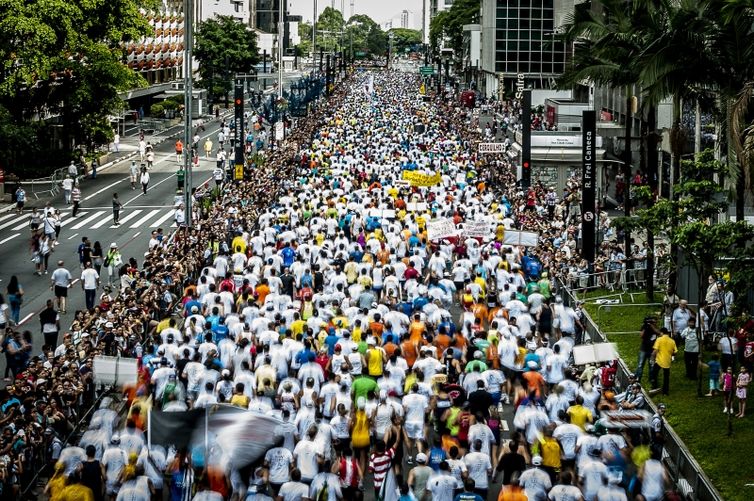
This year, the São Silvestre Race will have 50,000 participants moving through the avenues of São Paulo – Archive/Marcelo Camargo/Agência Brasil
Breaking brands
“We always say that São Silvestre is one of the most democratic sporting and even entertainment competitions because not everyone comes to compete. There are people who come to make personal achievements, break their own mark and for their own objective. Everyone comes with their own plan and everyone is well received”, emphasizes Castelheiro. This is actually what makes São Silvestre more special, highlights Martha Maria Dallari. “São Silvestre’s strengths are these stories, these are the people who decide to run, challenge themselves, meet friends and celebrate the new year.”
He adds that another important aspect is that street racing makes people reconnect and take ownership of public space.
“When you run in São Silvestre, you run through some of the most beautiful places in the city or through places that are landmarks in the city. This is a way of connecting with the history and historical points of the city”, he highlights.
The program Reporting Paths – 100 Times São Silvestrewhich celebrates the 100th edition of the race, will air this Monday (29), exceptionally from 10:30 pm, on TV Brasil, EBC broadcaster.