▲ Facilities of Peking University, the oldest in the country, which is among the most requested.Photo Jessica Xanthomila
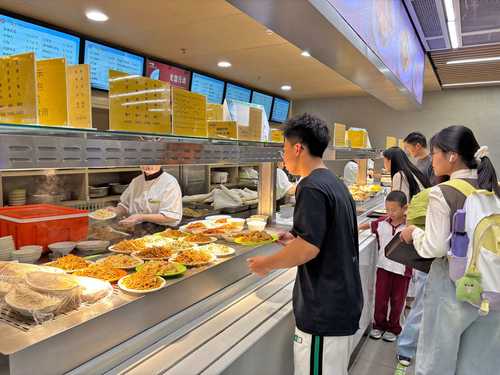
▲ One of the eight restaurants installed on the same campus.Photo Jessica Xanthomila
Jessica Xanthomila
Sent
La Jornada Newspaper
Sunday, October 26, 2025, p. 4
Beijing. China has achieved a high level in higher education with its more than 3,000 universities – mostly public –, five of which are among the 50 best in the world, according to the QS Global World Ranking 2025. The academic offer has led to more than 10 million young people participating in the national admission exam in recent years, of which around 80 percent enter an institution, according to academics and officials consulted.
Educational excellence has also been fostered by the increasing interest of students in careers related to information technologies, artificial intelligence and engineering, given the high-value job opportunities, government support and the impact on national development.
The level that the Asian giant has reached is one of the factors that has led it to dominate 57 of the 64 critical technologies in the world, such as quantum sensors, drones and robots, while between 2003 and 2007 it only led three. It has surpassed the United States, which went from 60, in that same period, to only seven between 2019 and 2023, according to a report by the Australian Strategic Policy Institute.
For Chang Fuliang, dean of the Beijing Foreign Studies University, and Wang Jiao, director of the secretariat of the Polytechnic Institute of this city, the prestige of higher education has been achieved thanks to the budget that the government grants it (around 21.2 billion dollars), the training of its teachers and the collaboration that universities maintain with companies so that their graduates respond to labor demand.
Between 2021 and 2025, the Chinese government has trained 55 million university students “as part of its ambitious expansion of the higher education system,” as reported by the China Global Television Network (CGTN) last September.
To enter universities, students must present the Gaokaoa national admission exam that lasts two days, and is one of the most competitive, decisive tests and for which they prepare hard during their academic training. Although around 80 percent manage to enter educational centers, it is estimated that only 5 percent are admitted to one of the nine elite institutions: Peking, Tsinghua, Fundan, Shanghai Jiao Tong, Zheijiang, Nanjing, Harbin Institute of Technology, Xian Jiaotong and Science and Technology universities.
The institutions where Mao and Xi studied
For many young people, the dream is to enter Peking University and Tsinghua University. The first is the oldest institution, founded in 1898, and has seen historical political figures such as Mao Tse Tung, founder of the People’s Republic of China, and Li Dazhao, one of the promoters of the Communist Party, pass through its classrooms, libraries and hallways.
This study house, located in the Haidian district – the educational epicenter – is the 14th best in the world, according to the QS Global World Ranking 2025, and is focused on training related to the humanities, social sciences and medicine.
Behind Beida – as it is colloquially known – is Tsinghua University, which is in 17th position in the ranking. It is the institution where President Xi Jinping studied and is a pillar in scientific innovation, talent training and national development.
The dimension of this type of university is observed in its facilities. In the case of Beida, it has a central library that is one of the largest in Asia, Lake Weiming and the famous Boya Tower. Its size is also evident in the number of restaurants it has: eight, some with four floors, which offer a wide variety of Chinese and international food.
Chang Fuliang, dean of the Beijing Foreign Studies University, recognized that there is still educational inequality in the country, as it cannot be guaranteed that all students receive the same quality of training as they have in those elite universities, which are also the ones that obtain the most budget.
Therefore, “so that their children can enter the best educational centers, their parents pay for expensive courses outside of school,” he stated.
The discipline and demands required to study in these institutions have been proven by the Mexican Mora Ordóñez, a master’s degree student in law at the Faculty of Law of Peking University.
In an interview, the lawyer expressed that in the almost two years of studying in Asian lands, what has surprised her most is “the rigor of the educational system, which could lead to saying that it is very difficult, but much of the economic and technological advance of the country is due to the fact that they bet on quality, open, democratic and plural education.”
In fact, she highlighted that for her many of the students at this institution “are geniuses,” given the intellectual level they must reach to pass the exam. Gaokao.
Regarding the students who do not get a place in the more than 3 thousand universities, Chang explained that some of them are peasants and the other urban. For the latter, their communities look for jobs for them, in addition to being registered to receive financial aid due to lack of work.
In the case of farmers, “there is not much rush to give them employment,” given that their families have plots of land. “They can work their land or find a job in the cities, like in construction,” he explained.