At a critical moment for his government, Javier Milei received an economic and political support from the president of the United States, Donald Trump, this Tuesday after a meeting that both held in New York.
“He has done a fantastic job,” said the ruler sitting next to the Argentine president.
When journalists asked him if he was going to “rescue” the Argentine economy, Trump replied that they don’t need it. “We are going to help them,” he said.
Trump referred to the financial aid that his government offered this Monday to Argentina, through messages published by the Treasury Secretary, Scott Besent, in X, shortly before Wall Stret opened.
In them, the Chief of Finance reported that his country is ready to do “whatever is necessary” to support Argentina “, adding that” all options are on the table. “
That signal sent to the markets was interpreted as the possibility of the US to make a loan to the Milei government.
The options, Besent said, “may include, but not limited” to a currency exchange mechanism (known as SWAP lines), direct currency purchases and government debt purchases called dollars in dollars by the Treasury Stabilization Fund (ESF, for its acronym in English).
If the offer is specified, it would be a very unusual movement. President Bill Clinton, at the end of 1994, when Mexico suffered the economic recession of the “El Tequilazo” -in the middle of a strong devaluation of the peso and a massive escape of capitals -, lent the neighboring country about US $ 20,000 million dl sp f.
In parallel, this Tuesday the World Bank, of which the US is the largest shareholder, accelerated its financial support to the Milei government, committing to disburseing US $ 4 billion of a pre -existing aid package of US $ 12,000 million in the coming months.
The euphoria era in which Milei received the applause of investors to cut public spending and fiscal deficit, lower inflation, underpin the growth and get an agreement with the International Monetary Fund (IMF) of US $ 20,000 million, began fading in the middle of this year.
Doubts arose in the financial markets about the effectiveness of their plan when it was found that the reserves of the Central Bank were practically in red and that the political support for their party was decreasing.
In recent days, investors began to give signs of distrust and under a growing pressure of the markets, the Central Bank of the country made an emergency movement and allocated more than US $ 1 billion of its squalid reserves to stabilize the exchange market.
In the midst of this panorama, many wonder how the Argentine economy deteriorated so much – and in a few months – to the point that Trump went out to show his support for Milei.
This are some of the causes:
1. Drive of dollars
When Milei came to power in December 2023 “he started well,” says Marina Dal Poggetto, executive director of the Eco Grow Consultores firm.
At that time, the Central Bank focused on buying many dollars and reducing the fiscal deficit, lowering the risk that the country represents for investors and receiving a vote of confidence from the markets.
With a pragmatic approach, the economist tells BBC Mundo, the Argentine president managed to maintain governance.
“Milei sits on the exchange rate to lower inflation,” that is, he puts the dollar a stop so he does not rise too much, explains Dal Poggetto.
This model was sustained, he adds, but began to make waters when the country began to run out of dollars.
The Government managed to get more green tickets and then, in April of this year, the IMF assured him a loan that gave the Argentine economy a respite.
The country promised, among other things, to refinance the maturities of public debt in local currency and foreign currency, but did not accumulate a sufficient amount of dollars to ensure payments.
With the shortage of dollars there was a kind of monetary squeeze with high interest rates that affected economic growth.
Upon arriving in July, things did not paint well, the Central Bank had not accumulated the expected reserves and, as a snowball, in recent weeks the distrust of the markets increased.
For September, when the government suffered an electoral defeat in the province of Buenos Aires, its position was weakened in front of the eyes of investors.
The tensions loosen this Monday when the US government offered Milei financial assistance and after Trump’s support messages on Tuesday.
This week the Argentine government announced that it suspends the so -called “withholdings of grain”, that is, the taxes that the Government applies on exports of agricultural products, with the aim of getting currencies amid the exchange tension.
This temporary suspension of taxes will be extended only until October 31, five days after the legislative elections, also known as half -period elections, in order to increase the circulating of dollars in the short term.
2. Political context
The expectations of the markets pointed to Milei to make a fiscal adjustment, that he would accumulate dollars and that his party won in a series of elections prior to the presidential elections in 2027.
The fiscal adjustment did, but the accumulation of dollars and the support of the voters are two factors that are apparently giving an invoice to the government of Milei.
The combination of an electoral defeat and the recent corruption scandals have not helped him.
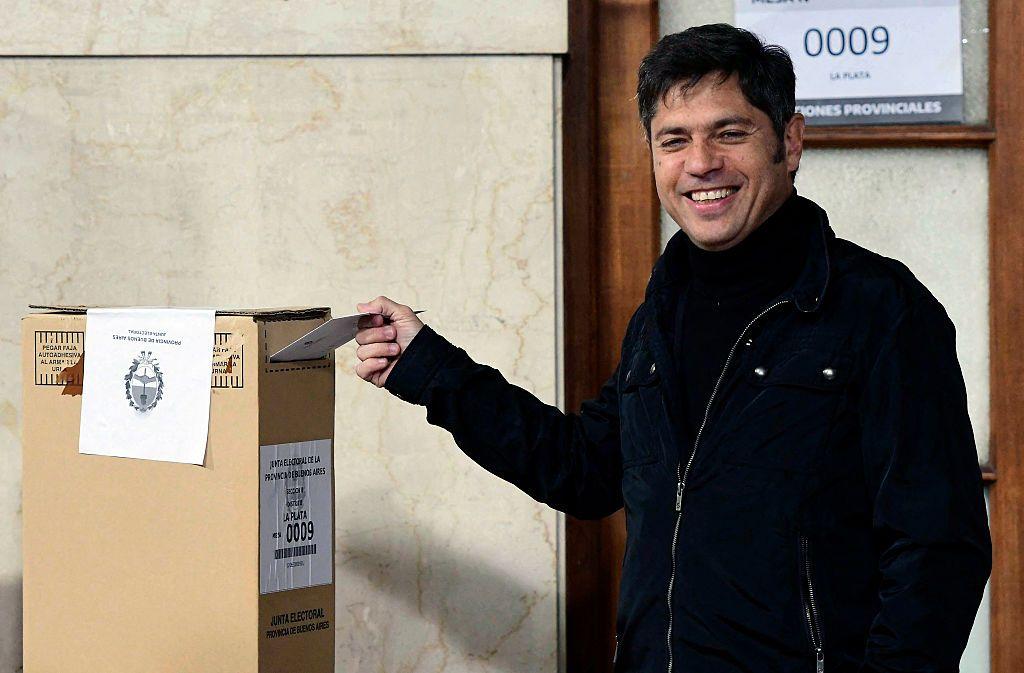
His party lost to the Peronist opposition in the elections for legislators of the largest electoral region in the country, the province of Buenos Aires, which the president himself had raised as a key test of his government at the national level, lighting an alarm light in the confidence of the markets.
And among the corruption scandals, the dissemination of audios in which Karina Milei, sister of President Javier Milei, has caused impact, with an alleged collection of bribes.
The combination of several factors has generated “a combo of financial, exchange and political tension,” says Lorenzo Sigaut Gravina, an economist of the consultant balances.
With a minority in Congress, the Government suffered the rejection of several of its key projects, while the governors, on the other hand, demand resources for their provinces in exchange for supporting the reforms.
On the other hand, Milei’s approval levels have dropped and that also makes investors nervous.
One of the challenges that the Argentine president has at this time is to arrive at the end of October without new setbacks arising and, from there, look for ways to build political agreements to sustain his plans beyond that date.
3. overvalued
Different economists agree that the Argentine weight is overvalued. Some point out that between 20% and 30%.
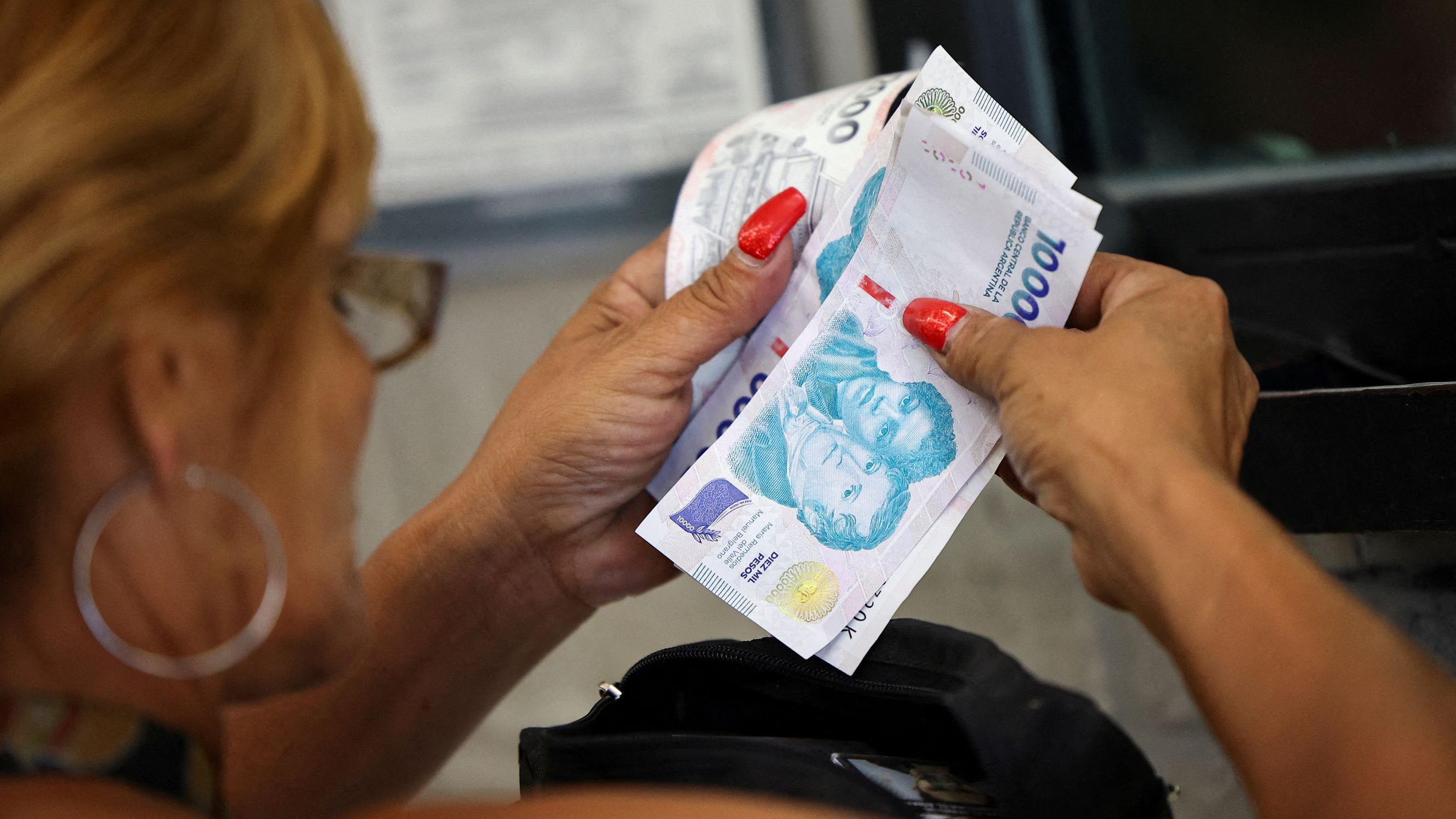
Mauricio Monge, economist senior For Latin America of Oxford Economics, it tells BBC Mundo that this overvaluation is one of the key causes of the financial storm of recent days.
As markets need to give confidence and ensure payments to bond holders who expire in the coming months, the economist argues that “what the country really needs is a depreciation of the currency.”
There are different ways to do it. For example, completely liberalize the exchange rate, something that “is not the most recommended,” says Monge.
Another path is to modify the boundaries of the bands (the roof and the floor) in which the exchange rate moves up or down. In other words, expand the limits of the dollar movement.
Argentina needs to generate a constant flow of dollars. At this time that is not happening and exports are not growing at the expected levels.
The idea would be to lower imports and increase exports to enter the country more dollars.
That would create a higher commercial surplus (greater exports than imports) so that the Central Bank and Treasury can accumulate reservations.
Milei will face a crucial electoral evidence in October when renewing about half of the Congress in Argentina, which will determine political support to its economic agenda.
If you do not get the expected results, analysts believe there will be an impact on the markets and, although the US has given you your support, the long -term panorama would become more challenging.
For now, it is not known what would be the amount of the loan that Trump’s economic team could give to the Milei government or under what conditions.
In the same way, there is great uncertainty about what the White House would get in exchange for a hypothetical financial rescue.
All these unknowns should be resolved in the coming weeks.

Click here To read more BBC News World Stories.
Subscribe here To our new newsletter to receive every Friday a selection of our best content of the week.
You can also follow us in YouTube, Instagram, Tiktok, X, Facebook and in our WhatsApp channel.
And remember that you can receive notifications in our app. Download the latest version and act.