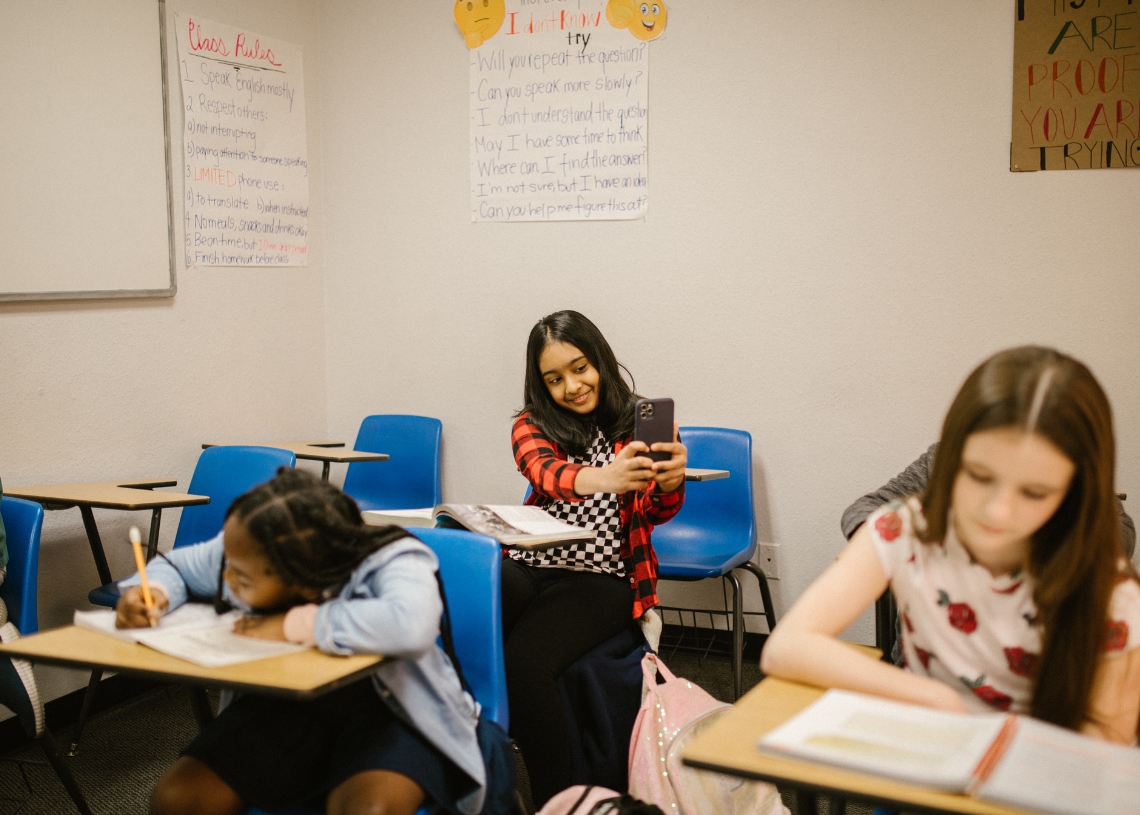
Clara, 13 years, received an offensive message in the WhatsApp class group. At first he thought it would be something punctual, but soon mocking, assemblies and comments increasingly cruel and frequent began to arrive. Days later, tired and angry, he decided to get rid of memes about another partner. Some laughed, others put emojis of laughs and many others kept silent. Of all who saw it, nobody intervened to improve the situation. In a matter of weeks, Clara had gone from being a victim to also become an aggressor and passive observer of what was happening around her.
This story, based on observed cases In our researchshows that cyberbullying is much more than an isolated event between an aggressor and a victim. It is a complex, surprisingly cyclical social dynamic. To the roles that we traditionally associate to harassment in the network – CIBVICTIMA AND CIBERGRESTOR – a third in discord is added: the cyberbasters. This triangulated approach best captures the reality in which a person can simultaneously be the three things: cybervíctima – cibertivegressive -ciberobservador (as well as present only one of the roles or combinations of two).
In fact, being cybervíctima today significantly increases the chances of becoming a cyber speaker or a cyberbaster in the future. This finding underlines a worrying reality: violence engenders violence, and to break the vicious circle of the cyberbullying, we need to understand how and why these roles are exchanged.
A study over 18 months
To better understand these dynamics, we carry out A longitudinal study for 18 months in which more than a thousand Spanish teenagers participated, aged between 11 and 17 years. Through a three -phase follow -up, with about six months apart between each one, we analyzed how the three main roles of the cyberbullying evolved: the cybervíctima, the cybergizer and the cyberbservter.
The first relevant result was the marked tendency to the “chronification” of the roles. That is, being cybervíctima, cybergiving or cyberbaster at a certain time predicts that it will continue to be in the future. This suggests that cyberbullying is not a sporadic event, but can be deeply rooted in the social interactions of adolescents, perpetuating itself as a stable form of violence.
The victim, at the center of the violence cycle
However, the most revealing discovery of our study was to discover that cybervictimization is a crucial predictor of cybergiving and subsequent cyberb observation. Teenagers suffering from cyberbullying are more likely to become cybergizers or cyberbasters six months later.
Why this role change? One of the hypothesis is that the victim, feeling helpless and frustrated, can see in the aggression a form of revenge or an attempt to recover the power and status that was taken away. Stress and pain derived from victimization can lead to a hostile interpretation of other social interactions, which in turn can trigger aggressive behavior, even if it is not directed towards the original stalker.
Similarly, having been a victim can make a teenager more aware of cyberbullying dynamics, but the fear of suffering again can lead him to adopt a role as passive observer as a self -protection mechanism.
Interestingly, this predictive relationship seems to be unidirectional. Our analysis did not find that being cyber speaker or cyberbaster predicts a future cybervictimization. The experience of being a victim is, therefore, the true trampoline from which it skip to other roles. This is what we must prevent.
How to break the cycle? Practical implications
Understanding that cyberbullying is a cyclical problem and that the roles are chronicled has important implications for prevention. It is not enough to act in a timely manner, sustained strategies are needed in the time that address the problem from several perspectives where there is a job from educational managers and families, mainly.
-
Digital literacy and risk prevention. It is essential to teach minors, from an early age, to use the Internet safely and responsible. This includes protecting your personal information and knowing how already asking for help. Reducing cybervictimization is key, since it is the main motor of the cycle. It is important that schools have within their tutorial action plan prevention programs based on evidence. For example, our team has developed the program Safety.net with tools for teachers and for families.
-
Empower the observer. Prevention programs should focus on observers so that they do not remain liabilities (adopt a victim -centered approach acting as defenders). It is crucial to promote empathy and give them tools to feel able to intervene, either defending the victim or denouncing harassment. An observer who becomes a defender breaks the social reinforcement that the aggressor receives and thereby modifies the relationship of forces in the dynamics of power in the classroom.
-
Support the victim to avoid retaliation. It is vital to offer victims psychological support and tools to manage their frustration and anger constructively, offering healthy alternatives to aggression to break the cycle of violence.
-
Work with the aggressor. The aggressors are victims of their own process, so it is also necessary to deepen the reasons that lead them to make use of violence and give them tools to channel their emotions in a less harmful way.
Putting the focus on the victim and the observer in cyberbullying cases is not only an act of justice, but the smartest strategy to deactivate the engine of network violence.
By Joaquín Manuel González Cabrera (Teacher and principal researcher of the CyberPsychology Group and the Emotional Welfare Area at the Institute for Transfer and Research (ITEI), UNIR – INTERNATIONAL UNIVERSITY OF LA RIOJA), Juan Manuel Machimbarrena (Added professor of the Department of Clinical Psychology and Health and Research Methodology, University of the Basque Country / Euskal Herriko Unibertsitatea), Raquel Escortell Sánchez (Professor of the Psychology of Education and Psychobiology and researcher of the group in cyberpsychology, UNIR – INTERNATIONAL UNIVERSITY OF LA RIOJA) and Vanessa Caba Machado (Teacher at the Faculty of Education and Postdoctoral Researcher in the CyberPsychology Group, UNIR – INTERNATIONAL UNIVERSITY OF LA RIOJA).
This article was originally published in The conversation. Read the original.