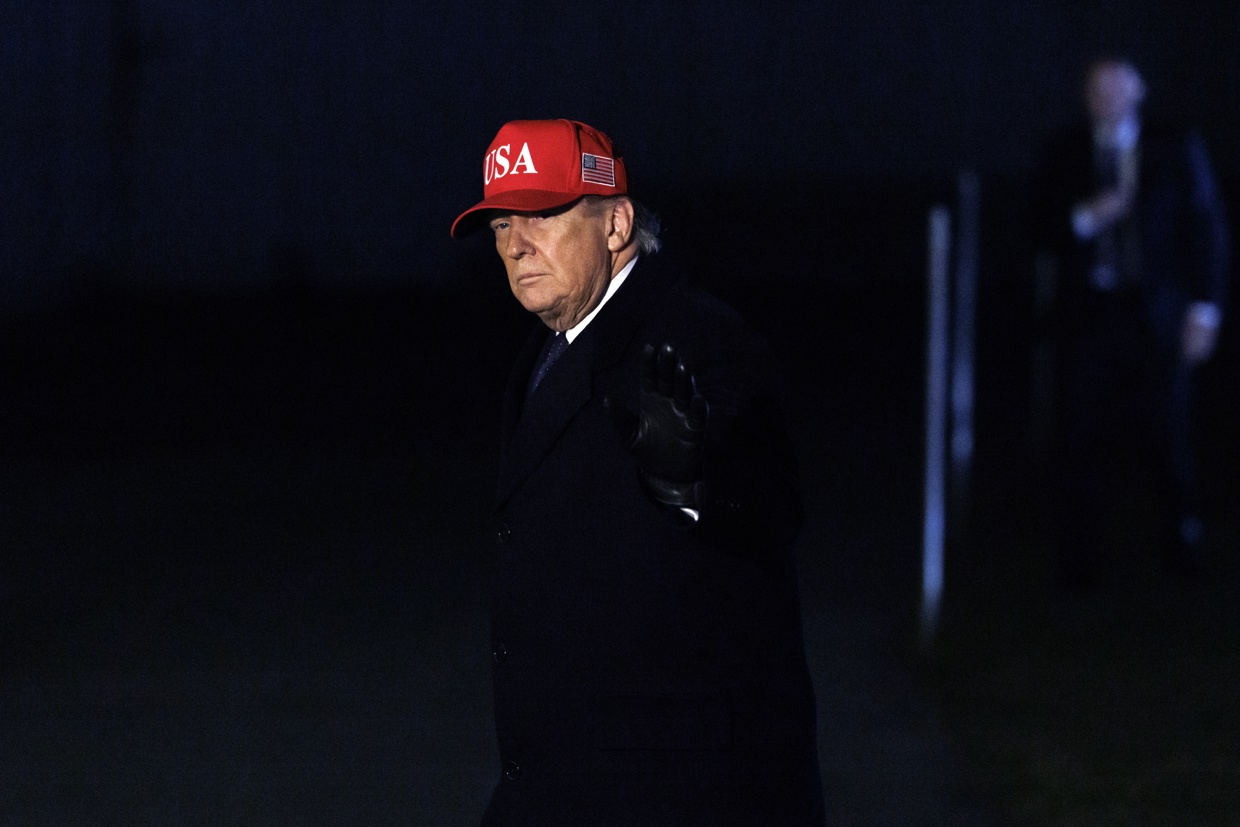
Early on Saturday, February 28, when the first American and Israeli missiles hit targets in Iran and They killed Supreme Leader Ali KhameneiDonald Trump opened a front that none of his predecessors in the White House had wanted to cross.
Trump crossed it with a phone call to Netanyahu and a video posted on social networks at 2:30 in the morning. What no one expected, however, was not the war itself, but the silence, coldness or outright rejection with which a good part of Trump’s own voters received it.
The polls: a war without popular support
The numbers are discouraging for the White House. A Reuters/Ipsos poll conducted between February 28 and March 1 found that only 27% of Americans approve of the attacks. 43% disapprove and an additional 29% say they are not sure.
The partisan division is total but asymmetrical: 74% of Democrats disapprove of the attacks, compared to 7% who approve. Among independents, 44% disapprove and only 19% approve. The Republican Party itself is far from unanimity: 55% support the attacks, but 31% say they have no opinion yet, an unusually high figure for a presidential action of this magnitude.
Perhaps the most revealing data for internal politics: More than half of those surveyed, including 23% of Republicans themselves, believe that Trump uses military force “too often”. And 42% of Republicans said they would be less likely to support the campaign if it leads to “US troop casualties in the Middle East,” according to the poll. Trump’s approval dropped one point to 39%in the same survey.
Until this Monday has been reported of the death of four American soldiers and five seriously wounded. “Several others suffered minor injuries from shrapnel and concussions,” according to a statement from yesterday Sunday of the United States Central Command (Centcom).
The political arc: from neocon euphoria to MAGA break
The political reaction in Washington It followed, in general terms, partisan lines, but with notable fractures on the Republican flank.
The falcons: the dream come true. In the more interventionist wing of the Republican Party, the attacks were met with euphoria. Senator Lindsey Graham celebrated the operation on Meet the Press stating that the “mother of all terrorism is sinking”.
The editorial board of Wall Street Journal applauded the operation, but issued a warning that reveals the depth of his concerns: the “biggest mistake” Trump could make would be “ending the bombing campaign too soon.” That editorial, which celebrates the beginning of a conflict with unforeseeable consequences and calls for it to continue, says a lot about what this sector of conservatism wants.
Democrats: indignation without unity. The Democratic response was loud but fragmented. New York Mayor Zohran Mamdani He called the attacks a “catastrophic escalation in a war of illegal aggression” and noted that Americans want relief from the affordability crisis, not another war.
“Today’s military attacks on Iran, carried out by the United States and Israel, mark a catastrophic escalation in a war of illegal aggression. Bombing cities. Killing civilians. Opening a new theater of war. Americans do not want this. They do not want another war for regime change. They want relief from the affordability crisis. They want peace,” he said in one post on.
For its part, he Senator Tim Kaine of Virginia, member of the Senate Armed Services and Foreign Relations committees, which co-sponsors the war powers resolution, He described the attacks as “tragic” in a opinion article from Wall Street Journal published on Sunday.
Kaine declared to NewsNation who wants upcoming briefings to be made public: “If we’re losing troops, if they’re losing their lives and getting wounded, how come they’re going to give us a briefing in a classified environment? If they’re comfortable with what they’re doing, they wouldn’t mind sharing it.”
Democrats in Congress They plan to force a war powers vote this weekarguing that the president cannot start a war without authorization from Congress. Reps. Ro Khanna, D-Calif., and Thomas Massie, R-Ky., introduced a measure known as the war powers resolution.
But the Democratic opposition lacked a single voice. Democratic Senator John Fetterman of Pennsylvania broke with his party to defend the attacks on CNN: “I don’t understand why we can’t just say, ‘Thank God!’”
The MAGA fracture: the most significant break. The most striking signal did not come from the Democrats but from the Trumpist ecosystem itself. Conservative journalist Tucker Carlson, In an interview with Jonathan Karl of ABC News, He called the attacks “absolutely disgusting and evil” and warned that “this is going to shuffle the deck in a profound way.”
The former congresswoman and MAGA supporter Marjorie Taylor Greene He published a diatribe of almost 700 words on X: “The Trump administration actually asked in a survey how many casualties they were willing to accept in a war with Iran??? Zero, you bunch of sick liars… We voted for America First and ZERO wars.” In a second message he added: “This is not what we thought MAGA was going to be. Shame!”
In another post he said: “We are no longer a nation divided between the left and the right, we are now a nation divided between those who want to fight wars for Israel and those who just want peace and to be able to pay their bills and their health insurance.”
Rep. Thomas Massie of Kentucky was equally blunt: “I oppose this war. This is not ‘America First'”. These voices are a minority within the Republican Party. But its political significance is enormous.
Nick Fuentesa 27-year-old far-right extremist podcaster who has accompanied, not without contradictions, the MAGA universe with his trail of millions of followers groypers, has reacted angrily. “Something has gone terribly wrong.” His focus on America First It is opposed to financing or unleashing wars abroad. “What is this administration doing, other than covering up Epstein’s files, embezzling money through government contracts, and taking us to war over Israel?” Fuentes said. “This Administration needs to be shut down immediately. Don’t vote in the midterm elections, and if you do, vote Democrat, screw this.”
The electoral cost: a high-risk bet
A analysis published todayciting two senior White House officials and a Republican close to the Administration, reveals that Trump went ahead with the attacks despite private warnings from his own advisers about the political risks heading into November.
“None of those officials foresee immediate political consequences. Instead, they foresee what one described as a ‘slow burn effect,’ driven by the duration of the conflict, the extent of retaliation, the number of American casualties and the impact on gasoline prices.”
“The juxtaposition between a successful State of the Union address focused on affordability and going to war in the Middle East days later is not only disconcerting, it’s mind-boggling,” said Republican strategist Rob Godfrey. “Making midterm voters comfortable with that juxtaposition will be one of the White House’s most important tasks in the coming weeks.”
White House political models show dozens of close congressional districts where even moderate voter skepticism could prove decisive, or at least force vulnerable Republican representatives to vote on thorny war powers resolutions. Currently, Republicans control Congress with a narrow margin of 218 seats to 214 Democrats.
“Why did you start this war, Mr. President?”
That question, which New York Times became the title of his Saturday editorial, sums up the perplexity that runs through the American political spectrum.
He Washington Post published two key opinion pieces: one warning that Trump is opening “a war with no easy way out” and another pointing out that the president went to war “without having presented a good argument”comparing the decision with that of Iraq in 2003 and remembering that if it had not been for that war, Barack Obama probably would not have become president in 2008.
He Wall Street Journal reported that Trump’s war goals changed at least twice in a single Sunday“complicating the mission.” Trump’s justifications have included the imminent threat, which the Pentagon itself denied before Congress, the elimination of nuclear capabilities (an argument that contrasts with his previous claim of having “destroyed” them in June), and the rhetoric of “regime change” borrowed from the neoconservative vocabulary that he always claimed to despise.
He Washington Post also reported that the attacks occur just as the first primaries of the midterm elections are approaching, which raises the political stakes of an operation whose duration Trump himself estimated at “about four weeks.”
If that war is quick and decisive, domestic politics can absorb it. If it spreads as it did in Afghanistan and Iraq, it suggests that no regime collapse is quick or clean, and the political price could be losing Congress in November. And with it, the domestic agenda that Trump promised to the same voters who today view actions against Tehran with distrust.