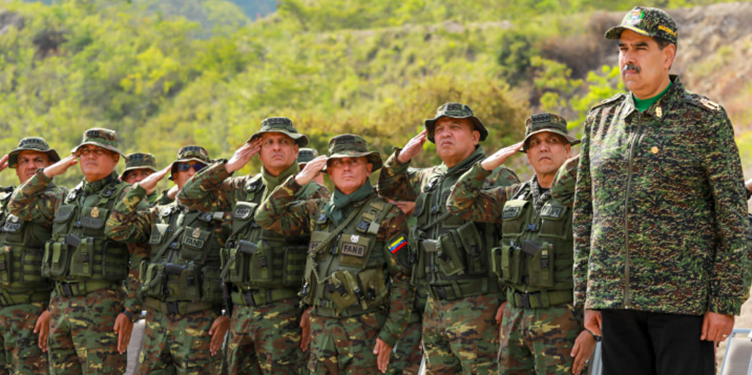
The network mixes State, armed forces and drug trafficking in Venezuela.
MADRID, Spain.- For more than three decades, the so-called Cartel of the Suns has been the subject of accusations, investigations and international controversies. For some analysts and governments, it is a criminal structure that involves senior officials of the Venezuelan State in cocaine trafficking. Authorities in Caracas deny it, saying it is a “political invention” used to discredit the government. Various opinions place it somewhere in between: it would not be a traditional cartel with a single leadership, but rather a system of corruption and alliances between military sectors and transnational armed groups, consolidated in the midst of the political and economic crisis in Venezuela.
The expression “Cartel of the Suns” appeared for the first time in the Venezuelan press in the early 90s, associated with investigations into drug trafficking within the National Guard. The name refers to the insignia in the shape of “suns” that identify the rank of the senior officers of that armed body. Since then, the term has evolved to become synonymous with a network that facilitates and protects the transit of cocaine from Venezuelan territory to the United States, the Caribbean and West Africa.
Starting in the late 90s and early 2000s, when Hugo Chavez broke military cooperation with the United States, the structure would have gained strength. Without the presence of the DEA and in the midst of an internal reorganization of the Armed Forces, some officers began to control border territories and strategic routes, while the Colombian guerrillas, especially the FARC, found refuge in Venezuela during the military offensive of the Álvaro Uribe government in Colombia. This interaction, security specialists point out, facilitated operational agreements: logistics, territorial protection and use of clandestine runways and ports in exchange for rents.
A system more than an organization
Unlike the large Colombian cartels or mexicans, The Cartel of the Suns does not operate as a centralized structure, it does not have a formal leadership or a rigid organizational chart. Various studies on organized crime in Venezuela describe it as a fragmented and adaptable network, made up of active-duty and retired officers who control specific points in the trafficking chain: border crossings in the states of Táchira and Apure, ports in the Venezuelan Caribbean, and runways in jungle areas near Colombia and Brazil.
Analysts point out that this system also fulfills an internal political function. In a country where the economic crisis has deteriorated the salaries of most civil servants, allowing access to illicit income becomes a way of ensuring military loyalty to the government. That is one of the reasons why, more than a classic poster, it is interpreted as a governance mechanism within the state apparatus.
In 2020, US prosecutors accused Nicolás Maduro and other senior officials of “conspiring to introduce cocaine into US territory.” Washington is currently offering $50 million as a reward for information leading to the arrest of Maduro, and $25 million for Diosdado Cabello, one of the most influential leaders of Chavismo.
The United States maintains that the Cartel of the Suns not only facilitates cocaine trafficking, but does so with the intention of “using drugs as a political weapon” against the United States itself. The tax accusations allege that, for at least two decades, sectors of the Venezuelan government have collaborated with Colombian armed groups to flood the North American market with cocaine, in exchange for territorial support and illicit financing. According to official statements from the State Department, this system would have allowed the Venezuelan civil and military leadership to obtain economic benefits and, at the same time, reinforce internal alliances that guarantee the stability of the regime.
A network with international projection
The Colombian-Venezuelan border has functioned for years as a gray zone in which irregular armed structures, peasant communities in a state of vulnerability and a state military presence coexist. FARC dissidents, ELN members, and gangs dedicated to gasoline and gold smuggling interact in these territories, creating favorable conditions for multiple illegal economies, including drug trafficking.
Experts consulted by international media agree that the Venezuelan route has become one of the most relevant for cocaine trafficking to Europe and the United States. Drugs usually cross the territory by land and river routes to ports and clandestine airstrips, from where they depart in small planes or fast boats to Caribbean islands or transit countries in the Atlantic.
The scheme operates as a decentralized chain. There is no single boss who articulates the flow; Instead, each military group or cell controls a section of the route. When an officer retires, is transferred or loses influence, another replaces him, maintaining the operational structure. This flexibility allows the network to survive internal purges, government changes, or military rotations.
Between the official denial and the accumulated evidence
The Venezuelan government maintains that the Cartel of the Suns does not exist and that this is an argument used by the United States and other countries to justify diplomatic pressure and sanctions. However, the existence of judicial processes, journalistic investigations, testimonies of former officials and collaborations with the US justice system has fueled the international perception that there is, at least, one criminal structure tolerated and benefited from the State.
The case of Hugo Carvajal, former head of military intelligence, and that of former general Clíver Alcalá, both subject to judicial proceedings in the United States, has reinforced these interpretations. Both held high-level positions and had access to sensitive information from the military apparatus. The implications of these confessions, added to dozens of sanctions and open files, are projected on the Venezuelan political balance.
To this day, the Cartel of the Suns continues to be a key issue in understanding the Venezuelan crisis. Beyond its changing forms, denials and crossed accusations, what seems clear is that control of territory and the illegal economy has become a central component of political power in Venezuela. While the country is going through a prolonged crisis, this system of alliances between state actors and criminal networks continues to operate as a fundamental piece of support for the regime and regional instability.