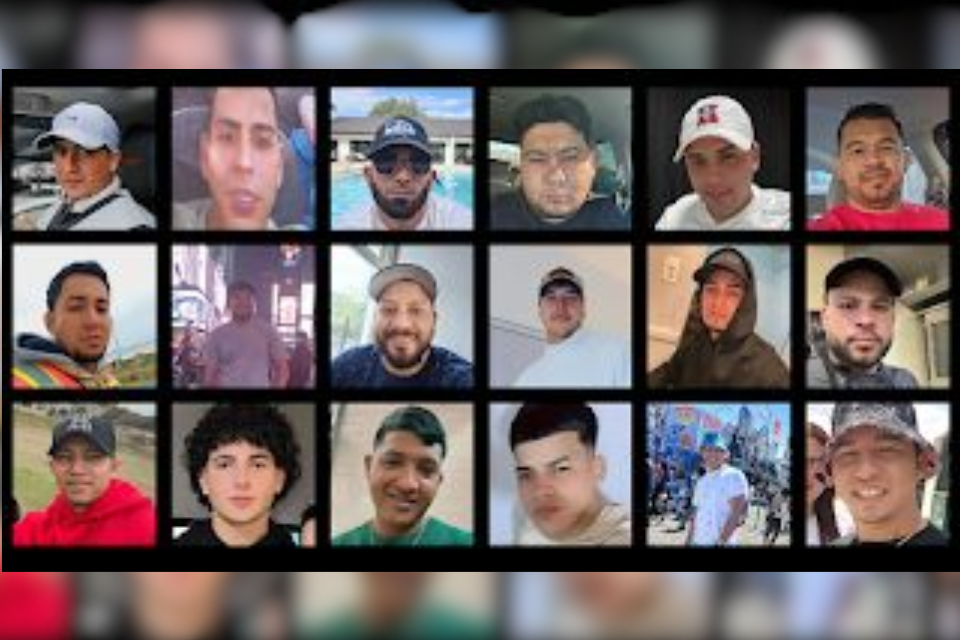
On March 15, President Donald Trump’s government sent 238 Venezuelan immigrants to a maximum security prison in El Salvador. Last week, they were released with the same rush with which they had taken them. This database gathers detailed information about these Venezuelans deported to the CECOT, whose names were first published by CBS News. The men were returned to Venezuela and the total number amounts to more than 250. These are their stories
By: Trevizo pearlPropublic, Texas Tribune; Melisa SánchezPropublic; Mica RosenbergPropublic; Gabriel Sandoval, Propublic; Jeff Ernsthausen, Propublic; Ronna Risquez, Alianza Rebelde investigates; Adrián González, Fake News hunters; Adriana Núñez Moros, independent journalist; Carlos Centeno, independent journalist; Maryam Jameel, Propublic; Gerardo del Valle, Propublic; Cengiz Yar, Propublic; Lomi Kriel, Propublic, Texas Tribune; Nicole Foy, Propublic; Rafael Carranza, Arizona luminaire; Lisa Seville, Propublic; Kate Morrisey, independent journalist.
Posted in collaboration with PROPUBLIC, The Texas TribuneRebelde Alliance investigates (The whistle, Runrun.es and Talcual) and Fake News Hunters
To know the stories of the 238 men deported to El Salvador Click here
PROPUBLICA, The Texas Tribune and a team of Venezuelan journalists from Rebelde Investiga (Runrun.es, SuchWhich And the whistle) and Fake News Hunters The last four months have spent investigating the lives and background of 238 Venezuelan men who were imprisoned in El Salvador. We have collected an unprecedented report, case by case.
We accessed government data to determine whether they had been convicted of crimes in the United States or if they had pending charges. We discovered that lThe majority were only for infractions to immigration laws. We also interviewed relatives of more than 100 of the deportees, we reviewed thousands of pages of judicial files in the United States and South America, and analyze data from the federal immigration courts.
The White House spokeswoman, Abigail Jackson, avoided answering questions about the men who appear in the database, but said that Trump “is committed to the US people to fulfill their promises to the US people and to expel undocumented criminals and terrorists who are a threat to public security.” Jackson sent the questions to the National Security Department, who also did not answer.
We obtained internal information that shows that Trump’s government knew that at least 197 of the deportees had no conviction For no crime in the United States, and that only six had been convicted of violent crimes. We identify less than a dozen additional convictions, both for crimes committed in the United States and abroad, which were not reflected in government data.
Almost half of the deportees, 118they were expelled from the country with their immigration cases still in process, which should have protected them from being deported. Some were a few days after their final audience.
At least 166 of the deportees have tattoos. According to family interviews, judicial documents and records, the Government was largely based on tattoos to link them to those deported with the Aragua train, although experts consider that tattoos are not a reliable indicator of belonging to the gang.
When they were arrested, many of them were working in the United States. At least 20 They were barbers or stylists, 38 They were day laborers or workers of construction such as workers or masons and at least 25 They were distributors or taxi application conductors.
The Venezuelans are between 18 and 46 years old. The consequences of being imprisoned for months go beyond those deported. Their wives could not cover the rent. His relatives had to suspend their medical treatments. His children did not know if they would see them again.
Methodology
This database is part of a joint investigation of PROPUBLICA, The Texas Tribune and Venezuelan media Fake News Hunters and Rebel Research Alliance on the 238 Venezuelans deported to CECOT on March 15, and whose names were first published by CBS News.
In the processes to confirm the identity of the deportees, we seek by date of birth in the official records of the Venezuelan government, including the Database of the Identification Service (SAIME) of the Ministry of Internal Relations, Justice and Peace; the public database of the Venezuelan Institute for Social Security (IVSS); and the Public Database of the Electoral Registry. The team of journalists of this alliance of US and Venezuelan media interviewed relatives of more than 100 of those deported, in addition to dozens of lawyers who represent them and civil organizations that collaborate in their defense. The interviews were conducted before the deportees were released, and many of them were carried out in Spanish.
We review the social media accounts of deportees and their relatives, in addition to reports, press releases from the United States government and judicial documents. To determine what happened with its immigration cases, we analyzed the data of the Executive Office for Immigration Review of the United States Department of Justice.
We also obtained, exclusively, information that the Government had compiled on the deported men before their expulsion. Among those data, it was recorded if they had been convicted of crimes in the United States, if they had pending charges or if they were only for violations of immigration laws. Data on nine cases were missing. To verify and expand that information we seek in databases of public records of the United States; We review the police websites, Sheriff departments and county courts; We read judicial documents, and submit numerous requests from public records to the forces of the order and the judicial systems throughout the country.
To seek criminal records abroad, we review the records of the Official Website of the Supreme Court of Justice of Venezuela and we consult a global legal database. We also obtained judicial and police information from Chile, Peru and Colombia, and we interviewed police officers from these countries, in which some of the migrants previously lived. In addition, we were able to access three databases of the Venezuelan Police and an Interpol report of January 2024 that were used to prepare a list of more than 1,400 alleged members of Venezuelan gangs, including members of the Aragua Train. When comparing the list with the names of the 238 deported, we find no coincidences.
The data collected on the criminal records of deported men are not exhaustive, since there is no universal database of accusations or convictions.
In the case of people who, according to President Donald Trump’s government, had criminal proceedings or pending convictions in the United States, we tried to contact their relatives and lawyers. We included all the answers of those who answered us.
In addition, we consult the US government about each of these cases. The administration did not answer our questions about the deportees, except in the entries in which the opposite is indicated.
The database indicates the age of men as of March 15, date on which they were deported.
We continue to investigate. You or someone who knows is among those deported? Do you have information about the deportation operation that you can share with us? You can fill this form or write to whatsapp al 917-327-4868. Please be the most specific, clear and concise that I can.
To know the stories of the 238 men deported to El Salvador Click here
——-
They also collaborated in this investigation: Kate Morrisey, independent journalist; Gabriel Pasquini, independent journalist; Coral Murphy Marcos, independent journalist; Liz Gascón, Ari journalist; Melany Garces, Ari journalist; Paula Rangel, ARI journalist; Lucía Pineda, journalist of ARI; Mayreth Casanova, journalist of ARI; Perdomo Luna, Ari journalist; Sheyla Urdaneta, journalist of ARI; María José Dugarte, independent journalist; Juan Hernández Vargas, data engineer and Gabriela Rincón, journalist of fake news.
Wendy Selene Pérez translation with the help of Google Translate. Ezequiel Zaidenwerg-Dib contributed to translation.
*Journalism in Venezuela is exercised in a hostile environment for the press with dozens of legal instruments arranged for the punishment of the word, especially the laws “against hatred”, “against fascism” and “against blockade.” This content was written taking into consideration the threats and limits that, consequently, have been imposed on the dissemination of information from within the country.
Post views: 433