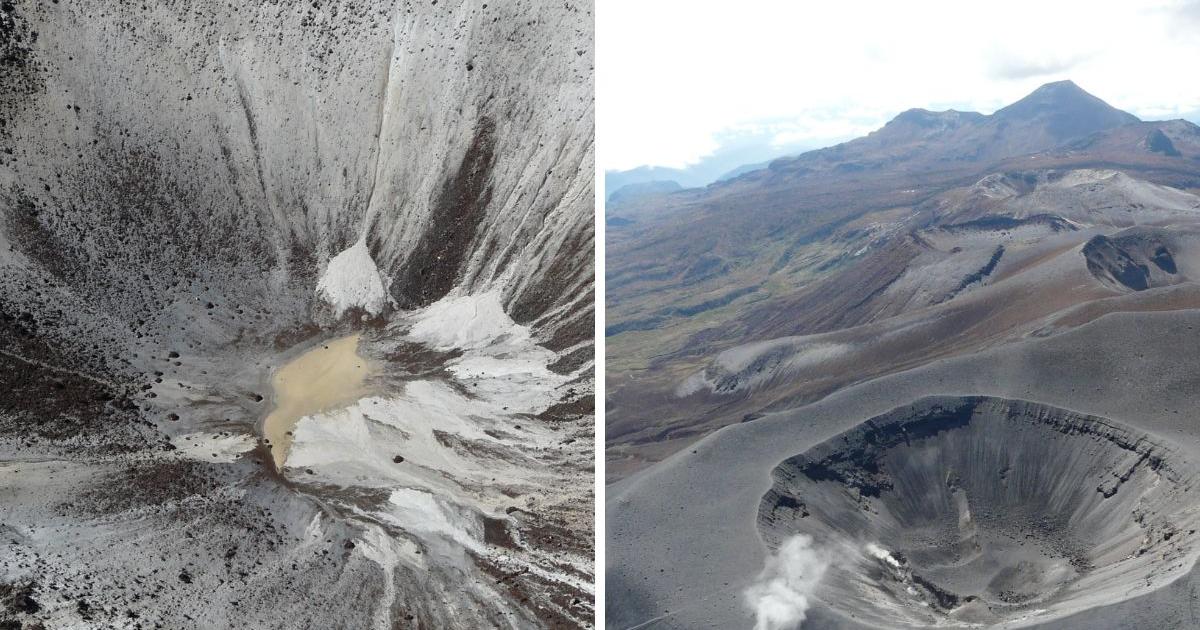
Currently, the volcano is found on yellow alert and relief agencies have made a caution call.
When was the last time the Puracé volcano erupted? Historical of seismicity, according to the SGC
Colombian Geological Service.
He Puracé volcano, located in the department of Caucahas been on yellow alert for several weeks due to the increase in its seismic and geological activity.
In a newsletter issued by the Colombian Geological Service (SGC) the past February 17, 2025, the presence of a seismic tremor that began at 2:51 pm was reported. and that could be associated with a possible ash broadcast. However, due to the cloudiness that covered the top of the volcano, the eruption could not be confirmed visually.
Of interest: Volcané Puracé on yellow alert: Increase in seismic activity and security recommendations is reported
The yellow alert maintains constant monitoring due to the various phenomena that the volcano could present. These include Sporadic ash emissions, small explosions inside the crater, thermal anomalies, degasification and the possibility of lahars or landslides in nearby areas.
The winds also play a fundamental role in ash dispersionwhich could affect visibility and air quality in surrounding towns such as Puracé, Coconuco and Popayán.
When was the last time the Puracé volcano erupted? Historical of seismicity, according to the SGC
Colombian Geological Service.
When was the last time the Puracé volcano erupted?
Throughout the last 150 years, the Puracé volcano has had five eruptive periods, with rest intervals between 10 and 20 years.
The last significant eruption occurred in March 1977, when an ash broadcast was recorded. This event joined the long activity history of the volcano, which has been constantly monitored since 1986which has allowed to study and better understand its seismic and eruptive behavior.
One of the most tragic episodes in the history of the volcano took place on May 26, 1949when an unexpected eruption came to the lives of 16 students of the Alejandro de Humboldt National Lyceum.
The young people had organized an excursion to the volcano, ignoring the warnings of the local authorities and indigenous people about volcanic activity. The eruption, which launched ashes, gases and blocks, was heard in the city of Popayán and left a deep brand in the historical memory of the country.
This event, in which They commemorate 76 years in 2025, highlights the importance of continuous volcano monitoring and education on volcanic risk management to protect human lives.
Also read: The biggest fish in the world in La Guajira?
Recommendations for the population close to the Puracé volcano
- Stay informed: It is necessary to follow the bulletins issued by the SGC and constantly consult the official information channels, such as social networks and the entity’s website.
- Avoid areas close to the volcano: In case of the presence of ash or signals of minor explosions, local authorities could recommend the temporary closure of routes or the evacuation of vulnerable areas.
- Take precautions in case of ash fall: If they are near the area affected by the ash, it is recommended to wear masks or wet cloths to cover the nose and mouth, as well as protective glasses to avoid eye damage. In addition, it is advisable to stay inside the homes and close doors and windows.
- Be alert to the lahares: If it is located in areas close to water sources or at the base of the volcano, pay attention to heavy rains or landslides that could generate lahares, and follow the instructions of local authorities to protect themselves.
The SGC has reiterated its commitment to continue monitoring volcanic activity and will continue to provide updated information as the situation progresses. In addition, it makes a called to local authorities and the National Unit for Disaster Risk Management (UNGRD) to maintain prevention measures and coordinate in the attention to any event that may arise due to the activity of the volcano.
Source: Integrated digital system.