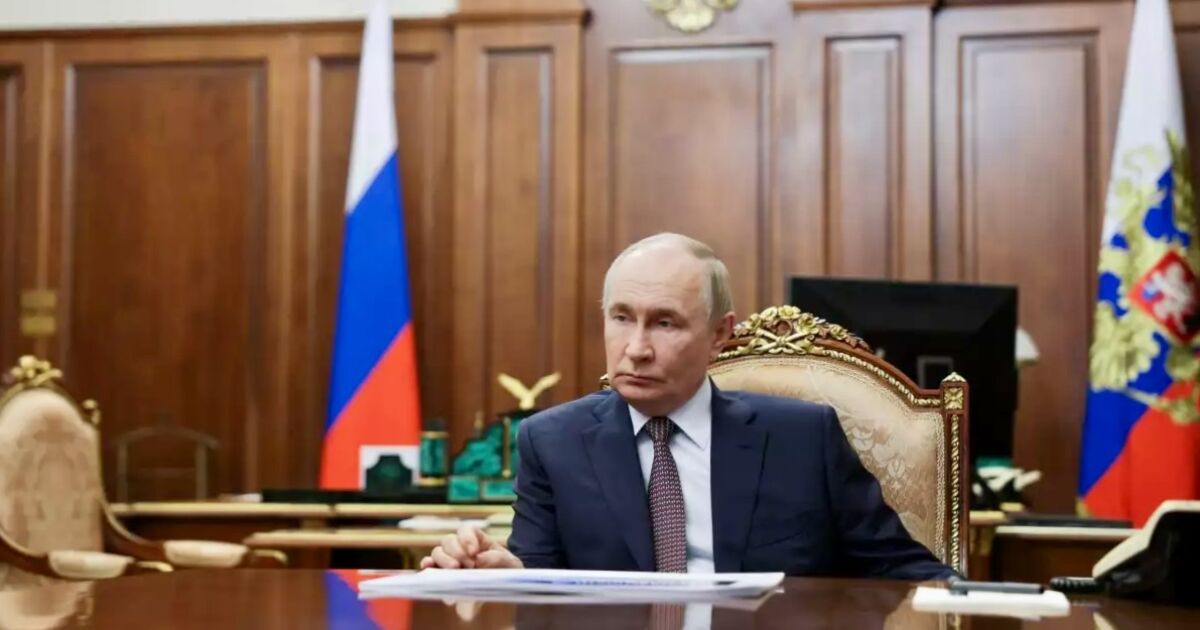
The United States, Europe and its allies have imposed more than 25,000 sanctions other than Russia for the 2022 Ukraine War and the annexation of Crimea in 2014, in an attempt to sink the Russian economy, valued at 2.2 billion dollars, and undermine support for President Vladimir Putin.
Washington has also imposed tariffs on India in response to New Delhi oil trade with Moscow.
Putin states that the Russian economy has exceeded expectations. In the last two years it has grown faster than the G7 countries, despite the western predictions of a collapse. He has ordered companies and officials to challenge the sanctions by all means at their disposal.
However, there are more and more signs of tension in the economy, which according to the Central Bank is now technically in recession and suffers high inflation.
Some punitive measures – in particular the disconnection of Russian banks of the Swift Payment System in 2022 and Washington’s warnings to Chinese banks last year against support for the war effort of Russia – have fueled the fear of secondary sanctions.
“Chinese banks fear being included in secondary sanctions lists, so they do not accept Russia money,” a payment market source told Reuters.
These concerns seem to be behind the reappearance of barter transactions, much more difficult to track.
In 2024, the Russian Ministry of Economy published a “Barter Transactions Guide with the Foreigner” of 14 pages, in which it advised companies how to use this method to avoid sanctions. He even proposed the creation of a commercial platform that would function as a barter bag.
“Foreign trade barter transactions allow the exchange of goods and services with foreign companies without the need for international transactions,” said the ministry document, citing “the conditions of the restrictions of the sanctions.”
Until recently, there were few indications of commercial interest in this type of transactions. However, last month, Reuters reported that the Chinese company Hainan Longpan Oilfield Technology Co. intended to trade with steel and aluminum alloys in exchange for marine engines.
The company did not respond to the request for comments.
For this article, Reuters has been able to identify eight transactions of this type of goods in kind based on commercial sources, public statements of customs services and companies. It had not been previously informed of these transactions.
Although the news agency could not establish the global value or volume of bartering in the Russian economy due to the opacity of transactions, three commercial sources said that the practice was increasingly frequent.
“Barter growth is a symptom of defolarization, the pressure of the sanctions and the liquidity problems between the partners,” Maxim Spassky, secretary of the General Council of the Russian-Asian Union of Industrialists and Entrepreneurs, an organism of the sector, told Reuters. Spassky said that barter volumes are likely to continue growing.
One of the commercial sources – which spoke about anonymity due to the delicate information – said the system helped to avoid the sanctions that disconnect to the Russian banks of transactions in dollars and euros.
Three analysts said that a possible indication of the magnitude of the bartering was the growing divergence between the foreign trade statistics of the Central Bank and the customs service data, which reached 7,000 million dollars in the first half of this year.
In response to a request for comments, the Russian customs service confirmed that bartering with different countries “were carried out for a wide range of goods.” He said, however, that the number of barter transactions was insignificant compared to the total volume of foreign trade contracts.
The Russian foreign trade surplus between January and July decreased by 14% compared to the previous year, to 77.2 billion dollars (MDD), according to data published by the Federal Customs Service. Exports during this period decreased by 11,500 MDD, to 232,600 million pesos, while imports increased by 1,200 million pesos, up to 155,400 million pesos.
The Government and the Central Bank declined to talk about bartering with Reuters, beyond saying that there were no data available on such transactions, since they would be included in global figures if legally notified. A source close to the government said that data divergence could be due to differences in the methodology.

Autmobiles per grain
In a transaction identified by Reuters from two commercial sources, Chinese cars were exchanged for Russian wheat. According to one of the sources, the Chinese partners of the operation asked their Russian counterparts to pay in grain.
Chinese partners bought vehicles in China in exchange for yuan. The Russian partner bought grain with rubles. Then, wheat was changed to cars.
Reuters could not establish negotiated volumes, or the mechanism by which merchants decided the value of grain or cars.
In two other transactions, linen seeds were exchanged by goods, including appliances and construction materials from China, according to customs statements.
Experts knowledgeable about Russian foreign trade pointed out that one of the linen transactions, registered in a 2024 statement of the Russian customs service in the Urales region, had an estimated value of about $ 100,000.
China is one of the main importers of Russian flax seeds, used in industrial processes and as a nutritional product.
In other transactions, metals were delivered to China in exchange for machinery, Chinese services were exchanged for raw materials and a Russian importer bought aluminum to pay a Chinese company. One of the treatment was with Pakistan.
Some barter transactions have allowed the importation of Western products to Russia despite the sanctions, two sources said with knowledge of transactions, without providing details about what products.
In the Business Forum of the Kazan Expo, held in August, Chinese companies cited the issue of agreements between the problems that hinder the development of bilateral trade. Xu Xinjing, president of Hainan Longpan Oilfield Technology Co., LTD, said the barter trade could be a solution.
In his speech at the conference, Xu said that “in the current conditions of limited payments,” the barter offered new opportunities to the companies of Russia and the Asian countries.
Barter is not the only solution. Some merchants have resorted to the so -called “payment agents”, which by a commission facilitate payments through various systems, but these transactions can be risky.
Another way to execute the payment is through the Russian state bank VTB, which has a branch in Shanghai. Others use cryptocurrencies linked to the US dollar.
“Small companies are actively using cryptocurrencies. Some transport effective, others work through compensation, other diversify the accounts with different banks,” says Sergey Putyatinsky, vice president of Operations and Informatics of BCS, one of the main Russian financial companies.
“There is still no prepared technological response. The economy is surviving, and companies are simultaneously applying between 10 and 15 different payment methods,” he said.
With Reuters information