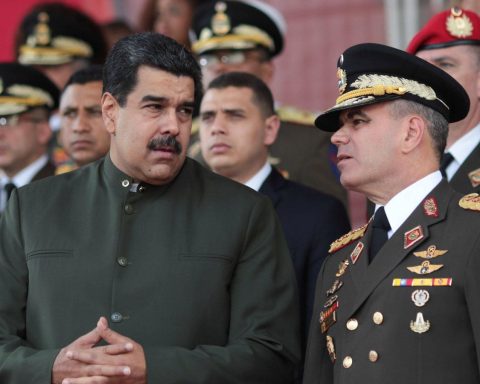
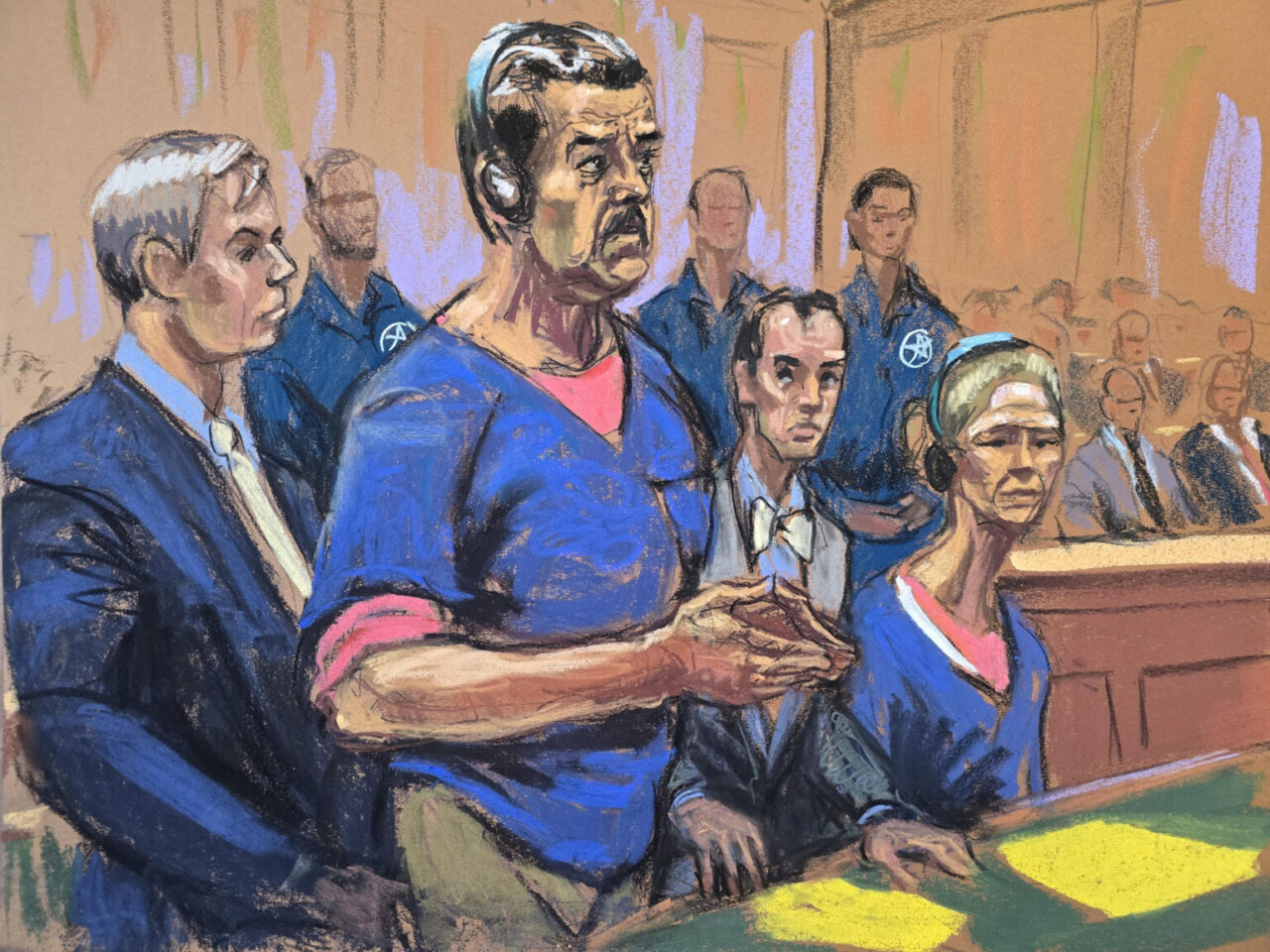
Nicolás Maduro will spend the rest of his days behind bars and will finally be held accountable before justice. No one can save him from that, either because the judicial process he is facing in the United States ends with a sentence that could be up to life imprisonment, or because the judicial process being followed in Argentina for crimes against humanity goes ahead, because A federal judge from Buenos Aires signed the extradition request.
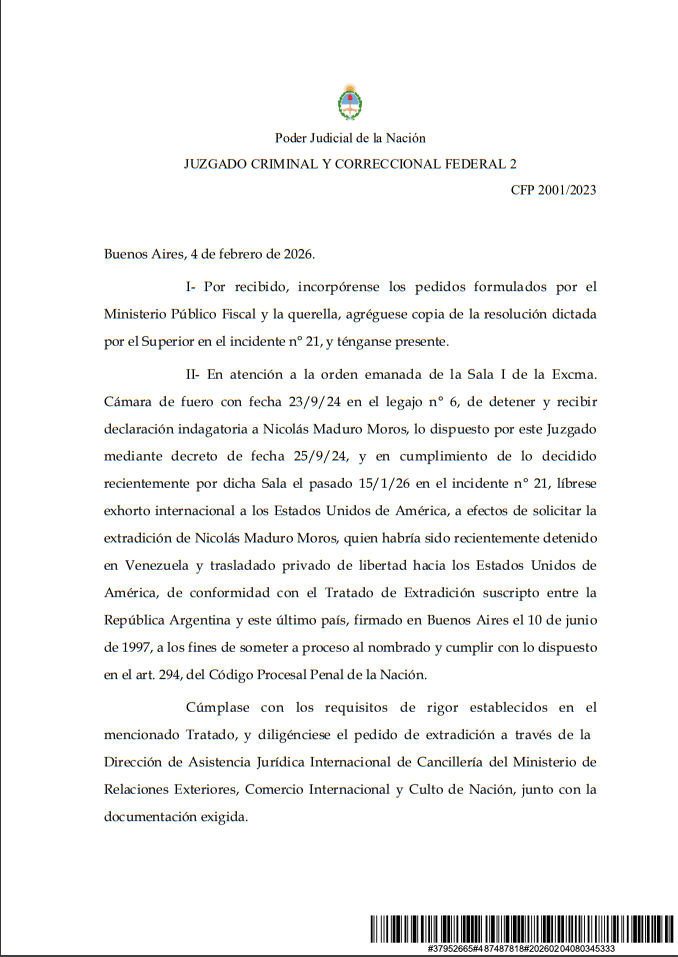
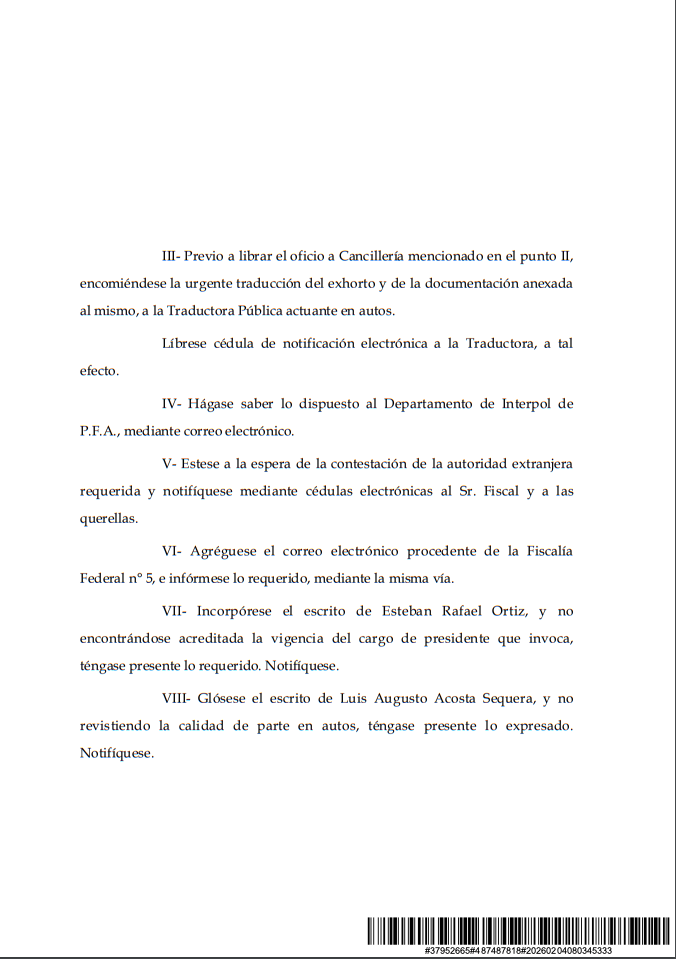
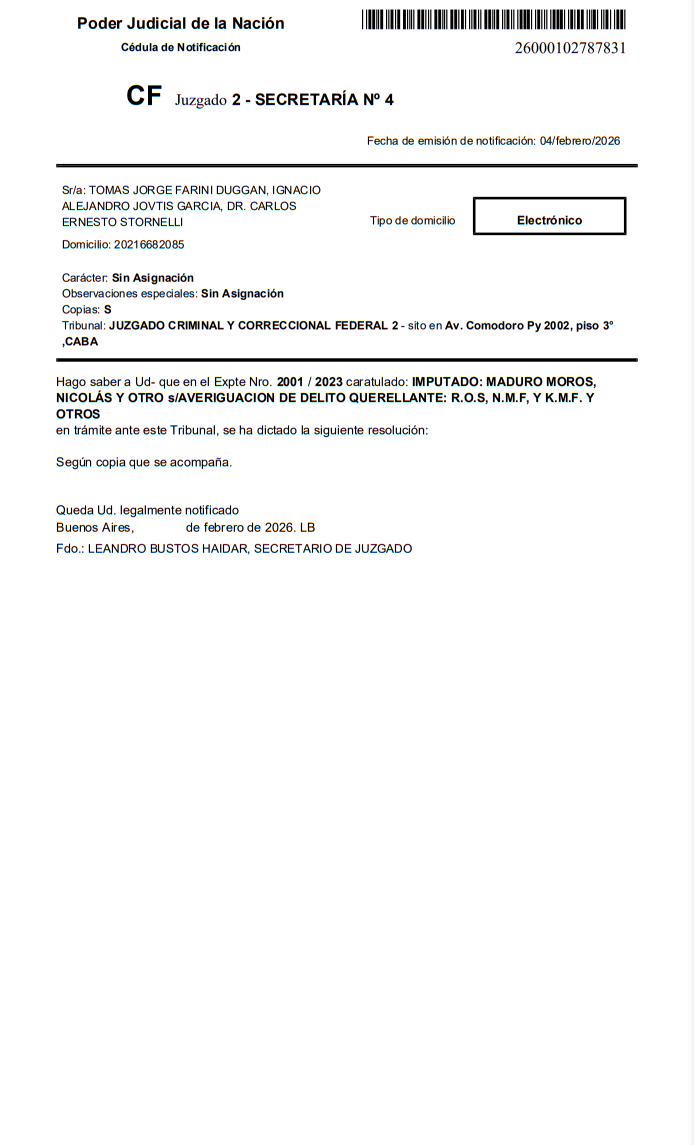
The text issued by the Federal Criminal and Correctional Court 2 of Buenos Aires, dated February 4, 2026, states: “In response to the order issued by Chamber I of the Supreme Court dated 9/23/24 in file No. 6, to detain and receive an investigative statement from Nicolás Maduro Moros, the provisions of this Court by decree dated 9/25/24, and in compliance with what was recently decided by said Chamber on 1/15/26 in incident No. 21, an international appeal is issued to the United States of America, in order to request the extradition of Nicolás Maduro Moros, who would have been recently detained in Venezuela and transferred deprived of liberty to the United States of America, in accordance with the Extradition Treaty signed between the Argentine Republic and the latter country, signed in Buenos Aires on June 10, 1997, in order to subject the person named to trial and comply with the provisions of article 294, of the National Criminal Procedure Code.
The National spoke with the lawyer Tomas Farini DugganArgentine jurist who is leading this process that began against Maduro in 2023, and that in 2024 he managed to get an arrest warrant issued for him and 16 other members of the regime, after a court had previously demonstrated that there were sufficient elements for these people to be prosecuted in Argentina, thanks to the principle of universal jurisdiction, guaranteed in the constitution of that country.
“What we did was expand the complaint, not only with the Bachelet report and all the cases that are documented there, but with a number of complaints from the Penal Forum and other organizations and more or less 20 victims who expanded the complaint for our cause and with that we managed to activate universal jurisdiction in Argentina,” he said.
It turns out that due to a clause in article 118 of the Constitution of the southern country, Argentina is practically the only country in the world authorized to carry out this type of procedure based on universal jurisdiction, which allows judging the commission of crimes against humanity and genocide, even if they have not occurred in its territory and even if the alleged perpetrator or the victims do not have Argentine nationality.
This clause of the Argentine Constitution allows the judges of that country to judge “crimes against humanity, committed anywhere, against any person from anywhere in the world. What is a condition is that they are not tried in the place where they are committed,” Farinni explained in conversation with The National.
The Argentine jurist recalled that among that same list of those who are requested by the Argentine justice system to be tried for crimes against humanity, Diosdado Cabello and the former military man Justo Noguera Pietri also appear, who was in charge of the General Command of the Bolivarian National Guard and was governor of the state of Bolívar until 2021.
In fact, Noguera Pietri is the only Chavismo official mentioned in this case who has tried to defend himself before the Argentine justice system to avoid annulling this arrest warrant against him and has legal representation before the Argentine justice system, which has tried various resources to evade his legal responsibilities in that country, without any success.
But where does this process come from?
In this process against Nicolás Maduro, for crimes against humanity, the same victims for whom he is also being investigated in the International Criminal Court are not mentioned, therefore, it is a completely legitimate process protected by Argentine laws and at this moment in which Maduro is imprisoned in New York to be tried for drug trafficking and terrorism, since January 3 of this year, it could become a plan B, in the event that the defense of the former dictator manages to let him be free.
“This was a long process – from the moment the complaint was filed until the extradition request was signed – where a lot of evidence was accumulated, to demonstrate precisely, on the one hand, that crimes were systematically committed in Venezuela and that they were not prosecuted in that country and that was proven with judges and prosecutors who had to escape from Venezuela because they were persecuted for the simple fact of trying to prosecute some of these crimes perpetrated by the Venezuelan State,” said lawyer Farini.
In the interview, the jurist explained that it was also very easy to document that the Venezuelan State was committing crimes against the civilian population to generate “State terrorism”, “which is nothing more than anticipating the damage to generate terror and making it public is the best way to anticipate it, just as it happened, in many cases, Nicolás Maduro himself, on the national network, made known the people he was about to persecute and in other cases Diosdado Cabello, who is the Minister of Peace, Security and Justice of Venezuela, has a program, Con el mallet giving, where precisely, when one appeared on that program, one knew that one was going to be kidnapped or murdered,” he recalled.
The work done with the Bachelet report by the United Nations was essential for this case to move forward, as it had enough material for the alleged perpetrators to be charged, thanks to the field work that was done in the country, which was able to demonstrate the systematicity of the crimes committed by the leadership of Chavismo. All of this allowed universal jurisdiction to be opened to judge them for crimes against humanity.
The legal explanation of why Argentina and its justice apparatus has been involved in this process was given by Farini: “Who has priority to investigate the crimes that are committed is the country where it is committed. When that country does not investigate them, as is the case of Venezuela or simulates investigations, this has been proven, the priority in the investigation is in the rest of the countries that have signed the Rome Statute, of which Argentina is a part, and if none of those countries investigates, then the International Criminal Court investigates, what happens is that the rest Of the countries that signed the Rome Statute do not have a broad universal jurisdiction clause like Argentina.”
The importance of requesting this extradition of Nicolás Maduro from the United States to Argentina, because “if for any reason Nicolás Maduro were to be released, there being a formal request for extradition from Argentina to the United States, the United States should not grant the freedom but rather send him to Argentina. I do not think it will happen in any case, but if the United States ordered the release of Maduro and there is an extradition request, what the United States has to do is send him to Argentina,” said the lawyer.
Another alternative, in this process, according to the lawyer’s explanation, is that the United States does not refer him (to Nicolás Maduro) and then collaborate so that the judge and the Argentine prosecutor who are part of the process travel to New York and investigate him in the United States and this would allow the case to advance to the oral trial phase with the accused in absentia. The truth is that with all these judicial processes underway, Nicolás Maduro, the only certainty that Nicolás Maduro can have at this time is that he will have to be held accountable before justice, whether he wants to or not.