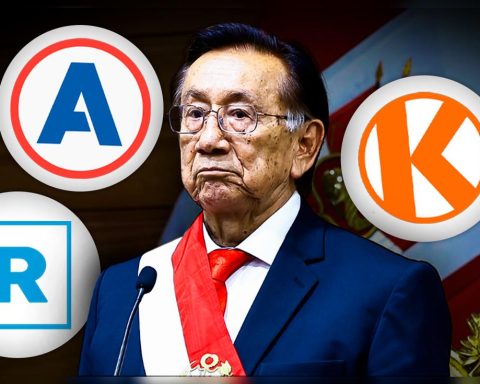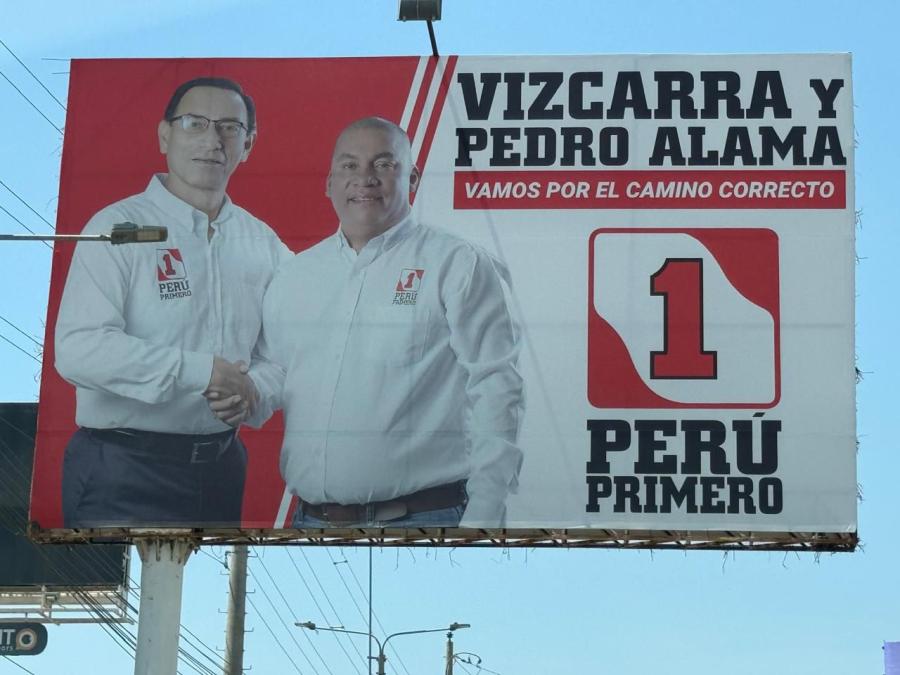
They are not candidates, but their political parties use them as workhorses to get a few votes in order to, at least, not lose registration after the general elections on April 12 of this year.
The most eloquent case is that of the former president Martin Vizcarraimprisoned and disqualified from holding public office, who continues to appear on posters and billboards of congressional candidates for Peru First.
There are also posters of the former mayor of Trujillo, Arturo Bazán Fernández, indicating that he is running for the presidency when, in reality, he is running for the vice presidency of the country; and posters and videos on social networks of Juanita de Urresti, wife of the convicted Daniel Urresti, who appears with her husband in Podemos Peru shirts, as if they were both running for public office.
Can the State do something about this misleading advertising?
DIFFERENT LOOKS
At the electoral level, specialist José Manuel Villalobos told Peru21 that “the electoral legislation does not provide for a sanction” for this type of behavior.
“There is no legal framework, it is not up to the National Elections Jury (JNE) to make a statement. If it makes a statement, the parties can take it as an interference. What these parties do is a campaign strategy that is not prohibited. The press, civil society can question it, but not the JNE,” he stated.
However, he maintained that, within the framework of the signing of the Electoral Ethical Pact, the JNE could make an exhortation in this regard, since the publication of these posters with characters who cannot be candidates deceives the electoral population.
In the field of consumer defense, lawyer Álex Sosa explained to Peru21 that there is a difference between political propaganda and commercial advertising. The second, he noted, is all types of communication that persuades consumers to carry out commercial transactions, and that is regulated by the Law for the Repression of Unfair Competition, approved by Legislative Decree 1044.
“But this rule only applies to competitive acts, that is, to commercial acts,” he said.
Political propaganda, he continued, is any type of communication that aims to persuade the election of a certain candidate or political party. That is a form of communication “that does not have a commercial nature, therefore, the law is not applicable to it and Indecopi does not have any type of interference.”
“Any complaint filed for misleading propaganda before Indecopi will be declared inadmissible,” he said.
Sosa said that until before the publication of the decree, in July 2008, there were “confusions” about whether Indecopi was competent or not. From that date “the consultation was settled by that jurisdiction.”
And in the criminal sphere? Criminal lawyer Luis Lamas Puccio told this newspaper that this aspect “has to be subject to control and supervision by the JNE.”
He said that the highest electoral body “has to take measures in this regard and, in addition, these candidacies may be the subject of some objection or objection by those who feel aggrieved by this type of advertising proposals that are false.”
“The JNE also has prerogatives to act ex officio,” he said.
Notwithstanding this, the jurist maintained that, in these cases, “indications arise regarding criminal liability regarding the handling of false information that possibly leads to liability regarding falsehood in general, not just ideological.”
“Publishing information that is false, that aims to deceive public opinion, the electoral population, showing facts that have no legal basis and that are false, can lead to ex officio intervention by the Public Ministry,” he stated.
Lamas Puccio explained that these processes could be opened, with respect to the candidates who spread false information, against those who allow their images to be disseminated in these terms and against the political parties themselves, which are legal entities “used to commit these crimes.”
Finally, he said that, in addition to the crime of falsehood, “other indications of other criminal responsibilities could also arise.”
“There is the responsibility of the different instances within the party in the sense of the criminal responsibility of the legal entity, because there are also the accessory consequences, which are intermediate sanctions between the criminal and administrative sanctions that apply to legal entities. There is the intervention, the raid, the dissolution or the temporary suspension of the activities that the legal entities are carrying out,” he concluded.