What is possible for the majority of citizens who are not in the Expocuba pavilions?
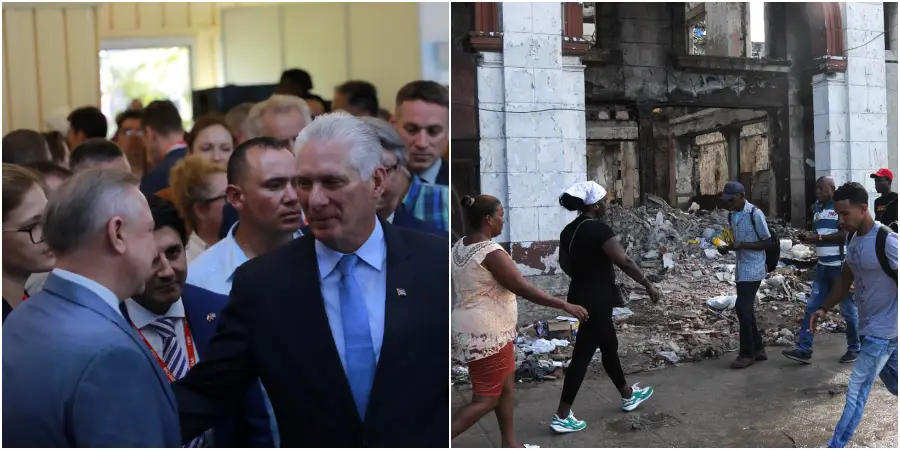
MIAMI, United States. – The XLI Havana International Fair (FIHAV 2025), which opened this Monday at Expocuba, is being presented by the Cuban Government as proof that “yes it is possible” to move forward after the Hurricane Melissa and in the middle of the economic crisis.
According to the Cuban News Agency (ACN)the deputy prime minister and head of the Ministry of Foreign Trade and Foreign Investment (MINCEX), Oscar Pérez-Oliva Fraga, defined the fair as “a declaration of will that it is possible, after the devastating passage of Hurricane Melissa”, in an event headed by Miguel Díaz-Canel and Manuel Marrero Cruz.
Pérez-Oliva’s message is part of the official speech of “creative resistance”. Despite the damage in the eastern provinces, the ACN summarizes its argument as follows: the trade meeting “was necessary” and “in the face of the criminal economic war imposed by the US government, the response has been not to paralyze us,” the deputy prime minister insisted. The official also stated that the fair is organized “for the benefit of the people, who have earned and deserve more prosperity, more well-being and more opportunities,” and that each step in terms of investment and exports should be “a step towards a better future.”
In the current crisis scenario, FIHAV appears as a showcase. According to the ACN, the 2025 edition brings together 715 companies from 52 countries, including 268 Cuban companies from different sectors and forms of management. The authorities highlighted the presence of official delegations from Venezuela, Russia, Mexico, Iran, Angola, South Africa, Saudi Arabia, Republic of the Congo, Panama, Zimbabwe and the Czech Republic, as well as regional integration organizations such as ALBA-TCP, the Latin American Integration Association and the Eurasian Economic Union. The ACN also highlights the assistance of “numerous Cuban businessmen residing abroad, committed to contributing to the economic and social development of their country.”
Pérez-Oliva presented the fair as “an expression of a country that resists, that creates and strives to move forward,” and maintained that “FIHAV is more than a commercial meeting point, it is a space where visions are shared, alliances are generated and opportunities are identified.” The 2025 edition is also dedicated to the centenary of Fidel Castro and the 65th anniversary of MINCEX itself, which reinforces the political-symbolic component of the event.
FIHAV 2025 is, in effect, a demonstration that the Cuban State still “can” organize large events, attract traditional political partners and project an image of dynamism abroad. The underlying question, however, is another: what is possible for the majority of citizens who are not in the Expocuba pavilions? Can you stop queuing for cash, electricity, food or medicine? Can they plan a business without fear of a sudden rule change? Can they live without depending on a remittance or leaving the country?
What you can’t
The inauguration of FIHAV 2025 occurs in a country that international organizations and analysts describe as having the worst economic situation since 1959 or even since independence. The Economic Commission for Latin America and the Caribbean (ECLAC) estimated a drop in Cuban gross domestic product (GDP) of around 1% in 2024 and foresees another decline, although slight, in 2025, after several years of stagnation and setbacks.
According to that same analysisthe economy has suffered a decade of low growth, high inflation, falling investments, chronic problems with electricity generation and a notable deterioration in living conditions.
Added to this is that, since 2019 – and according to official figures -, the economy has shrunk by around 11%.
In parallel, the Cuban peso is depreciating rapidly in the informal market: the currency reached a historic low of 450 pesos per dollar this month, in a context of partial dollarization that fuels inequality.
Daily evidence shows that the Cuban State fails to guarantee something as basic as sufficient food or minimally stable electrical service for the majority of the population. The international press itselfsupported by official figures, describes a crisis that combines food shortages, persistent inflation, prolonged blackouts and a general deterioration of essential services.
The ration book, which for decades functioned as a minimum safety net, no longer covers the needs of the month, and the Government itself has tried to reduce the number of people who receive subsidized food, from about four million books, according to official data. cited by AP.
Added to these shortcomings is the electrical crisis. In a single year there have been five national blackouts. Even outside of such total collapses, prolonged outages are part of the routine. In August 2024, blackouts of up to 14 hours a day were reported in large areas of the country, which left millions of residents “unprotected” against the heat and compromised the conservation of refrigerated food. Now they reach 20 hours a day or even exceed it.
The precariousness also reaches the daily financial system: right now there are long lines in front of banks and ATMs in Havana and other cities, where citizens wait early to try to withdraw cash, in a context of banknote shortages and a fragmented monetary system, with several exchange rates and key stores that operate in foreign currency.
The difficulty in accessing the cash necessary to buy food or other basic products thus adds to inflation and shortages, and reinforces the feeling that daily life has become an obstacle course.
The fall in economic activity is also perceived in internal transportation. In 2024, cargo traffic within the country plummeted 19%data that the state statistical system itself offers as an indirect indicator of the state of the economy. Less cargo moving means less production, fewer goods circulating and less capacity of the State to supply markets and services.
As for the private sector, the Government exhibits it at the fair as part of the national economic framework, but maintains close control. According to a bulletin from Caribbean Council Based on official data, by mid-2024 more than 11,000 private micro, small and medium-sized enterprises (MSMEs) were registered in Cuba and the non-state sector was already generating around 30% of employment and 55% of retail sales in value, in addition to contributing close to 23% of tax revenues. However, the same analysis warns that authorities had slowed down the approval of new MSMEs and strengthened the supervision and capacity of local governments to decide which businesses are authorized.
In short, the government’s “yes we can” has very clear limits: you can set up an international fair with hundreds of companies and foreign delegations, dedicate it to the centenary of Fidel Castro and proclaim that the economy is “the center of priorities.” Even the official media can also talk about a country that “resists” and “expressions of courage and resistance.” But, beyond the official “yes we can”, there is a long list of needs that the regime cannot – because it does not prioritize them as it does with the construction of hotels or because, ultimately, it does not want to – satisfy.