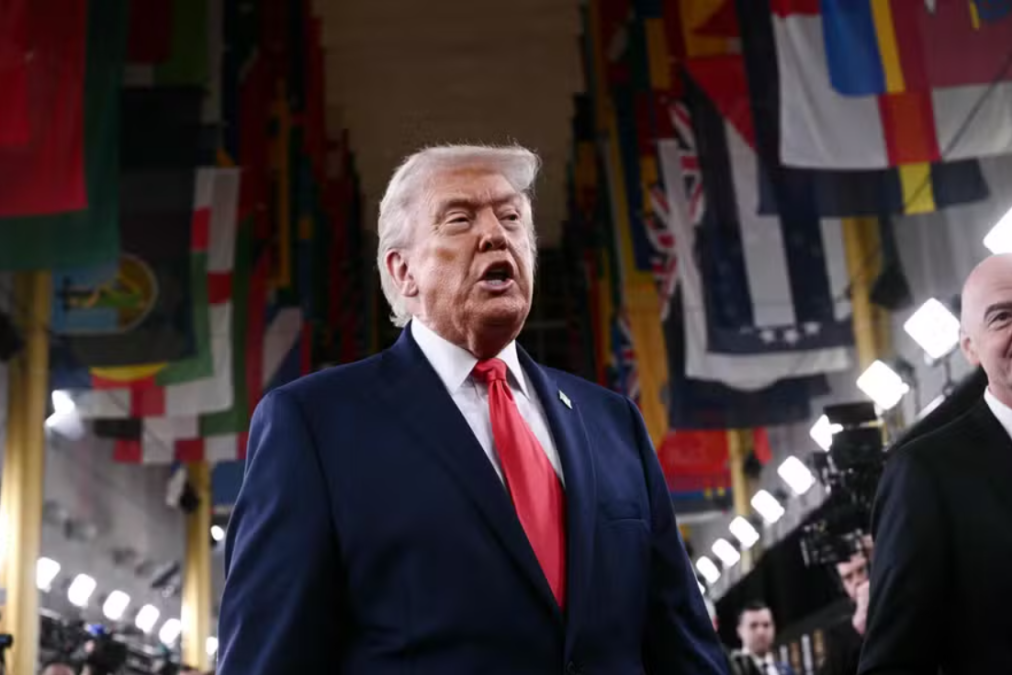
On December 4, the government of donald trump presented the new National Security Strategy (NSS), a document that redefines the global priorities of the United States and marks a turn with respect to the strategies issued by previous administrations.
The NSS functions as the official roadmap guiding foreign, military and national security policy, and this version emphasizes a return to a tougher, unilateral vision focused on the country’s internal interests.
One of the central axes of the new strategy is the absolute priority to the Western Hemisphere. The document openly recovers the logic of the Monroe Doctrine, pointing out that the United States must strengthen its influence in Latin America to confront migration, organized crime, drug trafficking and cross-border threats. The administration even proposes the expanded use of security tools—including more aggressive operations against cartels—and a more conditioned relationship with the governments of the region.
The strategy also toughens the immigration posture and elevates border control to the level of “vital strategic interest.” The text states that “the era of mass migration must end,” placing migration management as one of the pillars of national security. This includes stricter internal measures and also greater diplomatic pressure on sending and transit countries, seeking to reduce migratory flows to the United States.
Finally, the NSS proposes a readjustment of the global role of the United States. The strategy reduces the priority on the Middle East and regions where Washington was deeply involved in previous decades. Instead, it aims to strengthen economic competitiveness against China, secure critical supply chains, attract strategic industries and redefine the relationship with Europe, which it criticizes for its immigration management and for relying too much on American protection.
With all this, the Trump administration proposes a geopolitical map with a more economic, more regional and less multilateral focus.
GLOBAL INTERVENTION
The internationalist Carlos Novoa Shuña maintained that, in the document, the United States wants to reinforce “this tacit position of world domination.”
“I don’t think it is a major shift towards Latin America, but rather it emphasizes reinforcing Latin America as its backyard and emphasizes that it cannot allow leftist governments to spread there,” he declared to Perú21.
He added that at this moment Trump is “the great president of the right and has a personality in which he believes he is the messiah, the policeman of the world, and is reinforcing his position of dominance towards Latin America.”
“It is a matter of theory rather than practice, more talk than action; and it has declared that Europe’s dominance is coming to an end,” he continued.
Novoa explained that, globally, “we are moving towards a new international order” in which China is growing and the US is striving to postpone its dominance.
“Europe has its own problems with the issue of internal migration, which has reduced the welfare state for the vast majority of migrants from Africa and Muslim countries, which has produced social changes that the right has taken advantage of,” he said. Trump’s speeches, however, “are populist par excellence.”
“In the Middle East we cannot speak of democracy because Syrians, Palestinians and Lebanese are organized by family clans that have centuries of dominance. Israel is the only democracy,” he clarified.
And in what order is Peru? Novoa said that our country is affected “from a policy perspective against illegal migrants, from an economic perspective, because countries have to comply with the precepts or official positions that Trump has implemented. So, Peru, as a State, ‘is behaving well,’ it does nothing to anger Trump, as Colombia has done, for example.”
In that sense, he added that, if the US has to pressure any government to set up military bases or for its troops to pass through, it will do so, as in fact it has been doing with Caribbean countries.
For his part, fellow internationalist Francisco Belaunde Matossian pointed out to Peru21 that the NSS is “an officialization of the policy that the US is already imposing,” which contemplates “greater control over Latin America wrapped in the issue of the fight against drug trafficking,” but which, in reality, “has to do with fighting against the influence of China.”
The document, he assured, “hints that they could intervene in all countries where there is drug trafficking, such as Colombia and, who knows, even Peru.” Belaunde said that the next Peruvian government could claim to have problems fighting drug trafficking and ask the United States for help to send drones to destroy drug trafficking laboratories. He recalled that in Brazil the son of former president Jair Bolsonaro, who will run for president, asked Trump to send drones for that purpose.
“So, it is not that the US government intervenes internationally, but that it could receive requests from countries like Ecuador, like Peru to support the fight against drug trafficking, not only in financial matters or with radars, but with some bombing of laboratories where cocaine is produced. Anything is possible,” he said.
Regarding Europe, Belaunde said that the US sees the European Union “as an enemy” and that it is in favor of far-right parties that fight against migration even if deep down they reveal “a kind of racism.”
Finally, he stated that he is concerned about “that carte blanche that Trump wants to give himself to intervene in Latin America whenever he wants and also about Europe.”
“Before, there was talk of US imperialism, which many people on the left already exaggerated, like Evo Morales. But here there is clearly a kind of imperialism that seeks to impose what they consider values. Before, the US acted in favor of democracy, but now it says that it wants a Europe free of migrants and that they are in favor of parties that they call patriotic, that are extreme right and that collide with democracy. That is something worrying. And it is curious because it was said that Trump was looking for a isolationism, but that is no longer the case, now it is intervening in several countries, which is a violation of the principles of international law. It is an ideological conquest of the world and, above all, in Europe, which is part of Western civilization… The most worrying thing is the totalitarian vision of the United States. It is no longer the Soviet Union with the totalitarian vision, but the United States,” he concluded.
RECOMMENDED VIDEO