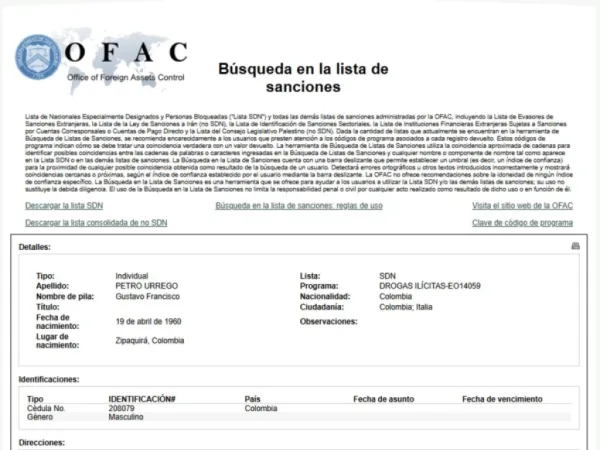
Gustavo Petro became this Friday the first sitting president of the country to be included by the United States Government in the List of Specially Designated Nationals and Blocked Personsalso called Clinton List.
According to the Office of Foreign Assets Control (Ofac)attached to Treasury Department of the North American country, the inclusion of the name of the head of state is due to the inaction that, as mentioned, the current Government has had in the fight against drug trafficking, based on the current figures of coca crops.
Scott Bessent, US Secretary of the Treasurysaid: “Since President Gustavo Petro came to power, cocaine production in Colombia has skyrocketed to record levels, flooding the United States and poisoning its citizens. President Petro has allowed drug cartels to flourish and has refused to stop this activity. Today, President Trump is taking strong action to protect our nation and make clear that we will not tolerate drug trafficking.”.
(Further: The US officially includes President Gustavo Petro on the Clinton List).
Drug trafficking
Colombian National Army
The news comes in a context of sharp deterioration in bilateral relations between Bogotá and Washington, traditionally close in trade, military cooperation and economic assistance. Since the return of donald trump to the White House in January, this historic bond is going through one of its most critical moments in decades.
The tension worsened last Sunday, when the American president accused Gustavo Petro of being “a drug trafficking leader” and announced the suspension of financial aid to Colombia, arguing an alleged lack of results in the fight against drugs.
What is the Clinton List?
Officially called List of Specially Designated Nationals and Blocked Personscreated in 1995 under the government of Democrat Bill Clinton, It is a consolidated entity administered by Ofac, attached to the United States Department of the Treasury..
This entity has broad powers to freeze assets, block financial operations and restrict US citizens or companies from establishing commercial relationships with individuals or groups included on the list.
(Besides: ‘The threat was fulfilled’: Petro on his inclusion on the Clinton list).
When a person or entity is included on this list, Their assets in the United States are blocked and US citizens or companies are generally prohibited from transacting with them..
In the case of President Petro, who has been included in the list, it would not affect the State’s shareholding in companies where there is state participation that have businesses or assets tied to the United States, as in the case of the oil company. Ecopetrol, but to all operations and businesses subject to the US market that the current head of state has in a personal capacity.

President Gustavo Petro
Mauricio León / Portfolio
“It is not that because he is the president, he is the majority owner of the companies or entities of the State. No. If not, the sanctions will be subject to the person and the shareholdings that one can corroborate.“, he explained to Portafolio Juan David López, foreign trade partner at Baker McKenzie Colombia.
And he added: “When a United States government includes people, organizations, countries, companies within this list, no North American company can carry out transactions with those companies. What happens if you make transactions? They can impose economic sanctions of up to 1,000 million pesos, about 250,000 dollars; It can block the assets of North American companies that carry out operations; They can prohibit transactions with certain people and the issue can even end in criminal sanctions for these companies.“.
(Further: The tax collection would have cost another Dian director his head).
It is worth mentioning that the US Congress does not have the power to add names directly, but it can promote laws that force the Treasury to evaluate the inclusion of certain actors, or that condition the Executive to act when certain parameters are met. In practice, these types of provisions operate as a political mandate that is usually executed by OFAC..
However, the intervention of the US Legislature is not a requirement, since both the Treasury Department and Ofac itself can make designations autonomously, without prior authorization from Congress, when they consider that there are sufficient grounds to apply sanctions.
PORTFOLIO