The Peace Council proposed by Donald Trump is presented as an alternative to the United Nations, which aspires to resolve conflicts in the world
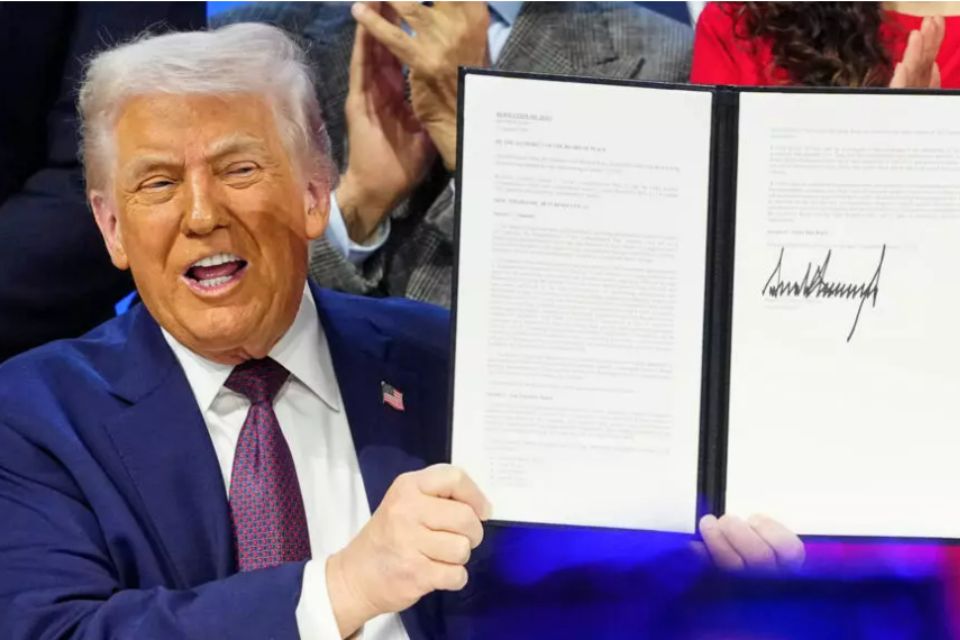
Donald Trump took advantage of the Davos Economic Forum, this Thursday, January 22, to officially launch his “Peace Council”, whose ambition is to work towards the resolution of conflicts in the world. The draft letter, disseminated in the media, outlines the contours of an initiative largely controlled by the American president, who would be its top person.
What will this “Peace Council” be used for?
Initially, the White House had announced the formation of a “Peace Council,” chaired by Donald Trump, as part of the plan to end the war in Gaza, a conflict that is not mentioned in the text of the letter. But if we go by this eight-page text, the mandate is much broader. “In my opinion, it will start with Gaza and then continue with conflicts as they arise,” President Donald Trump told Reuters in an interview earlier this week.
This “Peace Council” is presented rather as an alternative to the United Nations, which aspires to resolve conflicts in the world. “The Peace Council is an international organization that aims to promote stability, restore reliable and legitimate governance and ensure lasting peace in regions affected or threatened by conflict,” the preamble reads.
For historian Chloé Maurel, a UN specialist, this initiative is “clearly a way of evading the UN, of overlooking its authority and emptying it of its essence.”
Between the lines, there appears a thinly veiled criticism of the UN institution, calling for “the courage to move away from approaches and institutions that have too often failed” and underlining “the need for a more agile and effective international peacebuilding organization.”
*Read also: RSF claims that Trump is becoming one of the worst predators of the press
How would it work?
The letter states that “Donald J. Trump will be the first president of the Peace Council.” And his powers seem very broad. Firstly, he is the only one empowered to “invite” other heads of State and Government to join the Council and can decide to dismiss them, except in the case of “veto by a two-thirds majority of the Member States.”
On the other hand, “decisions are made by a majority of the Member States present and voting,” but “subject to the approval of the president.” Likewise, in the event of a tie, the president would have the power to arbitrate. He is also responsible for appointing his successor. “The replacement of the president can only take place following a voluntary resignation or due to incapacity, as determined by a unanimous vote of the executive committee.”
This restricted executive council, also led by Donald Trump, would be made up of seven members, all of them Americans, with the exception of former British Prime Minister Tony Blair, among whom are Secretary of State Marco Rubio, special envoy Steve Witkoff and Donald Trump’s son-in-law, Jared Kushner.
“In the eight pages of the statute, the word ‘democracy’ is not mentioned even once, which is eloquent,” says Chloé Maurel, who highlights that, in this structure, “Trump would be a kind of president for life, with the right to veto all decisions.”
The mandate of the States is three years, renewable by Donald Trump, except for those who pay one billion dollars upon entry, thus obtaining a permanent position. “This ‘Peace Council’ is the complete opposite of the ideal of democratic and egalitarian multilateralism as defined in 1945 with the creation of the UN. In the UN General Assembly, the historian recalls, almost all States are represented, and each one, whether rich or poor, has one vote.”
Which countries have already responded favorably?
Of the sixty invitations to be part of this “Peace Council”, some States have already given their agreement. Among them, many leaders of Arab countries. The King of Morocco, Mohamed VI, will join the council as a “founding member”, according to Moroccan diplomacy. The Egyptian president, Abdel Fattah al-Sissi, the president of the United Arab Emirates, Sheikh Mohammed ben Zayed Al Nahyane, and the king of Bahrain, Hamad ben Issa al-Khalifa, will do the same. Qatar, Saudi Arabia and Kuwait would also participate.
Benyamin Netanyahu also responded favorably to the invitation, the Israeli prime minister’s office announced on Wednesday. The Argentine president, Javier Milei, declared that he signed the document with Trump as a founding member of the Council.
Türkiye has indicated that it will respond favorably. The president of Kazakhstan, Kassym-Jomart Tokaïev, “will attend the signing ceremony” of the letter, according to his press service on Wednesday. In Azerbaijan, the Ministry of Foreign Affairs announced on Tuesday that President Ilham Aliyev was “ready to participate in the activities of the Peace Council.”
The president of Kosovo, Vjosa Osmai, also accepted the invitation, described as a “historic initiative.” In Hungary, Prime Minister Viktor Orbán accepted on Sunday the “honorable” invitation of his ally Donald Trump to be a “founding member” of the “Peace Council.” Armenian Prime Minister Nikol Pashinyan stated on Facebook on Tuesday that he had accepted the invitation.
Which countries have been most reluctant?
Several countries have expressed their distrust of this organization. Starting with France. President Emmanuel Macron’s entourage indicated on Monday that he “cannot give a favorable response” to the invitation at this time. This initiative “raises important questions, in particular regarding respect for the principles and structure of the United Nations, which cannot in any way be called into question.” The same goes for Norway.
Ukrainian President Volodymyr Zelensky said on Tuesday that he had received an invitation, but that he “can’t imagine” participating alongside Russia. Vladimir Putin has instructed his Government to “study” the proposal.
The British Government declared this Thursday that it will not participate. “This is, in effect, a legal treaty that raises much broader issues, and we are also concerned that President Putin is part of an organization that talks about peace, when we have not yet seen any signal from him indicating that he will commit to peace in Ukraine,” declared the head of diplomacy. The president of the European Commission, Ursula von der Leyen, has also been invited and is reserving her response, a spokesperson in Brussels said on Monday.
The German Government has expressed the need to “coordinate” with its partners. Croatian Prime Minister Andrej Plenkovic has said he wants more time. China has not said whether it accepts it, although it indicated on Wednesday that it “firmly defends the international system with the United Nations at its center.” In Canada, Foreign Minister Anita Anand told AFP: “We are examining the situation. But we are not going to pay a billion dollars.”
“The UN must react quickly,” says Chloé Maurel, who calls for the convening of an extraordinary General Assembly. Other countries that have indicated they have received an invitation include Italy, Sweden, Finland, Albania, Greece, Slovenia, Poland, Bulgaria, Brazil, Paraguay, Jordan, India and South Korea. The Vatican has also received an invitation.
*Journalism in Venezuela is carried out in a hostile environment for the press with dozens of legal instruments in place to punish the word, especially the laws “against hate”, “against fascism” and “against the blockade.” This content was written taking into consideration the threats and limits that, consequently, have been imposed on the dissemination of information from within the country.
Post Views: 77