The first version of Sheinbaum’s Water Law
At the beginning of October of this year, President Claudia Sheinbaum presented an initiative to issue the General Water Law and modify the National Water Law, with the intention of changing the regulation of water concessions so that they are not used for unauthorized purposes.
According to this version, the National Water Registry would be created with tools to control and make transparent the regime of concessions and allocations of this resource. In addition, the term “water responsibility” was also added for responsible management and good practices of the water authority, concessionaires, permit holders and users in general to improve the management, exploitation and reuse of national waters.
With this, sanctions were increased with fines between 20,000 and 50,000 Measurement and Update Unit (UMA), which in national currency is 2 to 5 million pesos; to those who change the use of the water for which it was concessioned, transfer the concession titles and permits and, to those who assign, supply, exchange for payments (whether in kind) for the partial or total use of the water.
Other details of the proposal are the creation of a national water reserve fund for the reallocation of water volumes and recovering the use of wastewater.
The proposal was made with a consultation in 13 forums in which “different sectors” were heard, in order to end the “black market” in which water is over-concessioned.
Mauricio Rodríguez Alonso, deputy director general of Water Administration, reported that after an analysis of 482,014 concession titles, 58,938 inconsistencies were found, several of alleged falsification or use of water other than the permitted activity.
As such, the president pointed out that this strategy was to “bring order and stop seeing water as a commodity” when it is a scarce resource and the State is the one who has the power to grant concessions.
(HERIKA MARTINEZ/AFP)
Farmers rejected the proposal because it was regressive
After the announcement, the population of the agricultural sector and farmers showed their discontent with the law, because it prohibits the transmission of water concessions and creates uncertainty in the heritage, because the lands, by themselves, lose their value without the permission to use the water resource.
Whether by sale between individuals or by inheritance, these transmissions sustained production from generation to generation.
For Baltazar Valdez Armentia, president of Campesinos Unidos de Sinaloa, the proposal affects the rights of farmers under the argument that there is corruption when granting concessions.
“The law is regressive, instead of increasing rights on the part of water users, in this case, it goes back and sanctions on the pretext that there is too much corruption in water management.
Later, the president rejected that the modifications to the National Water Law prohibit inheriting the concessions, but rather they are to put an end to the hoarding that began in 1992.
“Now they are trying to say that an ejidatario will not be able to give that water to his children, if he has a well on his plot, false. Of course it can be done, but what is no longer that hoarding,” he said.
He explained that ending the sales of concessions responds to the fact that the owners receive a benefit for a resource for which they did not initially pay because it was under irrigation use.
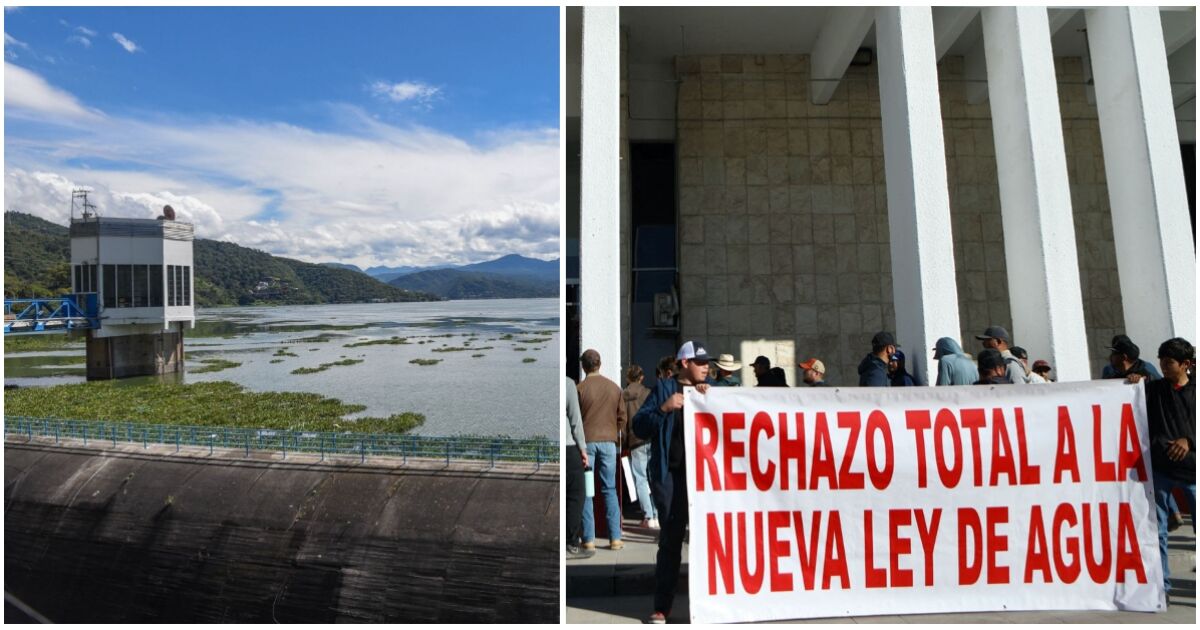
However, the farmers carried out blockades in several states in rejection.

(HERIKA MARTINEZ/AFP)
Key and controversial points
Concessions and transfers of rights: New mechanism for “reregistration” of permits generates doubts among producers and fear of losing certainty about the use of water on their lands.
More powers of the authority: Agencies may reduce or cancel concessioned volumes in contexts of low availability, a situation that is worrying for maintaining crops.
Fight the “black market” of water: Stop the irregular sale and purchase of concession titles and strengthen control of water use and for what.
Recognition of community systems: Specific rules for systems administered by peasant and Afro-Mexican communities.
New sanctions and responsibilities: Tightening penalties for illegal extraction, diversions or pollution, and the new concept of “water responsibility” for good practices.
Indication of “centralism” and lack of consultation”: The opposition argued that indigenous communities and the productive sector were not adequately consulted.
Changes and their approval
After multiple demonstrations and protests from the agricultural, peasant and even transport community, the legislators of Morena and allies made 50 modifications, including the separation of the land-water binomial, as well as the inheritance of properties.
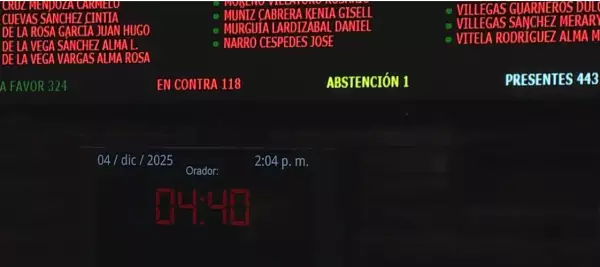
The Chamber of Deputies endorsed the law on December 4 after 24 hours of discussion and sent the minutes to the Senate for approval, granted shortly thereafter. In both votes, with a large difference of votes against.
Despite the demonstrations, the Secretary of the Interior highlighted that several organizations celebrated the approval of this initiative and dialogue tables will be held with producers and farmers to clear up doubts.
On the other hand, there are indications that there are no more resources to carry out the new functions in the water sector.
“There is a weakness: there are not enough resources for the water sector to be able to meet the goals established by both the National Water Plan and the infrastructure needs of the country,” commented Raúl Rodríguez, president of the Water Advisory Council with Political Expansion.
With information from Yared de la Rosa and Lidia Arista