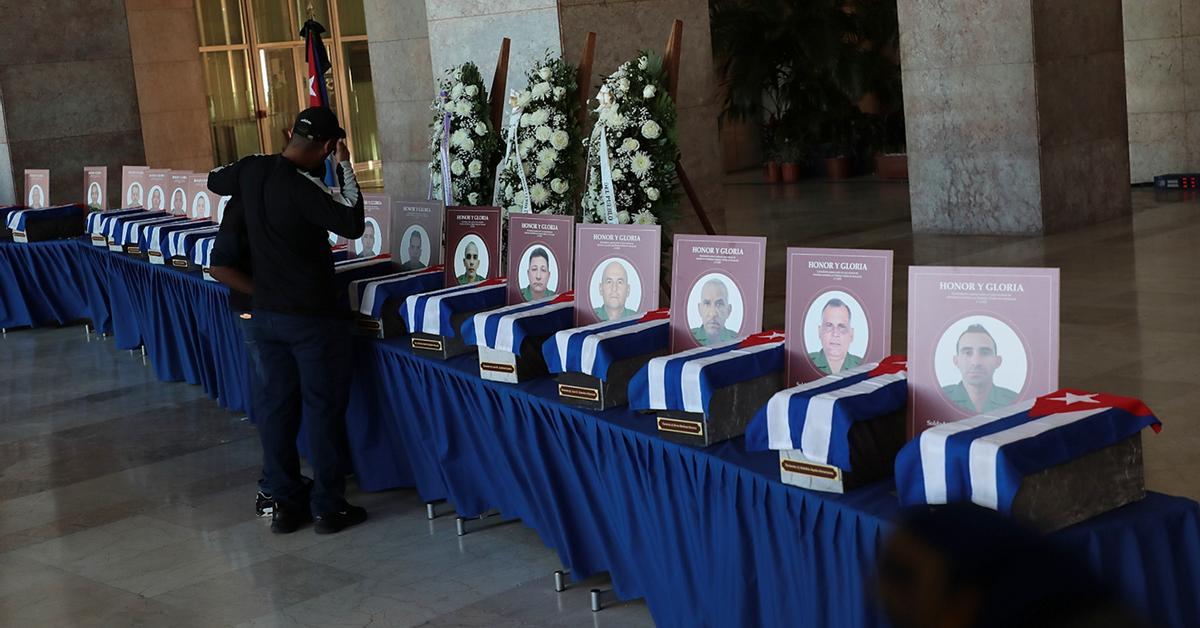
Havana/The Cuban regime has tried to close the debate on the island’s military presence in Venezuela by resorting to a slogan: “honor and glory.” However, the biographical sheets disseminated by official media about the 32 Cubans dead On January 3 in Venezuelan territory they opened more questions than they closed. A careful examination of these profiles allows us to reconstruct the effective composition of the contingent and, from this, approximate the real nature of the mission they carried out.
Of the deceased that Cuba officially recognizes, 21 belonged to the Ministry of the Interior and 11 to the Revolutionary Armed Forces (FAR). According to the updated list, within the Interior group, at least 18 were officers. Three senior officers are identified, with the ranks of colonel and lieutenant colonel, four majors and eleven junior officers, between captains and first lieutenants. Only three were non-commissioned officers. The result is a contingent with a disproportionate weight of command staff and professional personnel, a structure that is hardly compatible with a unit conceived for direct combat, but consistent with a system that prioritizes political loyalty over military effectiveness.
The biographies of these officers also do not refer to trajectories linked to line infantry or assault units. The vocabulary used insists on notions such as “discipline”, “loyalty”, “fulfillment of assigned missions” and “political example”, a rhetoric closer to State Security bodies than to operations on the ground. Everything indicates that a significant part of the contingent was oriented towards control, supervision and information gathering functions, not towards confrontations in open combat scenarios.
The facilities – including Nicolás Maduro’s own bunker – proved to be highly vulnerable
The profile of the personnel from the FAR reinforces this reading. Of the 11 soldiers, only one held the rank of officer and one of non-commissioned officer. The remaining nine were soldiers and reservists, several of them returning after extended periods of civilian working life. The mobilization of reservists with defined occupations is common in technical and logistical support tasks, but is unusual in high-intensity operations against well-trained forces.
The official files themselves emphasize that aspect. Instead of highlighting military training or combat experience, they meticulously detail the civilian trades and technical specialties of these soldiers. There are bricklayers trained in polytechnic education, automotive mechanics, drivers, operators of light equipment and loaders, transportation technicians and maintenance personnel. In at least seven cases, his experience in camp repair and maintenance, operation of theater equipment, or engineering conditioning of the theater of military operations is explicitly mentioned.
In Cuban military doctrine, inherited from the defunct Soviet Union, “engineering conditioning” refers to the physical preparation of the terrain and facilities, such as fortifications, shelters, protected structures, defensive positions and other infrastructure designed to resist attacks. For this type of tasks, precisely the profiles that appear repeatedly in the sheets are used. Even so, the facilities they were supposed to protect – including Nicolás Maduro’s own bunker – proved to be highly vulnerable.
The mission was less aimed at effectively protecting Chavista leaders against well-trained external enemies, and more at monitoring, supporting and protecting the regime.
If institution, rank and specialty are crossed, the classification of the contingent is eloquent. Between 15 and 17 of the 32 deaths can reasonably be linked to personal security, escort and control functions, almost all of them officials of the Ministry of the Interior. At least seven played command and coordination roles, typical of senior and intermediate officers. Between eight and nine were clearly associated with technical support, infrastructure and logistics, mostly FAR soldiers and reservists with specific civilian jobs. The rest correspond to generic military profiles, but in no case do they make up a majority of combatants sufficiently prepared to face elite troops.
Another element that is usually left out of the official story and external analyzes is the burden of social coercion that surrounds the so-called “internationalist missions.” In a country marked by precariousness and sustained impoverishment, leaving Cuba – even at great risk – becomes a powerful incentive. For many citizens, accepting a mission abroad does not respond to an ideological impulse, but rather to a survival strategy in the face of the misery that their families suffer within the Island.
In this context, the Cuban contingent killed in Venezuela does not seem to have been, for the most part, an effective combat force, but rather a combination of political security and technical-military support, made up of officers of the control apparatus and personnel selected for their practical skills rather than their war capacity. That reality clashes head-on with the epic narrative spread from Havana and in which Maduro probably believed.
Some analysts also maintain that the mission was less aimed at effectively protecting Chavista leaders against well-trained external enemies, and more at monitoring, supporting and protecting the Venezuelan regime based on the strategic interests from Cuba.