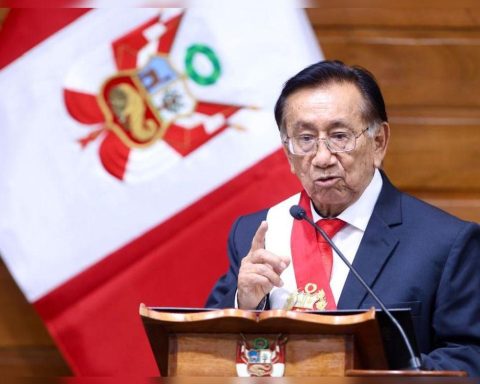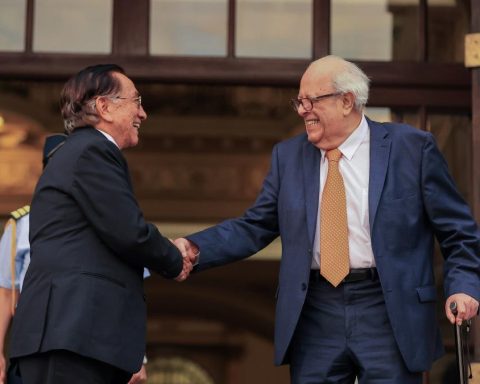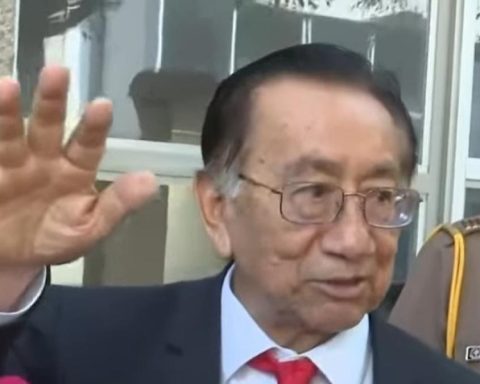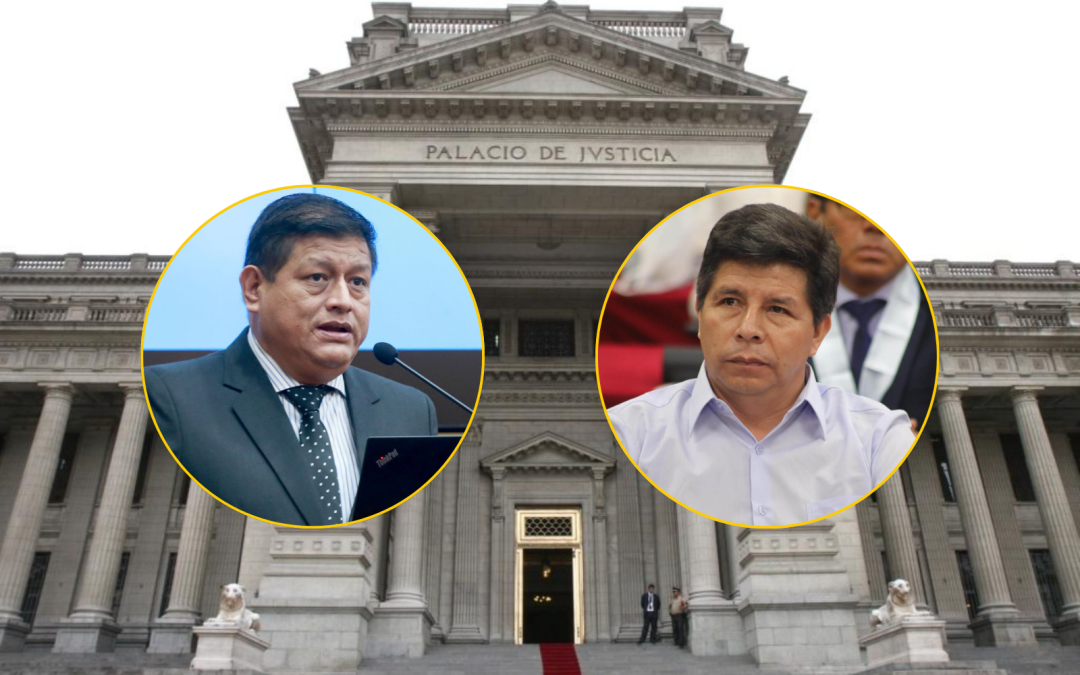
An unexpected appointment has shaken the corridors of the Judiciary: Walter Ayalaman near Pedro Castillo, he was appointed supernumerary judge in the Superior Court of Pasco since the 1st of this month.
The decision has generated controversy, as Ayala faces a fiscal investigation and a constitutional complaint in Congress for alleged favor in the promotions of police officers and the Armed Forces. This case opens a key question: what is the role of a supernumerary judge and a provisional judge?
According to the constitutionalist Aníbal Quiroga, a supernumerary judge – as in the case of Ayala – is, in practice, a substitute. He is not the holder and his permanence depends directly on the decision of the president of each court.
What does supernumerary mean?
The term supernumerary comes from the Latin supernumerarius. According to him Dictionary of the Royal Academy of the Spanish Language (DRAE)as a noun, is what exceeds or is outside the established or appraised number. In accordance with the above, as an adjective, the DRAE records the supernumerary adjective as “said of a military, of an official, etc.” who is in an analogous state to that of “leaves.”
The expression “Supernumerary Judge” has been adopted by the judicial system to call that lawyer appointed as a temporary judge (judicial officer) to cover the places that cannot be covered by the titular magistrates.
The role of supernumerary and provisional judges in Peru
“The supernumerary judges are street lawyers, selected by the upper courts to cover vacancies when there are no provisional judges available. They were previously called alternate judges,” said Quiroga.
In contrast, he recalled that the titular judges are those appointed in accordance with the Constitution: “Judges of lawyer, first instance, superior and supreme in all specialties. Its designation is granted by the National Board of Justice, after a contest, which gives them stability and legitimacy in office.”
Regarding the provisional judges, he indicated that they are less rank magistrates who temporarily assume a superior position due to their age, although without having passed by contest. “This provisionality would have to be brief, from a week or a month to much, but for 25 years it has become a permanent practice,” he warned.
Quiroga calculated that 40% of the judges in the country are provisional. “In the Supreme Court, the law establishes three rooms with 18 titular magistrates. However, 10 rooms with 50 supreme judges work. All difference are provisional higher vowels,” he said.
That problem, he said, is replicated in the upper courts: “Therefore, in Pasco a character as questioned as Walter Ayala, with serious investigations of the time of Castillo and author of amparo processes against the appointment of magistrates of the Constitutional Court.”
The law of the judicial career terminates termologically between the provisional judge and the supernumerary judge. The provisional judge is a titular judge who occupies a higher level immediately to the position where he is appointed and who assumes provisionally before the vacancy, license or impediment of the magistrate who was in said Superior Plaza. The supernumerary judge is a lawyer who assumes the position of judge without being the holder.
Both are temporary charges but the difference between one and the other is that the provisional judge is the titular judge who serves as his hierarchical superior in the immediate level to him; The supernumerary judge is the lawyer who serves as a titular judge.
The risk of a supernumerary judge
Quiroga stressed that supernumerary judges lack independence, as they depend on their superiors. “They are one hundred percent digited by the president of each court of justice. The National Board of Justice must fulfill its pending task. The competitions are delayed, and that prevents having titular judges, generating gaps that are filled with supernumeraries and provisional ones,” he said.
As reported Peru21being supernumerary judge, Ayala can be removed at any time by decision of the president of the Superior Court of Pasco, Ricardo Samuel del Pozo.
Ayala in the sight of the Prosecutor’s Office
Ayala faces fiscal investigation for alleged irregular promotions in the Police and the Armed Forces during his management as Minister of Defense in the Castillo Government.
In addition, in the same case, it has a constitutional complaint in Congress. It was already approved in the Permanent Commission and will soon be debated in the Plenary. If approved, it could lead to the lifting of its political prejudice and a formal accusation of the Public Ministry.
The new judge of the Pasco Appeals Room still maintains links with the surroundings of Castillo. On August 5, he shared on his Facebook a post of Cledin Castillo, nephew of the former president, in which together for Peru he announced his alliance with the party all with the people for the next elections. Asked about a possible Senate postulation as a guest of JP, Ayala did not respond.
He was Minister of Defense between July 29 and November 15, 2021, until the scandal of military promotions precipitated his departure. An aspiring effective collaborator claimed to have delivered 40 thousand dollars to the then secretary of the Palace, Bruno Pacheco, as part of those promotions.
An audio was even disseminated – known as the “Audio de la Alita” – in which a voice attributed to Ayala says: “Bruno, take me my can of that money.” He, however, denies it.
Constitutional complaint
In the next few days the constitutional complaint against Ayala must be voted in Congress.
Faced with the questions, the constitutionalist Natale Amprigo pointed to Peru21 that the president of the Superior Court of Pasco could withdraw the trust at any time. “Your designation has no temporality. They can take it out at any time,” he explained.
If, the president of the JNJ, Gino Ríos, would have to go to Congress to explain whether he had knowledge of the appointment, although – in practice – it is a confidence decision taken by Del Pozo.
The Popular Renewal Congressman, Ezra Medina, advanced to this newspaper that he will ask the headlines of the JNJ and the Superior Court of Pasco in the Justice and Constitution commissions, to explain how supernumerary judges are being designated in the country and, in particular, how the arrival of Walter Ayala was completed.
For now, the outcome of this story remains open.
Receive your Peru21 by email or by WhatsApp. Subscribe to our enriched digital newspaper. Take advantage of discounts here.