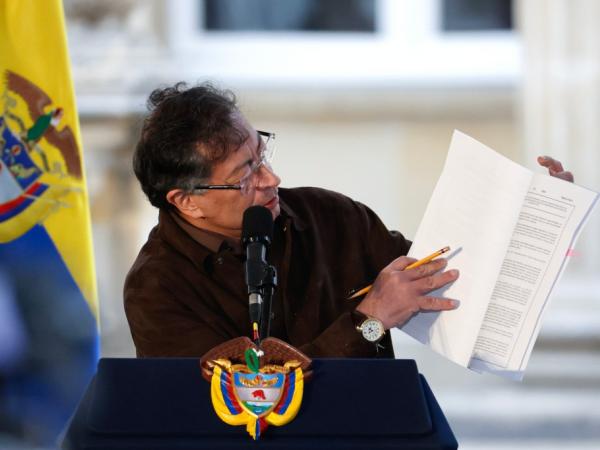
The government of President Gustavo Petro announced, this Thursday, October 23, a bill to convene a National Constituent Assembly. The draft, revealed by the Minister of Justice, Eduardo Montealegre, includes the articles, the questions that would be put to a vote and a point that has aroused special controversy: the delivery of extraordinary powers to the President of the Republic.
See also: (Petro Government presents project to convene a National Constituent Assembly)
According to the document, the project seeks for Congress to “give the President of the Republic specific extraordinary powers, p“or a period of six months from the publication of the law”. These powers would allow it to issue regulations with the force of law to define:
1. The requirements that the delegates of the Constituent Assembly must meet.
2. The definition of the population groups that will be represented.
3. The internal rules of the democratic mechanisms with which each group will choose its candidates.
This article, included as a paragraph in the second point of the draft, has generated concern among jurists and political sectorsespecially because it occurs in a pre-electoral context. Some analysts warn that it could be interpreted as a concentration of power in the Executive, while members of the cabinet, including Montealegre, have promoted the idea of a possible presidential re-election.
In addition to its political impact, the project gives the Government a campaign speech around the dichotomy between “continue” and “change”at a time when the country is preparing for a new electoral cycle.
See also: (How easy is it for a National Constituent Assembly to be approved?)
Scope of the Constituent Assembly
President Gustavo Petro
EFE
The draft establishes that the Constituent Assembly will be able to reform the entire Political Constitution, although without being able to revoke Congress. It also sets clear limits: it must respect international treaties on human rights, the norms of international law (Ius Cogens) and the principles of non-regression in fundamental and social rights.
The project contains 11 articles, which define the operating time of the Assembly, the referendum questions and the electoral process. According to the text, the Assembly will meet for three months, counting from its installation, which will occur 30 days after the official declaration of the election of its delegates by the National Electoral Council (CNE).
The questions that would be put to a vote
The project proposes that citizens answer two questions at the polls:
Do you agree to convene a Constituent Assembly that will meet for three (3) months, counting from its installation, which will take place thirty (30) calendar days after the declaration of the election of its delegates by the National Electoral Council, with the following characteristics?
It will be made up of 71 delegates elected by popular vote, distributed as follows: 44 by national constituency, 2 by the Afro-descendant people, 2 by the indigenous people, 2 by the peasant people, 2 by the victims of the armed conflict, 2 by the unions, 2 by the youth, 2 by the Rom people, 2 by the Raizal and Palenquero people, 6 by Colombians abroad, 2 delegates from mothers head of family and 3 delegates from the LGBTIQ+ people.
In all cases, half of the delegates must be women.
Do you agree with the Constituent Assembly reforming the entire Political Constitution, not revoking Congress and having as limits the previous commitments on human rights, the norms of Ius Cogens and the principle of non-regression in matters of social rights?
PORTFOLIO
*Information taken from EL TIEMPO