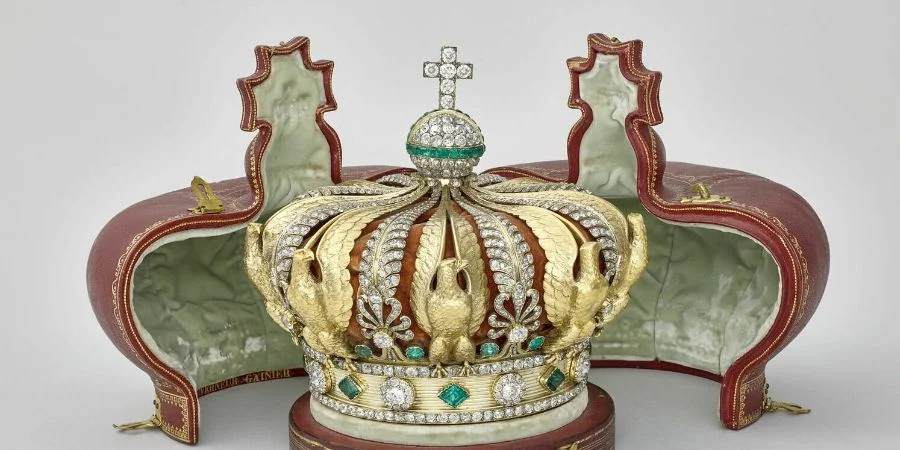
Eugenia de Montijo’s crown was stolen from the Louvre last Sunday, but fell during the thieves’ escape and was found damaged in the vicinity of the museum.
MIAMI, United States. – The crown of Empress Eugenia de Montijo – an emblematic piece of the Second French Empire – was the target of the theft that occurred this October 19 in the Apollo Gallery of the Louvre Museum. That crown entered the Louvre as a donation from the Cuban art collector Roberto Polo in 1988, who confirmed it to CubaNet in an interview from May 2023.
Also the Napoleon Foundation and the Louvre’s own collections system They recognize Polo and his wife as donors of Eugenia de Montijo’s crown.
On the day of the assault, four thieves entered through a window of the Apollo Gallery and broke display cases with mechanical tools. Eight jewels remain missing; Eugenia’s crown was taken but fell during the flight and appeared damaged nearby. The temporary closure of the museum and the criminal investigation were left in the hands of a specialized unit. INTERPOL confirmed on October 21 that eight objects remain in its database of stolen works.
The Paris Prosecutor’s Office estimated the economic value of the set of jewelry stolen in the October 19 assault at 88 million euros. The Louvre and the authorities, however, emphasize that its historical value is “inestimable.” There is no recent and specific public appraisal for the crown of Empress Eugenie, but its composition – gold with 1,354 diamonds, 1,136 “roses” (rose cuts) and 56 emeralds – and its authorship are recorded (Alexandre-Gabriel Lemonnier, 1855).
The crown was recovered outside the museum, after falling during the thieves’ escape, and has damage confirmed by the French Ministry of Culture. The French specialized press precise that appeared “deteriorated”, without the extent and exact nature of those defects being publicly detailed so far. The other eight stolen pieces are still missing, according to INTERPOL.
In interview with CubaNetRoberto Polo himself declared: “I donated the fuseau vase of Madame Mère that Napoleon had commissioned from the Sèvres manufacture and, later, the crown of the Empress Eugenie, the only one in existence of a French monarch with all its original stones, as well as [el óleo sobre lienzo] The worship of the shepherdsby Jean-Honoré Fragonard.”
The Napoleon Foundation summarizes the recent journey of the jewel: “Put up for auction in 1988, the crown was offered by the benefactors Mr. Roberto Polo and his wife to the Louvre Museum, where it joined other jewels from France’s royal past.” The Louvre record for the crown does indeed record it as “a gift from Mr. Roberto Polo and his wife, 1988.”
How did the crown come into Polo’s hands?
The crown was made in 1855 by Alexandre-Gabriel Lemonnier for the Universal Exhibition in Paris. After the fall of the Second Empire (1870) and despite the subsequent sale of the Crown Jewels by the Third Republic (1887), Eugenie recovered her crown and bequeathed it to Princess Marie-Clotilde Bonaparte. In 1988 it went up for auction. Roberto Polo and his then wife acquired it and offered it as a donation to the Louvre that same year.
Born in Havana in 1951, Polo is an artist, collector and patron. From the late 70s and 80s he was linked to the international art and market circuit, with a hectic public life.
In Castilla-La Mancha, part of its collection has been exhibited since 2019 in Toledo and 2020 in Cuenca under the label Roberto Polo Collection (CORPO), the result of an agreement with the Board.
At the level of patronage, institutional sources and specialized press indicate that Polo donated to the Louvre not only Eugenie’s crown, but also the painting The worship of the shepherds, by Jean-Honoré Fragonard, today on display in the museum. Likewise, he has been decorated by the French State for his support of the arts, according to press records and his foundation.
The case transcends the police chronicle: without the donation of a Cuban collector, the crown—a symbol of French imperial power—would not have been on stable display in the Louvre for the last 35 years.