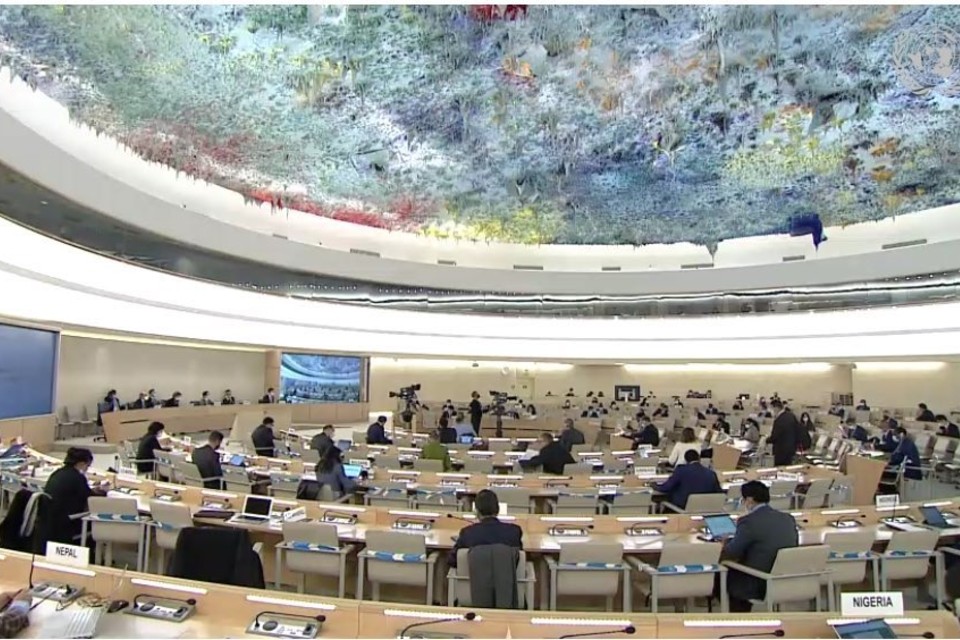
While the experts of the fact determination mission denounced situations that can be considered crimes against humanity, Venezuela rejected the content of the report by pointing out “invented testimonies.” Several countries offered to “build bridges” or support a “genuinely Venezuelan solution,” while states like Cuba, Russia or Bolivia accused the Human Rights Council of a “hostile and interference exercise” against the country
Liberation of all political prisoners, judicial processes without guarantees, torture and concern for the military deployment of the United States in the South Caribbean. These were part of the complaints expressed by the Member States of the United Nations Human Rights Council during the discussion of the latest report of the fact determination mission.
While mission experts denounced situations that can be considered crimes against humanity, Venezuela rejected the content of the report to the report point out “invented testimonies”.
In the middle, there are states that have nationals living the situations denounced in The report.
Such is the case of Argentina, who claimed the release of the Gendarme Nahuel Gallo, arrested since December 2024 and who they said “has been imprisoned, in captivity and invisible”; Peru, who denounced the arrest of two nationals; or Spain, who claimed the release of four Spanish citizens and 16 national doubles.
All these people, they said, “are deprived of due consular assistance.” According to the Venezuelan Criminal Forum, to date there are 89 foreigners detained in the country for political reasons. Most of them are Colombians.
Belgium denounced the effect of “rotating door” as a tactic to intimidate civil society, while Chile said that the administration of Nicolás Maduro applies a “deliberate state policy” and a “systematic plan” to silence and annul the dissent.
Paraguay warned about the “continuity of systematic patterns” of human rights violations, and pointed out the situation within prisons, the “growing number of deaths in custody, increased prisoner injuries and medical neglect to those deprived of liberty with serious diseases.”
Peru expressed its commitment together with other countries “with the efforts for a genuinely Venezuelan solution that strengthens peace, well -being, democracy, the rule of law.” In a similar line, Switzerland offered to “build bridges” for a solution to the crisis.
On the other hand, Norway, who served as a facilitator in several dialogue processes between the opposition and Maduro, expressed concern about the “complicity of the judicial sector and the Ombudsman’s Office with the authorities in the commission of the violation of human rights (…) political violence must cease and immediately.”
They described as “fundamental” that the Venezuelan authorities “take decisive measures to put the impunity for these crimes committed,” while urged to collaborate effectively with UN mechanisms and the International Criminal Court.
Portugal warned about the suppression of political opposition and the representation of Austria described violations as “alarming and unacceptable.”
Poland warned about the persecution escalation against human rights defenders, while Ireland focused on repression against journalists, indigenous communities and LGBTI people.
On the other side of the sidewalk, representations of countries such as Bolivia, Cuba or Russia referred to the sanctions, the deployment of the United States in the region or the “hostile and interference exercise” that, they said, represent the reports of the mission of determining facts as expressed Cuba.
The island’s representative called to the Office of the High Commissioner Volker Türk to “explore cooperation mechanisms under mutually agreed terms.”
«We express our rejection of the threat of the use of force against sovereignty, territorial integrity and political independence of Venezuela (…) we once again call this Council to promote a constructive, genuine and cooperation dialogue, ”said the Bolivian representative.
For its part, the delegation of Russia opposed “to use this organ to exert political pressure on Venezuela, we ask instead that the successes of Venezuelan leadership are observed.” They also pointed to “radicals directed from abroad that they use violent methods, use terrorism” to destabilize the country, repeating the complaints made about opposition leaders such as María Corina Machado.
*Journalism in Venezuela is exercised in a hostile environment for the press with dozens of legal instruments arranged for the punishment of the word, especially the laws “against hatred”, “against fascism” and “against blockade.” This content was written taking into consideration the threats and limits that, consequently, have been imposed on the dissemination of information from within the country.
Post views: 92