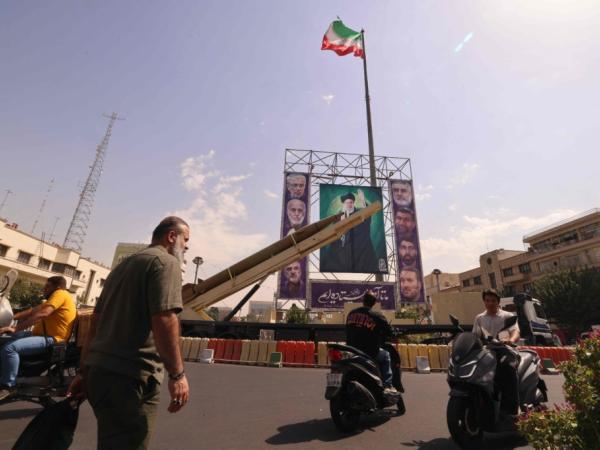
All UN resolutions related to sanctions against Tehran to prevent nuclear proliferation in Iran, raised by virtue of the 2015 agreement, They will reimpose on Saturday nightexcept for a unlikely last minute diplomatic advance.
(Read more: German government reaffirms its support to Israel despite the growing social pressure)
The joint comprehensive action plan (PAIC), signed in 2015 by Iran and by the five permanent members of the United Nations Security Council –China, United States, France, United Kingdom and Russia– As well as Germany and the European Union, it allowed the UN to lift international sanctions against Tehran in exchange for restrictions on its nuclear program.
But the sanctions will re -enter into force at midnight GMT on Saturday, when a reimposition mechanism (“Snapback”) requested on August 28 by Group E3 (Germany, France, United Kingdom) for considering that Tehran has breached its obligations. Next, the AFP explains what the “Snapback”:
(Read more: ‘We will revoke Petro’s visa for its incendiary actions’: USA)
What are the sanctions direct?
The sanctions are aimed at companies, entities and individuals that contribute directly or indirectly to the Iranian nuclear program or the development of ballistic missileseither because they provide the necessary equipment, technical knowledge or financing.
What sectors will be affected?
The sanctions that will be reimposed include in particular a seizure of conventional weapons, which prohibits any sale or transfer of weapons to Iran. Therefore, the imports, exports or transfers of pieces, goods and technology related to the nuclear and ballistic missile programs of Iran. The assets of entities and individuals abroad belonging to Iranian persons or entities linked to nuclear programs will also be frozen.
In addition, international entry and transit in the UN Member States to the people designated for participating in prohibited activities may be prohibited. UN Member States also They must restrict banking and financial activities that can help Iran in their nuclear or ballistic missile programs. In turn, the persons or entities that violate the provisions may be the object of freezing of their assets or assets at the international level.
(Read more: the states where the richest of the United States live. And how the money map changes)
Nuclear power
Are there other measures?
Yes, European Union adopted its own measures, which apply and expand the resolutions of the UN Security Council. The objective of these measures is to have a direct impact In the Iranian economy in order not only to hinder nuclear activity, but also to inflict an economic cost to Iranian power and force it to modify its behavior in nuclear proliferation.
Western powers fear that Iran acquire nuclear weapons, something that Tehran denies vigorously, while defending its right to develop a nuclear program for civil purposes.
Besides, United States already imposes its own sanctions, Including some that prohibit other countries to buy Iranian oil, after President Donald Trump retired from the 2015 agreement during his first term (2017-2021).
How does the “snapback” enter into force?
The “Snapback” process reactivates UN resolutions, but its practical implementation requires that UN Member States update their laws to comply with them. The EU and the United Kingdom must approve the necessary legislation for the sanctions to be applied, but have not yet given details about that process.

UN General Assembly.
(More news: Does ICE to intervene in US remittances to other countries?)
Will the sanctions be fulfilled?
The resolutions and sanctions of the UN Security Council are binding, but are violated regularly. The big question is whether countries like China and Russia, which consider illegal “snapback” activation, respect the measures against Iran.
Some countries, including China, continued to trade with Iran despite US sanctions, which were restored when the United States retired from the PAIC in 2018.
European powers anticipate that Russia will not comply with sanctions, but are not clear how China could react, that imports large amounts of oil from Iran.
“Evoid sanctions has a political, but also economic cost, because financial transactions are more expensive,” Clément Theme observed, associate researcher at the International Institute of Iranian Studies at the University of La Sorbonne. There will be greater pressure, for example, on shipping companies. “In the case of UN sanctions, there will probably be not a total blockade, but the costs will increase,” Therme summarized.
(More news: the commercial war is revived: new Trump tariffs to medicines and trucks)
AFP