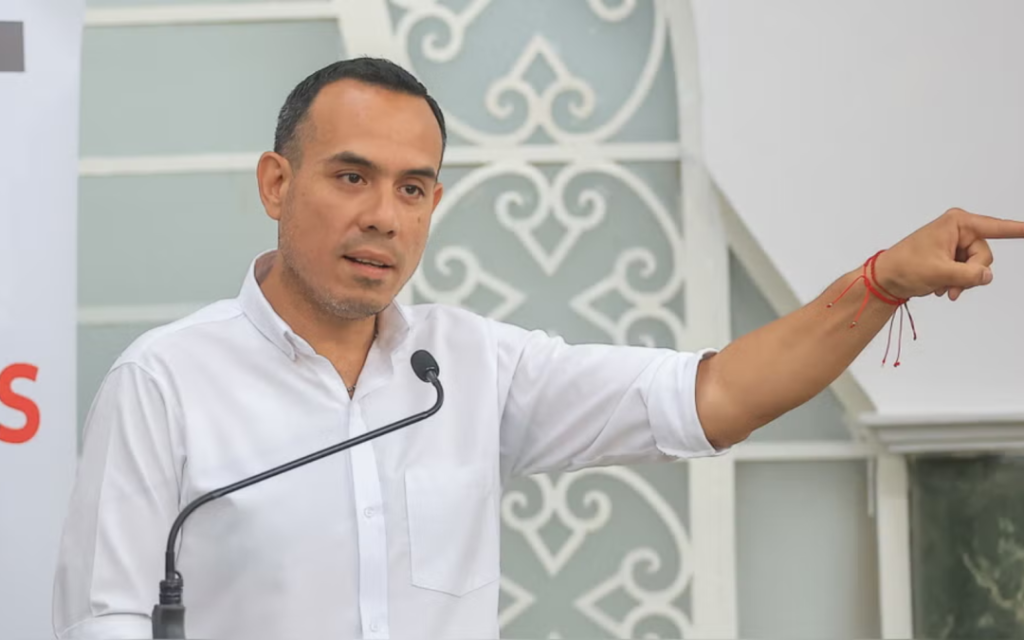
Here is a fragment of the interview.
Why is it discrimination that knowledge does not reach everyone?
It is the greatest discrimination in the century of knowledge. That is, when nothing was known, everyone was equivalent, there was no solution to certain problems. But, today, many problems have been solved; However, there is great inequality between those who have access and those who do not.
How to get more women into STEM careers?
We know that there is great discrimination against women, there has been and it is not that it is over. In particular, speaking of science and technology, where there is less female representation is in mathematics, physics and all scientific engineering.
So, we do have to see how to promote these vocations from childhood, because if a little girl, boys too, is not stimulated with good math and science courses, then they will hardly like it when they enter high school.
They have presented some very ambitious projects, is there talent?
The Secretariat works with its centers, but also with universities. We not only support our centers, which would be our direct obligation, but also all institutions to collaborate together on these types of solutions.
🇲🇽🇨🇱 The Secretariat of Science, Humanities, Technology and Innovation #Secihti and the Ministry of Science, Technology, Knowledge and Innovation of Chile @min_ciencia signed a Letter of Intent to strengthen regional capabilities in artificial intelligence #AI. 🧵➡️1/5 pic.twitter.com/DNdrn7DqMu
— Secretary of Science (@Secihti_Mx)
December 5, 2025
In many of our institutions, but also in the UNAM, in the Polytechnic (Institute), they have experience in designing semiconductors, very powerful microcomputers with which the chips that make any device work are built.
What is the importance of semiconductors? Every electronic device, your phone, television, washing machine, has mechanisms to operate that are based on semiconductors.
What do we want? That they can be produced in Mexico and that we do not import everything. Maybe we can’t produce phones and computers, but we can produce chips for medical devices, televisions, household appliances. And then try to produce it in large quantities to be able to export it.
Postdoctoral researchers are concerned about the problems of job placement.
They are absolutely right and we are seeing what we are going to do. I have met with them and we have that concern.
We train specialists and many of them cannot fit into a job. It’s not that they don’t have work, but that they don’t have work in their area. There it is our obligation to look for how we can also relate them to the industry. In Mexico, the industry does not hire doctors, great specialists, so we have to ensure that they recognize the need they have for highly trained people.
(Photo: Dulce Soto/Political Expansion)
Can the budget for science, which in Mexico is lower than in other countries, be a brake?
Of course, resources are essential. But we must also see that they have been gradually increasing in this government and that there are projects that are directly financed by the government. For example, “Olinia”, “Kutzari”, all the projects I have mentioned, are financed directly by the Presidency. They are not loaded in the resource that the Ministry of Science has.