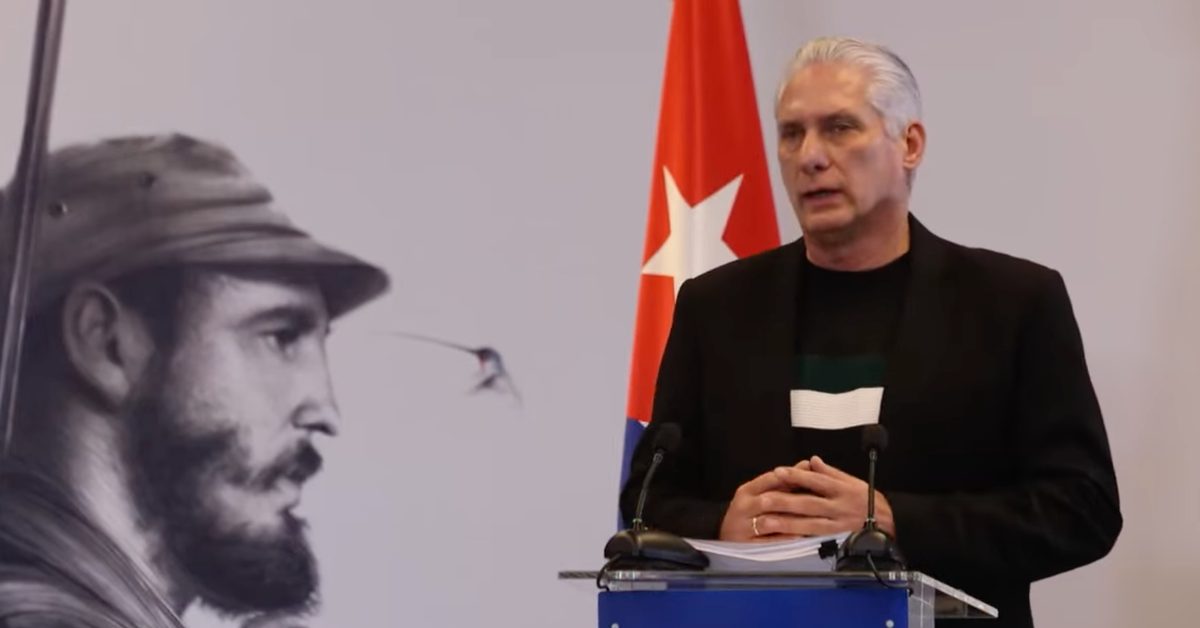
Madrid/With thousands of homes in blackout throughout the country, including Havana, a minority of Cubans will have heard the special appearance before the media by Miguel Díaz-Canel this Thursday morning. They did not miss much: the president did not announce any measures to confront the unprecedented crisis that the Island is suffering.
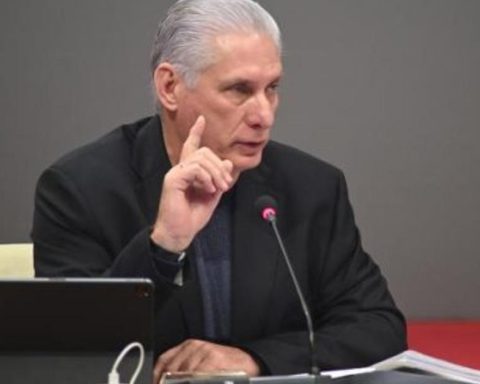
Díaz-Canel began on time, lamenting the “disinformation campaigns” and the “media war.” After saying that they had just held a meeting of the Council of Ministers to discuss the “acute fuel shortage,” he gave the microphone to Arleen Rodríguez. The official journalist – who caused a stir two weeks ago by minimizing the blackouts saying that Martí wrote his works without electricity – was giving the floor to the journalists present in the room. All from official media and the state press of related countries, such as Russia or China.
Will there be electricity tomorrow? Will transportation be paralyzed? How will hospitals work? No reporter asked these questions, which ordinary Cubans do ask themselves these days.
“There is no failed State,” he asserted, “but rather a State that has had to face the maximum pressures from the main power in the world.”
Quite the contrary, the first journalist who spoke, Oliver Zamora Oria, from Russia Today, gave rise to Díaz-Canel to develop the usual victimist discourse towards the United States, which he called the “imperial government.” “There is no failed State,” he asserted, “but rather a State that has had to face the maximum pressures from the main power in the world.” Repeating well-known slogans, he denounced the tools used by the United States, the “blockade” and “military aggression.”
Faced with that “imperial” force, he said, also insisting on a repeated phrase, “is the creative resistance,” although he acknowledged: “I am not an idealist, I know that we are going to live in difficult times.”
Likewise, he expressed that “Venezuela has been attacked,” with a “kidnapped” president, referring to the capture of Nicolas Maduro by the Donald Trump Administration, in a military operation on January 3. Previously, he noted, in December, the United States had established a “blockade” on tankers transporting Venezuelan crude oil. “Since that date, fuel has not been received,” he stated, not counting the 85,000 barrels. shipped from Mexico in January on the ship Ocean Mariner.
“The enemy is in pursuit of all the paths that can be opened to Cuba,” he complained, and boasted, without giving further details: “Cuba is not alone. There are many countries willing to help.” Shortly before, the Russian ambassador in Havana had declared that Moscow would continue sending oil to the Island, although he was cautious in saying: “We assume that this practice will continue.”
An hour into the hearing had passed when he timidly noted various pieces of information, without mentioning the measures of the plan. “We have been at zero distributed generation for four weeks,” he confessed, revealing why the Electrical Union has not included in its daily reports information about the energy that has that origin, as they used to, for just that long.
“We have been at zero distributed generation for four weeks”
Likewise, he insisted several times on increasing investment in renewable energy sources, mainly solar. At this time, he reported, the contribution of photovoltaic parks to the national electrical system (SEN) is 38% during daylight hours. When February ends, he also said, the contribution of this type of energy will be 98 megawatts (MW), and the following month, 52 MW more, and so on.
Although he mentioned again and again that a series of measures had been discussed in the Council of Ministers, Díaz-Canel finally said that “a group of ministers and vice-ministers will report on them little by little,” approximately “in a week.” These measures, he noted, “although they are not going to be permanent, they are going to require effort.” And he continued, anticipating the population’s complaint about offering more sacrifices: “If we don’t sacrifice ourselves, what do we do? Do we surrender? There is a lot to defend.”
The president elaborated on the need to “continue exploiting the sources we have such as oil,” which is “heavy,” and he exposed, not without circumlocution, diffuse measures in this regard, which in some cases seem, in the midst of the extreme shortage that the Island suffers, chimeras. For example, the “task” that the Petroleum Research Center says is in charge: creating a system “to achieve the refining of Cuban crude oil and improve its quality.”
He also mentioned, again without offering details, that “our storage capacities” are being increased, reduced since the fire at the Matanzas Supertanker Base more than three years ago, as well as national crude oil production. This is accompanied, he said, by “accompanying gas.” Díaz-Canel was referring to the production of Energas in association with the Canadian multinational Sherrittwhich exploits nickel and cobalt mines. This has recognized something that the president has not talked about: a decrease in gas production on the Island that, together with the reduction in mining production due to the lack of fuel, has the mining giant in trouble as far as its performance in Cuba is concerned.
He explained why in Havana there are more blackouts during the day: because they have decided to use more energy in actions that activate the economy.
Likewise, he explained why in Havana there are more blackouts during the day: because they have decided to use more energy in actions that activate the economy, for example in irrigation for rice plantations or in key sectors such as tobacco.
“We must take advantage of this as an opportunity,” he stated, “and understand that the country has to sustain itself with the energy sources that we produce.”
As for a possible dialogue with the United StatesDíaz-Canel reiterated what he already said via social networks: Cuba is willing to do so, as long as it is “without pressure, in a position of equals, of respect, without addressing issues that we can understand as interference with our national sovereignty.”
For the rest, he reiterated several times the idea that “all components of our territorial defensive systems are preparing,” and emphasized “priorities” such as “elevating the functioning of the Party, the State, and all institutions” to “prepare for an attempted attack”; establish a “political mobilization plan” – which was exemplified with the funeral honors for the 32 Cubans killed in the US operation in Caracas – or “the way in which we have to develop political communication, which has to respond to wartime communication.”
The conference was not a good example of political communication, in which the complacency of the media bordered on the hilarious at times. Thus, when the director of the Prensa Latina agency asked him: “Are we a country that sponsors international terrorism? Do we protect terrorists in Cuba?”, and Díaz-Canel answered: “You ask me some questions that you have answered thousands of times.”
Several testimonies came to this newspaper from Cubans who did have electricity but who turned off the transmission halfway, in desperation. “He’s talking rubbish and we’re not here for that,” said a Sancti Spíritus employee before leaving for work, for which he was already late.
“Discussing, debating, contributing, that does not produce electricity,” lamented a retired teacher from Havana.
“Discussing, debating, contributing, that does not produce electricity,” lamented a retired teacher from Havana. “With that rhetoric there is no possible progress.” A young mother asked online from Holguín for link from the internet broadcast: “My mother-in-law is tired of all the grinding and wants to turn off the television.”
In short, the fear of what Fidel Castro called in the Special Period “option zero” continues to hover over Cubans, the total absence of fuel. Those educated in those nineties remember a subject with that name, in which they taught how to take notes with charcoal or write on corrugated cardboard from packaging boxes, as well as the speeches pontificating about the idea of abandoning the cities (a la Kampuchea, the Cambodia of the Khmer Rouge) and planting the food that was needed with one’s own hands.
In recent days, from different places on the Island they reported to 14ymedio be summoning state workers to communicate energy cuts in the face of the extreme crisis situation. In Varadero, hotel employees were informed to remain “a full week” in the place, organizing themselves in shifts, “due to the oil contingency.”
Much more briefly, the Vice Minister of Foreign Affairs already announced, Carlos Fernández de Cossío that severe measures were coming, just a few days ago. In an interview with EFE, the vice chancellor said that the Government was defining a “reorganization process,” and stated: “It is not something simple, it is something difficult for the management of the Government and it is something very difficult for the population as a whole.”
After a press conference by Díaz-Canel, lasting more than two hours and before complacent media, Cuban citizens still do not know what awaits them.