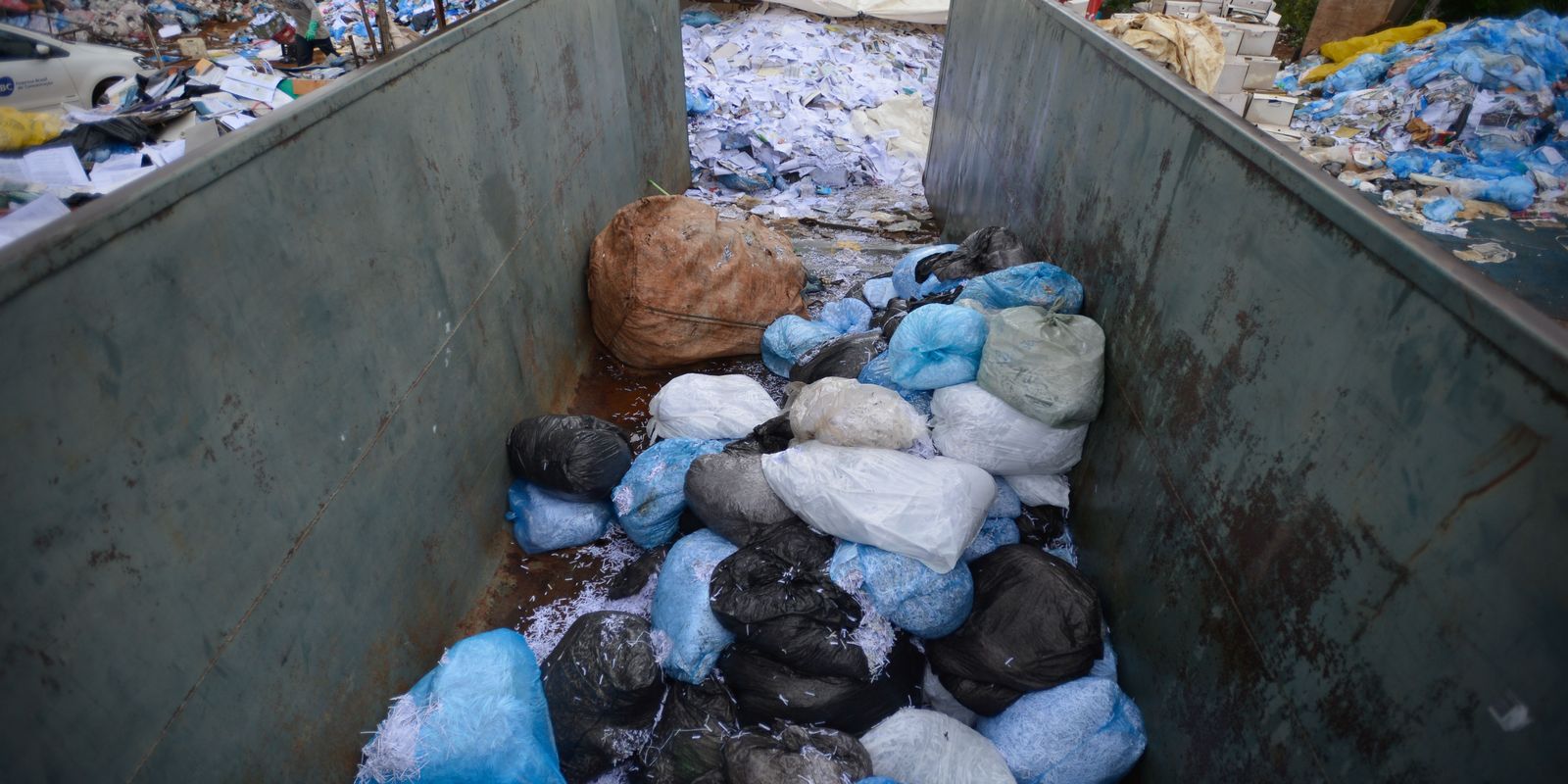
In 2024, Brazil generated 81.6 million tons of municipal solid waste (MSW), registering a growth of 0.75% compared to the previous year. Of this total, the majority – 76.4 million tons (93.7%) – was collected, with 41.4 million tons (59.7%) receiving environmentally appropriate disposal and sent to a landfill.
The total volume of MSW generated is equivalent to one average of 384 kilograms (kg) per inhabitant per year or 1,241 kg per dayaccording to the Panorama of Solid Waste in Brazil 2025, launched by the Brazilian Association of Waste and the Environment (Abrema), on Monday night (8).
Although inadequate final disposal still represents 40.3% of the total waste generated in Brazil, the data reveals an improvement compared to the previous year. At the time, 41.5% of the MSW generated was disposed of in inappropriate locationssuch as landfills or buried on the generating property.
“In the year in which Brazil banned all forms of irregular disposal of waste collected in municipalities, we still estimate the existence of almost 3 thousand landfills that receive environmental liabilities that put public health at risk, but which could become economic assets for the country”, highlights the president of Abrema, Pedro Maranhão.
Recycling
In 2024, 7.1 million tons of dry waste were sent for recycling, equivalent to 8.7% of the MSW generated. Of this volume, 2.5 million tons originated from the public collection service and 4.6 million tons were collected informally and transported directly for recycling.
Approximately 2.5 million tons (52%) of this material was recovered, and the remainder was sent for final disposal as waste.
Power generation
For the first time, the study included an analysis of the reuse of organic or non-recyclable waste intended for energy production. In the report, waste-derived fuel (RDF), biogas and biomethane production and composting were considered to establish the concept of bioenergy recycling.
According to Antônio Januzzi, technical director at Abrema who was part of the team responsible for the report, the methodology unified the reuse of organic materials and others unsuitable for dry recycling, such as paper soiled with organic materials, into a single piece of data. “The National Waste Policy itself defines that we can consider recycling, the use of waste to generate other elements that can be used.”
The data reveal that bioenergetic recycling reaches a higher percentage of organic waste than the practice of material recovery used for recycling dry waste, such as paper, glass, plastic and aluminum. When quantifying in a unified way, while the transformation of organics into energy or compost covers 11.7% of the total waste generated, mechanical recycling of dry goods reaches 8.7%.
Reverse logistics
This year’s edition of the panorama, which has a base year of 2024, also includes an analysis of the situation of reverse logistics in the country based on the 13 existing systems: pesticides, lead acid batteries, electronics, steel packaging, glass packaging, lubricating oil packaging and packaging in general, used lubricating oils, light bulbs, aluminum cans, medicines, batteries and tires.
According to Jannuzi, the data is positive in general, showing an evolution in the adoption of a cyclical economic model in the country. “This year, we had the publication of Decree 12,688/2025, also called the Plastic Decree, which will increase the number of materials that will be included in this cyclical economy from 13 to 14. And this is also an important driver within the waste management chain”, he concludes.
CNM
In a note sent to Brazil Agencythe National Confederation of Municipalities (CNM) points out that municipalities with up to 50 thousand inhabitants are those that most require support to eliminate landfills and implement sanitary landfills. “The closure of landfills and the implementation and operation of landfills require federative action, with the Union and states supporting municipalities technically and financially”, argues the entity.
The CNM assesses that there are several challenges to implementing sanitary landfills, such as the high cost of operation and the difficulty of finding areas that meet the criteria of the Brazilian Association of Technical Standards (ABNT), which take into account, for example, the type of soil and proximity to groundwater and urban areas.
“For some regions, such as the North of the country, it becomes almost impossible to find a location that can meet all the requirements. However, in some states with municipalities with a large territorial extension and small population size, consortia are unfeasible, as in order to count more than 100 thousand inhabitants, transshipment stations are required, increasing the cost. However, small municipalities do not have sufficient financial resources, which is why the CNM reinforces the need for federative action for Brazil to close all dumps.”
Regarding the potential for using waste to generate energy, the confederation highlights that this reuse is expensive and cites studies that indicate its viability only for municipalities or consortia with more than 300 thousand inhabitants. “The CNM warns that energy generation must be based on waste [resíduos sem viabilidade para reciclagem]so as not to generate social exclusion of waste pickers”, adds the note.
Article expanded at 7:27 pm to include a statement from the National Confederation of Municipalities (CNM).