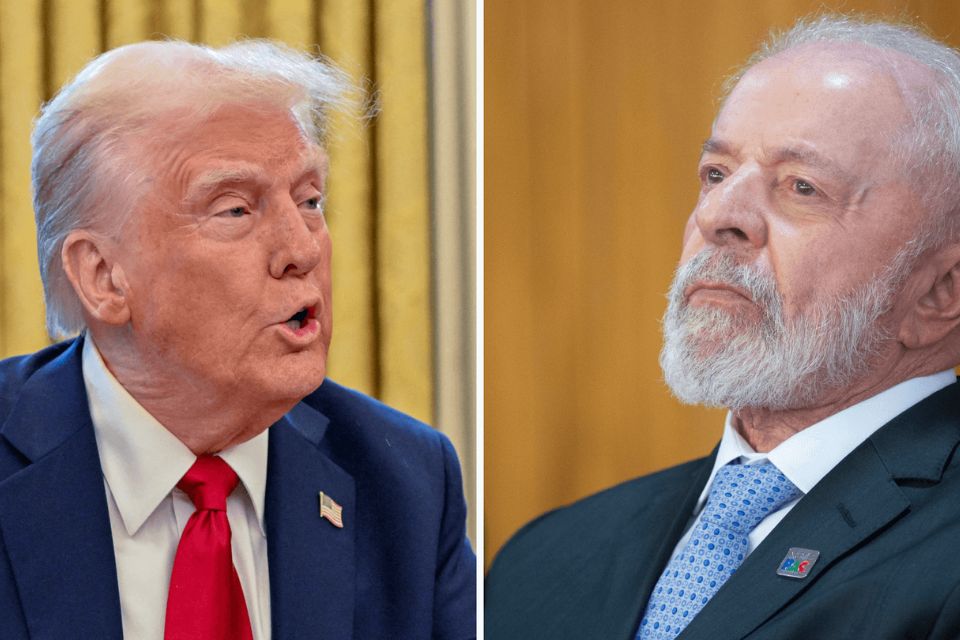
After several days of threats, US President Donald Trump signed on Wednesday, July 30, the application of additional 50% tariffs against Brazil
On Wednesday, July 30, the US government intensified its pressure on Brazil in support of former president Jair Bolsonaro. Washington announced new sanctions against the judge of the Supreme Court Alexandre de Moraes, before applying the 50% increase in customs tariffs announced on Brazilian products. The measure will enter into force on Friday, August 1.
The first blow came from the Department of the Treasury, with sanctions against Alexandre de Moraes, whom Washington accuses of “arbitrary arrests” and of not respecting “freedom of expression.” The Treasury considers that the judge, who has become the main figure of the highest Brazilian court, would have taken advantage of his position to “attack political opponents, particularly former president Jair Bolsonaro, to journalists, to US social networks and other US and international companies.”
“A worrying scenario, with imminent social and economic repercussions,” according to Eduardo Heron. The technical director of the Brazilian Coffee Exporters Council remembers that the United States is the largest coffee consumer in the world and is mainly supplied with Brazil.
“We want public authorities and the private sector to negotiate more balanced. Because, in the short term, Brazil will not be able to transfer eight million sacks of coffee to other destinations, and the United States will not be able to acquire that volume in the market,” Eduardo Heron indicates to our correspondent in Rio de Janeiro, Sarah Cozzolino.
However, on July 30, Donald Trump signed a decree that includes about 700 exceptions to surcharge, among which is not coffee. The orange juice sectors, oil or aviation will be fought from it. According to the decree, the additional tariff, which will enter into force as of August 6, is justified by “the unusual and extraordinary threat that Brazil represents for national security, the United States economy and foreign policy.” But although, among racks, Washington has been willing to negotiate, the US president hardens the tone in the political sphere.
“The tensions are concentrated around the figure of Judge Alexandre de Moraes, who is now subject to severe economic sanctions. It is the first time that this type of sanction is used against an agent of a democratic regime,” explains Mauricio Santoro, professor of international relations at the State University of Rio de Janeiro. These sanctions involve the freezing of all Alexandre de Moraes assets in the United States, as well as the prohibition of US citizens or companies to do business with the Brazilian judge, under penalty of being processed.
These measures complete those announced by the State Department on July 18, which affected all the judges of the Supreme Court and their close relatives, who are now prohibited from entering the United States.
*Also read: Reuters: Chevron obtained US restricted license to operate in Venezuela
The favorite target of the extreme Brazilian right
Over the years, Judge Alexandre de Moraes has become the favorite target of the Brazilian extreme right, which has now earned him the criticisms of Donald Trump. He is in charge of the judgments against former president Jair Bolsonaro. This ally of Donald Trump is being tried in his country for an alleged attempted coup after his defeat in the 2022 elections. His judgment must conclude in the coming weeks and the former president (2019-2022), 70, faces more than 40 years in prison.
Alexandre de Moraes also blocked for 40 days X in Brazil, until the network of billionaire Elon Musk fulfilled the orders of eliminating accounts accused of spreading false news. For the same reasons, in February he ordered the blockade of the Rumble video platform, very popular among the American conservatives.
On the other hand, Brazilian President Luiz Inacio Lula da Silva responded on Wednesday committing to defend his country’s sovereignty against the decision of the US president.
Lula promised to “defend (…) the sovereignty of the Brazilian people in the face of the measures announced by the president of the United States” during an official ceremony in Brasilia. Although the popularity of the leftist leader has rebounded in recent weeks, the supporters of Jair Bolsonaro do not plan to lower the pressure and summon demonstrations in the main cities of the country this Sunday, August 3.
*Journalism in Venezuela is exercised in a hostile environment for the press with dozens of legal instruments arranged for the punishment of the word, especially the laws “against hatred”, “against fascism” and “against blockade.” This content was written taking into consideration the threats and limits that, consequently, have been imposed on the dissemination of information from within the country.
Post views: 144