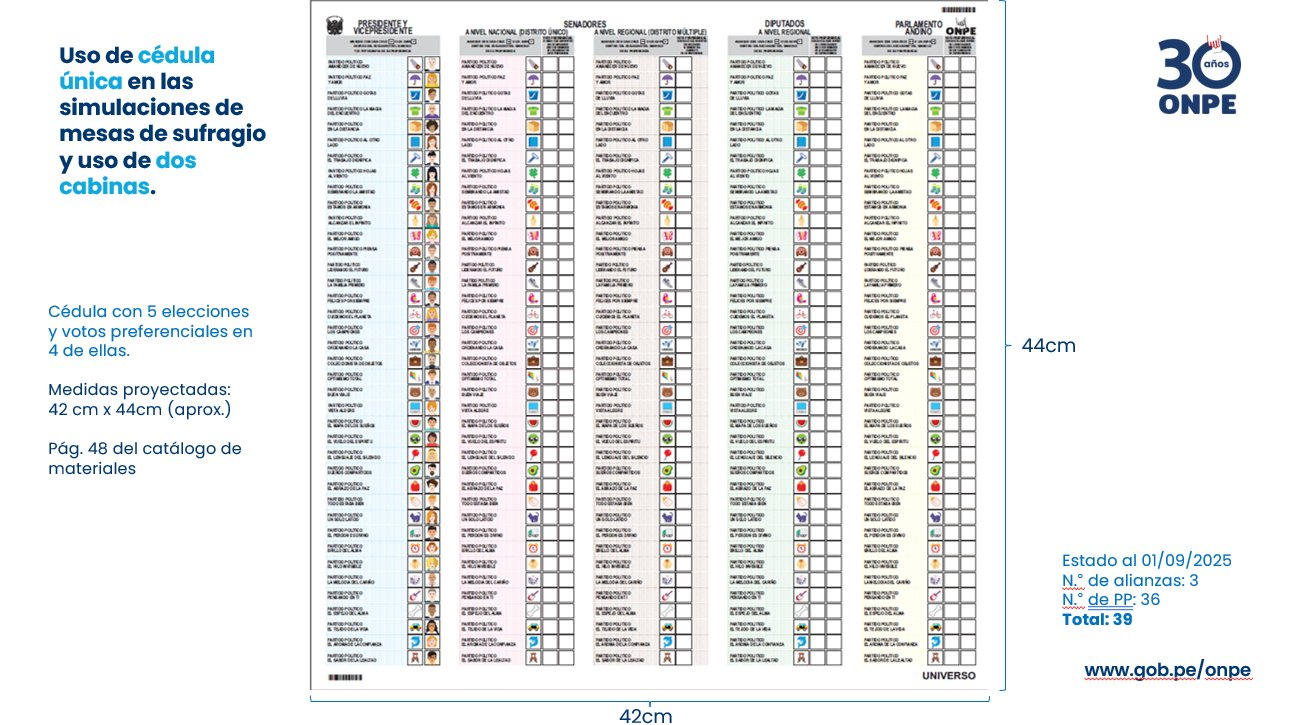
During the session on Tuesday, September 2 at the Constitution and Regulation Commission of the Congress of the RepublicPiero Corvetto, the head of the National Electoral Processes Office (ONPE), presented the first simulation of the electoral card that will be used in the general elections of Sunday, April 12, 2026, which will be one of the largest in the electoral history of the country.
Corvetto explained that the card It will be 42 cm wide by 44 cm high and will allow to vote simultaneously by five positions: President and vice president, national and regional senators and representatives of the Andean Parliament. This design responds to high political fragmentation, with 36 parties and 3 electoral alliances registered.
You can see: DElia Espinoza constitutionally denounces Santiváñez for alleged irregular contracts when she was Minister of the Interior
In the design, the party symbols and the photos of the presidency candidates and vice presidencies will appear on the left; While the center will be located three different columns for the Senate, the Chamber of Deputies and the Andean Parliament, with spaces for preferential votes. “It will still go through the process of evaluations,” he said Corvetto.
Regarding the vote of the members of the Armed Forces and the National Policewho on the elections day meet security work, the ONPE presented a more compact version of the card, 24 cm wide by 44 cm high, designed to facilitate its use in institutional environments with limited space.
You can see: Rosa María Palacios about Rafael López Aliaga trains: “He wants advertising for his campaign”
Digital Voting Pilot Plan
Also, the ONPE Announced a Pilot Digital Voting Plan, initially aimed to specific groups such as military, police, people with disabilities recorded in CONADIS, staff of Migrations, people’s defense, emergencies, firefightersand other priority sectors.
To access this modality, voters must have a current electronic ID, an active digital certificate and have a DNIE reader device or NFC technology, in addition to the Internet connection.
Faced with citizen concerns related to cybersecurity, Corvetto indicated that the software will be audited by specialized entities and training will be strengthened to guarantee a safe process. In the event that the project is not achieved in time, the printed cards will be used. “It would not be a failure, but the fulfillment of the norm,” he said.
You can see: JNE will go to the TC for registration of the Duberlí Rodríguez party: he will file competence against the PJ
2026 elections: up to 8 hours of counting
Corvetto warned that the traditional vote count could last up to eight hours, although the first results will be disseminated from 5:00 pm, with updates every five minutes to guarantee transparency and avoid speculation.
In Lima and Callao, the Technological System to support scrutiny, which uses a laptop and printer to digitize the process, which will help with count and reduce errors. “Just filling minutes and having this alert of whether the sums are fine or not, we reduce 2 hours the scrutiny in Lima and Callao,” he said.
In addition, he stressed that Peruvians who live abroad will be able to vote digitally if they have current electronic DNI and digital certificate. For this they must register between October 29 and December 13, 2025.
Political organizations will not opt for open primary elections
In parallel, Roberto BurneoPresident of the JNE, during a press conference, reported that to date None of the 39 political organizations has presented a non -affiliated list, So it is estimated that there will be no open primaries. Instead, the groups will opt for closed primaries or by elections through delegates, scheduled for November 30. “Only on December 23 we will know what candidates are going to participate,” he said.
Burneo also confirmed that the JNE attorney is evaluating the malicious studs presented during the alliances registration process.
Regarding the recent judicial resolution that ordered the registration of the Popular Unity Party, led by Duberlí Rodríguez, the Plenary of the JNE unanimously approved the presentation of a competence against the Judiciary before the Constitutional Court. “We are forming the legal team that will support this action,” Burneo said.