Malaga/As a child, in Spain, in the camps of Catholic Scout MovementI remember there was also something called volunteer work. It was carried out on Saturdays and consisted of completing tasks that, although presented as spontaneous, were actually assigned in advance. Everything had to be done “by one’s own will”, but under the gaze of the leaders – called the pack, in reference to the jungle booka reference for the scout movement.
That routine, a mix of discipline and fervor, was clothed in a mystique: serving others with joy –it’s worth who serves was the motto. Over the years I understood that, beyond youthful idealism, this was also a form of directed moral learning, an obedience wrapped in enthusiasm.
In Cuba, that spirit of joyful discipline and youthful symbology had its own version: a kind of scenography Baden-Powell tropical.
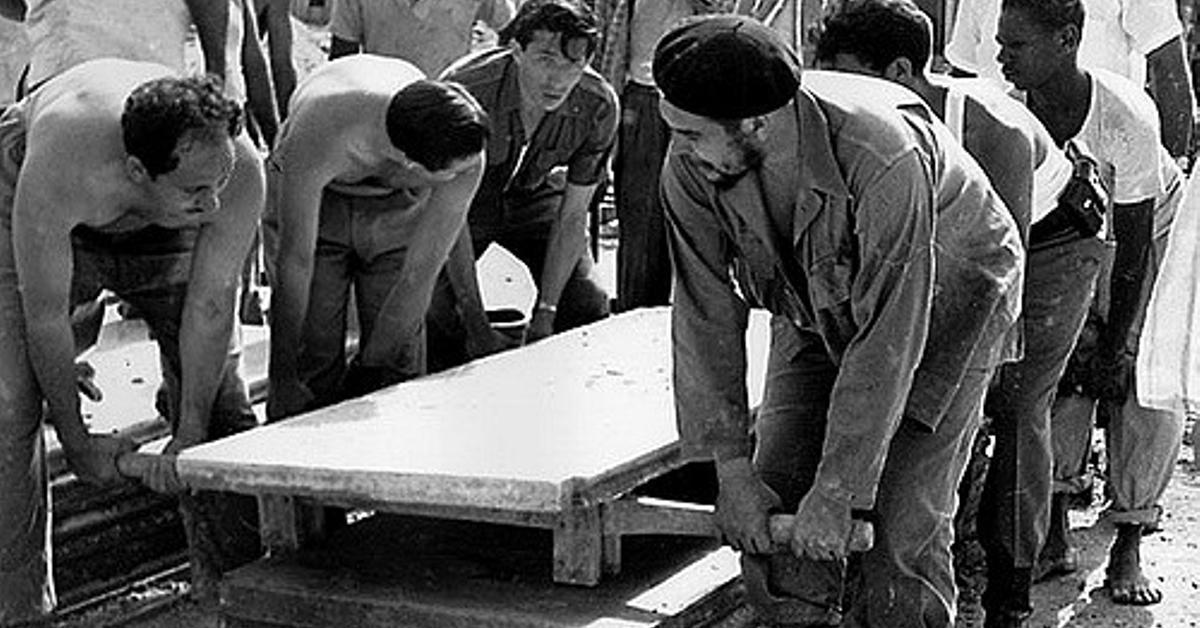
The call volunteer work It was never exactly a practice of solidarity, but rather an ideological tool intended to mold the new citizen: austere, loyal, cooperative, obedient. As a Cuban friend told me, “its value was not productive, but formative: it had to transform the young person into a collective being, going from I to we.” The objective was not the cut cane, but the reformed soul with a revolutionary spirit.
The rituals of the socialist utopia, modeled on the Soviet model, ran into an obstacle in the Caribbean that was impossible to overcome: the Creole, Hispanic, and Cervantes idiosyncrasy.
That moral training project also had its class bias: it sought to proletarianize the remains of the bourgeoisie, discipline the professional and domesticate the peasant, as attached to his land as the kulaks to theirs, when Lenin wanted to make them an example. But the new man they dreamed of ended up wanting to be a foreigner – and many were – or he became old without being one.
In a way, the system of pioneers with red scarves – copied from the USSR and countries like Romania or East Germany – was reminiscent of the scout movement, although under another flag and another creed: that of revolution.
But the result was different. The rituals of the socialist utopia, modeled on the Soviet model, ran into an obstacle in the Caribbean that was impossible to overcome: the Creole, Hispanic, Cervantes idiosyncrasy.
The spirit of the tropics did not fit with the parades, the uniforms or the doctrinal solemnity. Where communism asked for fervor and discipline, the Cuban responded with a story – a joke, we would say in Spain. Where heroism was demanded, mockery was born.
Popular humor and passive resistance were disguised in Cuba as “revolutionary participation.” He volunteer work It thus became a secular mass in which the faithful feigned devotion while chatting in silence.
Jorge Mañach had described it precisely decades before, when defining the choteo as “a mockery of every non-imperative form of authority.” An art of not taking anything seriously. In the Spanish peninsula perhaps it has a close relative: the banter Cadiz, that sing-song and corrosive irony that – like the choteo– disarms the solemnity with a smile, especially in its most popular and festive form: the carnival, with its chirigotas and cuples satirists.
Voluntary work, thought of as an academy of socialist conscience, ended up being a masquerade of appearances
In the end, the volunteer work It was the apotheosis of that conflict between obedience and humor. It was a liturgy without faith, a mandatory sacrifice to demonstrate ideological purity. And the Cuban, who cannot stand inflated pomp without giving it a nickname or a joke, turned the ideal of the new man into a tragicomic character: a harvest hero with the soul of a rogue from the Golden Age, devout in appearance, but master in the art of cleverly evading.
That attitude, so Cuban, has deeper roots: it inherits from the Hispanic spirit that mocking skepticism that runs through the Lazarillo and the Quixotewhere laughter does not destroy, but relativizes dogma. Cervantes ridiculed chivalric dreams with the same ingenuity with which the Cuban parodied revolutionary fervor: both made humor – and sarcasm – a form of lucidity.
When the communist ideal traveled from the Russian steppes to the Caribbean beaches, it changed its accent and temperature. The parades were filled with music, the slogans became songs and collectivism became a pretext for relaxation, so classic and “evocative” in more ways than one for Cubans in the so-called school in the countryside.
Communism, upon arriving in Cuba, became tropicalized: it acquired rhythm, but lost gravity. and the volunteer workthought of as an academy of socialist conscience, ended up being a masquerade of appearances, in which each one complied to avoid being singled out, pretended to comply and laughed, inside, to not give up.
Perhaps that laugh was the most Cuban of all forms of resistance. It was not epic or frontal, but it was effective: an intimate, intelligent, sanchopancesque resistance against the pomp of power.
As they said in bonche –already with resigned lucidity–, the volunteer work “temper to character”, or that other bantereven more cruel, that as an incentive for participating they would give you “a trip through the center” (read, a kick in the bottom). In those minimal sentences an entire philosophy was condensed: obey without believing, and laugh while still surviving. He volunteer workIn short, he did not create the new man: what he formed was the choteador national vanguard, capable of feigning enthusiasm while silently mocking the solemnity that oppressed him.
Humor has been, for Cubans, their manual of resistance against the bitter drink that the bartender of national history served them… and that she herself will not absolve.
Gratitude
I want to thank Jorge Mayor Ríos their valuable contributions, comments and suggestions to this text, the result of long conversations that, over the years, helped me better understand the complex contemporary history of revolutionary Cuba and the peculiarities of the Cuban soul. It was also he who first put reading of Jorge Manachstarting point for many of the ideas developed here.