In the Carnival Octavita we analyze why the holiday was marked by a pattern of citizen violence that was repeated in at least nine states of the country, with 16 documented cases. It began as a game with foam, tanganas and balloons filled with water and escalated to collective fights, public humiliations and physical attacks.
Glorimar Fernandez | ARI
On the afternoon of Tuesday, February 17, in the Tierra Negra sector of the Cabimas municipality, Zulia state, what a group of young people described as a “Carnival penance” became an act of cruelty that generated commotion. Several teenagers and an adult subdued a boy with a special condition, forced him to sit in a puddle of sewage and poured the contaminated liquid over his head and body, while holding him by his hair, forcing him to look at the camera amidst mockery and verbal attacks.
Videos recorded by the attackers themselves went viral in a matter of hours on social networks. The next day, officials from the Bolivarian National Police (PNB) arrested two 17-year-old teenagers and a 20-year-old young man, for being the main people responsible for this incident. They claimed that “they were playing Carnival.”
This case from Cabimas was not isolated, at least 16 cases were documented in Zulia, Miranda, Capital District, Trujillo, Mérida, Guárico, Aragua, Bolívar and La Guaira.
The fights and fights that were seen during the days of Carnival in different parts of Venezuela are not just isolated events, but a reflection of deeper tensions in society, according to the analysis of sociologist Rafael Uzcátegui, director of Laboratorio de Paz.
“From a sociological reading, these episodes can express the accumulation of frustration due to years of crisis, the normalization of violence in daily life, the weakening of social norms and the loss of trust between people. They also reflect how, in contexts where there are few spaces to channel conflict or express social unrest, aggressiveness moves towards everyday life,” he said.
*Read also: Provea: 10 years of Arco Minero leave ecocide, slavery and violence in the south
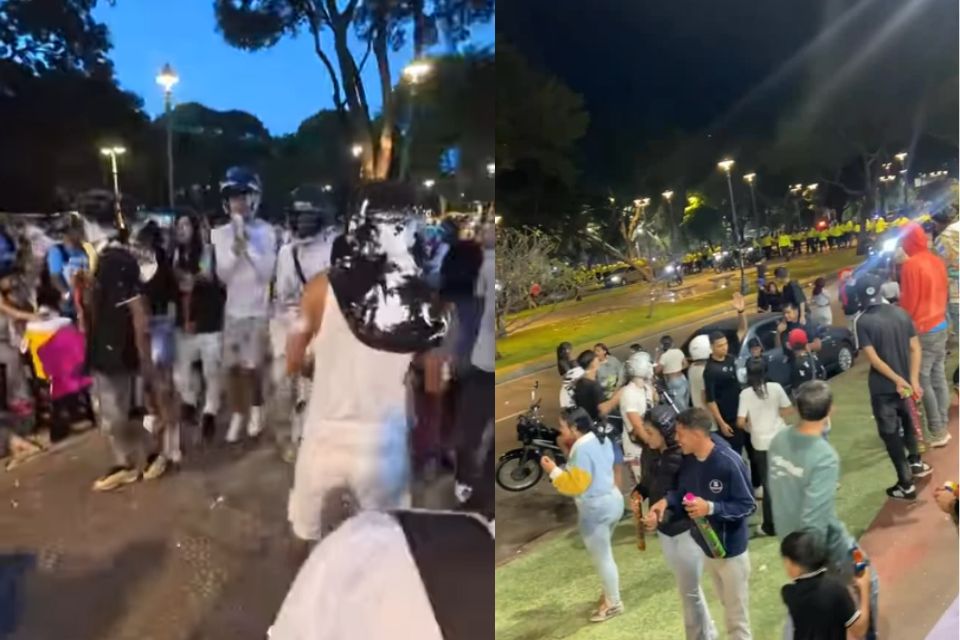
In Caracas, the incidents were concentrated in public spaces: in Los Próceres, groups of young people sprayed foam left and right, including elderly people who covered themselves with rags to protect themselves, They beat those who were recording and generated an atmosphere of few smiles and serious faces.
Dozens of PNB uniformed officers evicted to those causing the disorder. Exactly a year ago, in this same scenario, the 19-year-old young man, Luis Fernando Benítez Medina, was murdered after he refused to participate in a Carnival “game” that involved spraying spray foam and tanganas, which caused the attackers to attack him with cans, blunt objects and blows, causing serious injuries to his head and torso that caused his death.
Inside the Caracas Metroyoung people and adolescents, including a child dressed as Chavo del 8, planned and carried out attacks: they sprayed foam on passengers, such as an elderly man who was checking his cell phone, scaring him and fleeing after recording the act to upload it to networks.
This dynamic was repeated in other regions: in Ocumare del Tuy (Miranda)a “war” of bottles and foam on the acoustic shell Yolanda Moreno left families fleeing of blunt objects; in Boconó (Trujillo), two street fights during the parades, one near the Plazoleta San José Gregorio Hernández and another next to the Rafael Rangel Hospital, resulted in more than 10 people treated for injuriesincluding one stabbed and beaten, with the police absent at both times.
In La Guaira, a brawl in the Cinta Costera led to an investigation by the Public Ministry. While in Choroni (Aragua), El Callao (Bolívar), Altagracia de Orituco (Guárico) and La Puerta (Trujillo), scenes of pushing, running and confrontations between sides with foam, empty cans containing this product, bottles, sticks, among others, were repeated.
Finally, in Tucaní (Mérida), on the night of February 17, a group of young people took over the streets to attack with balloons and bombs of water to passers-by, among the victims were the occupants of a vehicle that was transporting a medical emergency to the hospital.
Roots of Carnival violence
Uzcátegui translated these situations as a wear and tear of the social fabric and the need to rebuild ties, trust and spaces for peaceful coexistence: “I cannot stop linking it to the anomic situation that results when the country’s main authority figure, the President, fraudulently steals an election, eroding himself as a reference for duty and the social contract, so much so that it motivates a foreign country to bomb the territory and arrest it by linking it to drug trafficking crimes.”
The citizen security expert, Luis Izquiel, specified that the agglomeration of people on land or sea, plus the throwing of water, foam or other substances, are circumstances that facilitate the start of brawls between people.
He explained that most of these cases go unpunished because the people who participate often do not know each other. Likewise, when faced with a large crowd of people, sometimes the security forces are overwhelmed by the situation.
“In the event that many people participate in a crime of injuries and it is not known exactly which of them caused them, article 424 of the Penal Code provides for the figure of corresponding complicity, through which a sanction is established against all those who participated, but with a reduction in the penalty to be imposed for the injuries caused.”
Another source consulted and linked to the Public Ministry believed that the authorities should take the necessary precautions and launch preventive campaigns before the mass holidays.
In his opinion, the principle of publicity must be done effectively: “although the law is already public, it is essential to actively remind the population of it when high-mobilization events such as Carnival are approaching.”
A contrast to these facts were the municipalities of Guaicaipuro de Miranda and Tovar de Aragua, where the mayors prohibited the use of foam, tangana and similar.
In both cases, these restrictions that were applied in advance, widely publicized and supported by security deployment, contributed to the festivities passing without disorder.
*Journalism in Venezuela is carried out in a hostile environment for the press with dozens of legal instruments in place to punish the word, especially the laws “against hate”, “against fascism” and “against the blockade.” This content was written taking into consideration the threats and limits that, consequently, have been imposed on the dissemination of information from within the country.
Post Views: 0