This political control in the political freedom in economic freedom is the Vietnamization of Cuba.
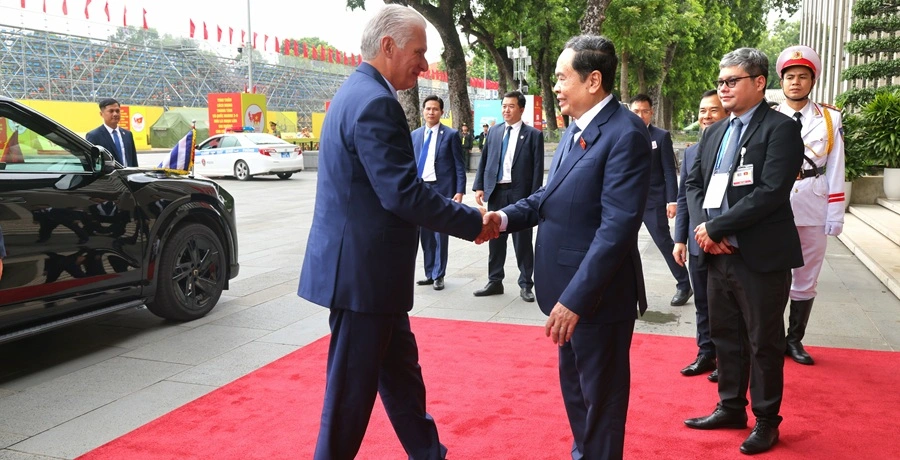
Puerto Padre, Cuba.- The Vietnamization of Cuba has already gone from crawling to take the first steps. Another Vietnam is in sight, according to Che Guevara, and this in the Caribbean, 90 miles from the United States. Yes, the Argentine would be happy. They are selling us vietnamization which energizing or new breakfast for tourists. We have seen the marketing in these days in voices and poses of Castrocommunist commissioners throughout Laya, from Díaz-Canel and his wife to political, governmental, business leaders, military and police chiefs, learned jurists and laymen and even an infant-adolescent entertainment.
The coming and going of the communist police station has been by double track, of Cuba to Vietnam and from Vietnam to Cuba, seasoned with a constant and sound donation equivalent to something like eight million dollars, collected by the Vietnamese for the Cuban communists who go around the world with their hand open. We do not know what has been agreed in secret among scenes, publicly and as it has been international news, the Vietnamese and Cuban communists agreed to collaborate in legal, defense, cybersecurity, biotechnology and rice agribusiness; Vietnam is missing cultivation and Cuba lands has oily ariable land.
There are cheerful people with those deals. Others are neither happy or sad. And others are very worried.
Euphemistically called “dictatorships of the proletariat”, but that are actually pure, prosaic, Cuba and Vietnam tyrannies have similar political systems, governed by the Communist Party. Blind, yes, it confuses some of the Vietnamese market economy that shows a breath of citizen and business independence, but that is really no more ease than the release of captive animals in a zoo designed as if it were a natural forest. A gum of freedom.
That iron control in the political with apparent freedom in the economic, discluse me, is what I call vietnamization of Cuba, and did not begin now but to find its embryo we have to go back to the beginning of the so -called basic units of cooperative production in agriculture, back in 1994, when the totalitarian state, which gift of a feudal lord to its servants, instead of carrying out an effective agrarian reform, transferring the possession From the earth to the Cuban who works it, he continued being the absolute owner of rural property, with the exception of peasant minifundios and with express prohibitive clauses of sale, leases and destination of production, with 70% destined for the State at wicked fixed prices.
Only the very serious crisis, but still candidly called Special periodcaused the totalitarian regime to partially transfer the surplus value of production to agricultural workers with some always pregnant autonomies of deception. The current crisis, dominated by an inflationary spiral with the usual depreciation of the national currency, cemented a little more vietnamization to the Cuban with the construction of the medium, small and micro companies (MSMEs), not a few born under the sign of corruption marked by nepotism and bribery, going or coming through two lanes from the primary socio -economic bases of political, business and governmental management, as is the case of the Vice President of the Council of Ministers and Minister of Economy and Planning.
The concept of vietnamization comes from the speech aimed at the nation by President Richard Nixon on November 3, 1969, when he said: “In this administration, we are vietnamizing the search for peace”; thus justified the withdrawal of US troops and the transfer of all military responsibilities to the South Vietnam government. That time, with the term vietnamization, Nixon coined primacy or priority, understanding predilection, by an action, a method, a territory or a population. By analogy we usually say, “the Cubanization of Venezuela”, as we said before the “Sovietization of Cuba”, for that reason I refer to the Vietnamization of Cuba.
The vietnamization of a territory, according to Umberto Eco, is the process of social transformation where booming minorities reject integration, becoming autonomous forces, challenging basic consensus that enabled what we call society, generating a permanent civil confrontation due regions prior to the modern era, in a kind of warrilla warfare for the proliferation of micro societies in constant friction by integration deficit, it is worth saying, of consensus. And something like that we suffered in Cuba more than 60 years ago, from 1959 to this day, when Cubans enter a civil, human, permanent confrontation, and not like the civil war that made the dictator Fulgencio Batista flee, but because the Castrocommunist dictators Umberto Eco, residents of a “medieval city”, only that it is not a medieval metaphor for certain deficiencies of primary sources of civilized life, yes, of electricity, drinking water, medicines and all human rights. No?
Now a suspicion arises. Will you try the Castrocommunist regime with the Vietnamization of Cuba show alleged changes to stay in power?
Unquestionably, that, pretending, is today as it was before other crises and in its entire existence, the strategic objective of the totalitarian regime, its “continuity”; They admit it, “we are continuity,” they say.
And, of course, to restore his maltrecha image of redeemers, within the few credible possibilities – hejanas, but logical, then possible – will resort to the theory of The catpardoGiuseppe’s novel Tomasi Di Lampedusa, where one of the characters says: “If we want everything to be as it is, it is necessary that everything changes.” But that literary phrase transformed into politics, in the case of Cuba has no place. And that will be dealing with the next article.