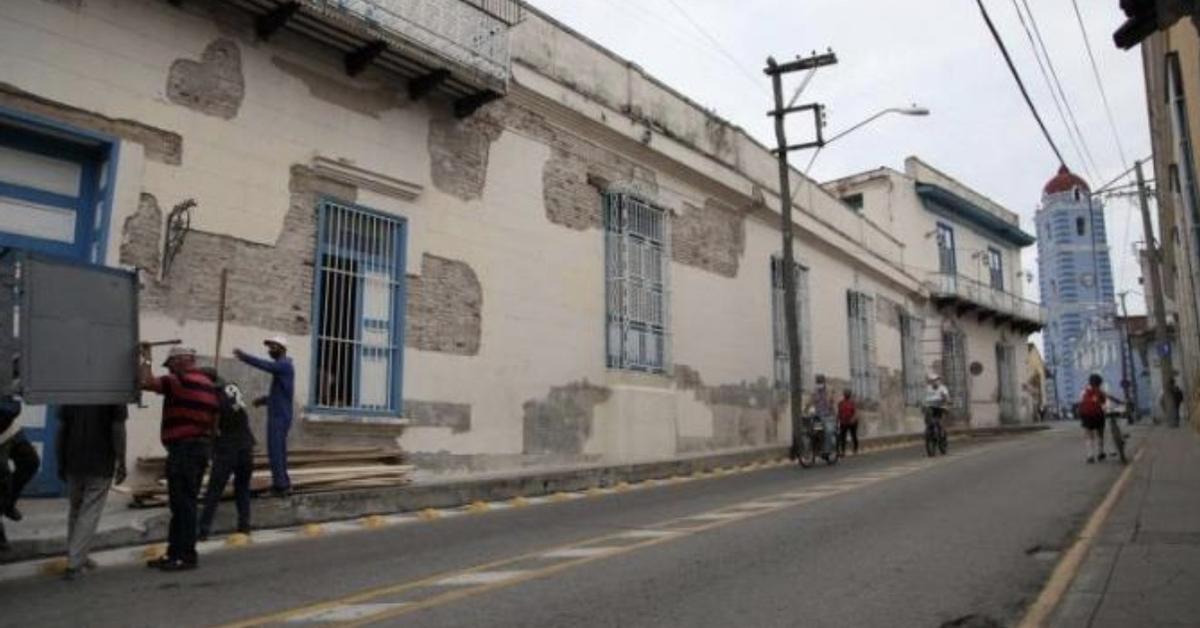
Havana/Structural problems and maintenance failures that have not been resolved even with the repairs undertaken intermittently since before the start of the pandemic. The dire situation of the Museum of Colonial Art of Sancti Spíritus, known as the House of a Hundred Doors and closed since 2019, is such that even the official press has attacked it.
“A closed museum is anything but a museum,” declares Martha Cuéllar Santiesteban, recently retired former director of the institution, to Escambrayin a note published this Monday, unusually critical. The woman, who received a special recognition as the best museologist in the country in 2021, points directly to the authorities as responsible: “There has been poor management when deciding what to do from a constructive point of view because during all these years work has not stopped in that regard. There have been botched jobs, delays… all under the argument of budget problems in the Municipal Directorate of Culture of Sancti Spíritus.”
Cuéllar concedes that this “is not uncertain”, but clarifies that it is a problem that the entire country suffers, and objects: “When this story began and now, the prices of the materials to be used and the effects have increased considerably. I had responsibility because I was the director. The time came when I no longer had dialogue because there were always justifications and I opted for my right to retire.”
In the House of a Hundred Doors, this deterioration has caused irreversible damage to both the structure of the property and pieces of incalculable historical value.
The deterioration has caused irreversible damage to both the structure of the property and pieces of incalculable historical value.
“The greatest magnitude is concentrated in the carpentry,” says Yadira Castillo Rodríguez, director of the museum for more than a year, who affirms that almost the “total amount of the annual budget” will be allocated to this repair.
Cuéllar, however, adds with concern that “money has been spent in a hurry to meet some date,” and continues, alluding to the common practice on the Island of “facelifting”: “The façade has been painted to please someone’s eye.”
These types of practices, he regrets, “delay and complicate the recovery and deep restoration of the place.” As an example, he defines as “botched work” the work carried out in the patio gallery, which “was taken down three times.” And he asserts: “A lot was invested in a single area unnecessarily. Thus, money was lost to advance in another object of work.”
According to Yoel Pérez Triana, who is in charge of the Culture and Art Sector in the province, a lot of damage has emerged in different institutions shortly after being restored, but his words are full of the voluntarism that the regime usually draws on: “Whatever is done must last over time. We have to work from priority, impregnate sensitivity towards our institutions in government directions because we need to be accompanied.”
It What happens in Sancti SpíritusIn any case, it is not an isolated case. In many provinces, museums and cultural institutions have been closed for years or operate partially, while their collections remain stored in inadequate spaces, without ventilation or minimum conservation conditions. Many pieces are not on display to the public, but rather kept in boxes or improvised premises, exposed to humidity and neglect, without systematic control of their condition.
In many provinces, museums and cultural institutions have been closed for years or operate partially
In 2024, during a digitization process carried out by the Photo Library of Cuba, it was necessary to discard numerous negatives and images due to advanced mold damage. According to a source consulted by 14ymediothese materials had reached a point of irreversible deterioration. “Photos with fungi put the rest of the archive at risk and should be discarded, regardless of their historical value,” she explained resignedly.
Given this institutional neglect, independent initiatives have emerged that try to rescue cultural heritage with very limited resources. Projects such as Archivos del Monte or Wild Archivists They work outside official structures and are dedicated to preserving, against the clock, amateur audiovisual materials that in many cases have been literally recovered from the trash. Thanks to these efforts, documents that had already been left out of any public conservation policy have been saved.
The prolonged closure of museums and the lack of heritage maintenance have placed the country’s cultural memory in a critical situation. Archives without ventilation, damaged photographs, pieces abandoned or stored for years without any classification show a continuous process of degradation. As long as there are no effective public conservation policies, the rescue of national memory will continue to depend on isolated initiatives that fight to preserve the little that still survives among improvised deposits and waste.