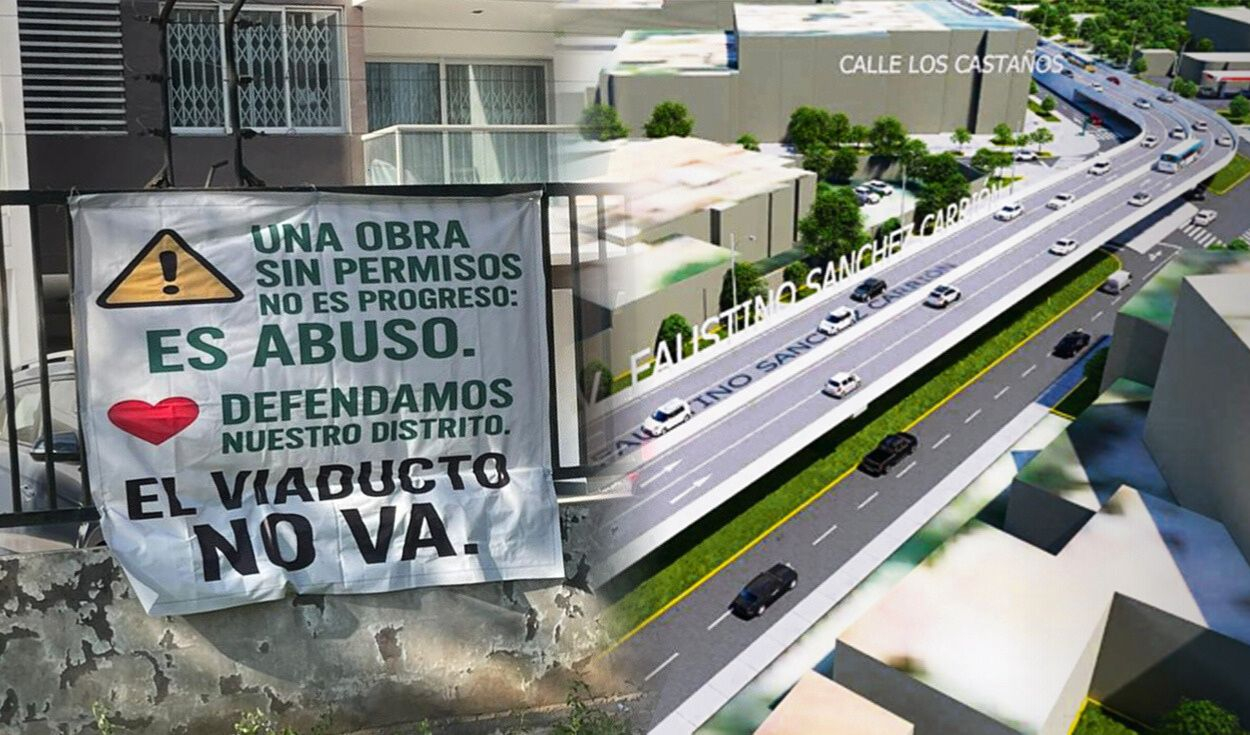
The construction of three elevated viaducts at critical points on Javier Prado Avenue, by the Municipality of Lima, has generated rejection from the residents of San Isidro, Magdalena, La Molina and Jesús María because, according to them, they will cause greater vehicle congestion, pollution and green areas will be affected. However, the capital municipality defends this work that was not in its initial plans.
“How are they going to destroy the area of trees? What are we going to breathe, cement, pollution? Everything they are going to destroy is going to fill us with dirt and noise,” say some residents of San Isidro, who have placed signs on the doors of their homes with a strong message: “No to viaducts.”
YOU CAN SEE: “Welcome to hell”: 4,366 Venezuelan prisoners in Peruvian prisons
On the route of Metro Line 4
But the most serious thing is not the noise or the dust, but the interference that this work will represent for the future Line 4 of the Lima Metro, a mass transportation project that will link Santa Anita with Callao through a 23.6-kilometer underground track that will pass under Javier Prado Avenue.
The work will benefit the population of 13 districts. And a branch is already being built in the Constitutional Province that will also connect to the new Jorge Chávez airport.
In this regard, the president of the Urban Transportation Authority (ATU), David Hernández, said in Andina that they were consulted and that he provided a technical opinion. He asked that the Municipality of Lima respect large projects such as Metro Line 4, and that if the viaducts are completed, they should not be “incompatible” with the mass transportation project. In that sense, he said that one of the ATU’s proposals is that the lower part of the viaducts be used as a station and lane for public transport.
And about the future underground stations of Line 4? The ATU said nothing.
A project of S/540 million
The MML work in Javier Prado, which has emerged at the last minute, is valued at S/540 million and it has not yet been clarified where the financing will come from; If it will be from transfers from the Central Government or with municipal funds. Furthermore, it does not have road, environmental or financial impact studies to support its execution, said the specialist in municipal issues, Martín D’Azevedo.
And urban planning experts, architects and NGOs oppose viaducts and rather point out that the State should opt for other quick and less costly solutions.
For example, the president of the NGO Luz Ámbar, Luis Quispe Candia, explains that viaducts are not convenient and are not going to solve the problem of congestion. “On the contrary, it is going to get worse, as is already happening in various parts of Lima. The solution is to implement the Integrated Transportation System (SIT), which already has a regulatory plan. That should be the priority.”
More buses to connect with the Metro
However, the ATU would intend to implement the SIT with the current carriers of the traditional system, which would be impossible because the companies do not own the vehicle units. “There are 385 traditional transportation companies and they have an average of 22 thousand buses, combis and buses, but they are not their property; they do not have money, not even a thousand buses will be purchased with them,” he notes.
The expert proposes that there be a public-private association to purchase the buses. “This is how it works in Chile, in Colombia, that way the Integrated System can be quickly implemented, instead of building these viaducts on Javier Prado, which will only attract more private units.”
“If the underground train were implemented under Javier Prado, travel demand would be alleviated, and if we put buses on the surface on top of that, viaducts are no longer necessary,” he adds.
Viaducts will not be a solution
While urban planner Pablo Vega Centeno, from the Pontifical Catholic University of Peru (PUCP), maintains that the viaducts on Javier Prado will not be the solution to traffic, as they will encourage the purchase of vehicles. “Viaducts are being built in a consolidated and dense area of the city, in an area where there are certain green areas that help mitigate a landscape of high vehicular density; to carry out this work they are going to eliminate 50-year-old trees, a whole forest that helps to have a more tolerable landscape.”
He maintains that other types of quick and short-term responses should be sought, such as beak and plaque control, which was suspended due to the pandemic. As recalled, this measure restricted the circulation of private vehicle units at times established according to the last number of the license plate, whether even or odd, with the purpose of reducing the number of vehicles on the roads, speeding up traffic and promoting the use of public transportation.
Vega Centeno highlights that viaducts are not contemplated in the Lima Plan for 2040, which has a huge portfolio of projects. There is also no link with the ATU mobility plan. “So, why is there an intention to carry out road works at full speed? It sounds suspicious,” he points out.
Meanwhile, the dean of the College of Architects, Lourdes Giusti, agrees that viaducts attract more cars and achieve the opposite objective, that is, more congestion. “It’s like a honeycomb, they all want to be there.”
It is proposed that there be green waves with an integrated network of smart traffic lights, which have sensors to identify where there is more and less vehicular flow and, depending on that, give the time to one intersection or another.
Another thing that could be done in the short term—as mentioned—is to create a free route for the Red Corridor, similar to the Metropolitan.
“So, if we had this Red Corridor, which goes faster, people could use it instead of spending so much gasoline and they would move faster.” In addition, he emphasizes that the police should be on the road to establish order and not allow motorcycles to be anywhere, nor for vans to stop anywhere.
“Why is so much money going to be invested, like 550 million soles, for a work that (will be replaced) as soon as Metro Line 4 is finished?” Giusti questioned.
And he added that Invermet, which is the metropolitan investment system, should not continue giving economic authorizations to projects located in areas where there are already plans in place.
In response, the manager of Invermet, Pablo Paredes, defended the work and said that it is already contracted. That is, there is no going back. He highlighted that not only are they two-lane viaducts, a segregated public transport lane is also planned. “With ATU we are coordinating to generate stops below the viaduct for users of the corridor.”
Those who have not commented on this delicate issue are the Ministry of Transportation and Communications and Ositrán. Why would it be?
There are 60 vehicular bridges in the portfolio
- The Municipality of Lima recently announced an ambitious Metropolitan Expressway project that includes the construction of 60 viaducts in key points of the city such as Huaylas, Pista Nueva, Nicolás Ayllón, Túpac Amaru and Javier Prado avenues.
- Traffic engineer David Fairlie maintains that the same solution cannot be given to different corridors, and that the normal thing is to make one type of solution and improve the intersection, the traffic lights. “Every corridor has a characteristic and the solution must be tailored.”