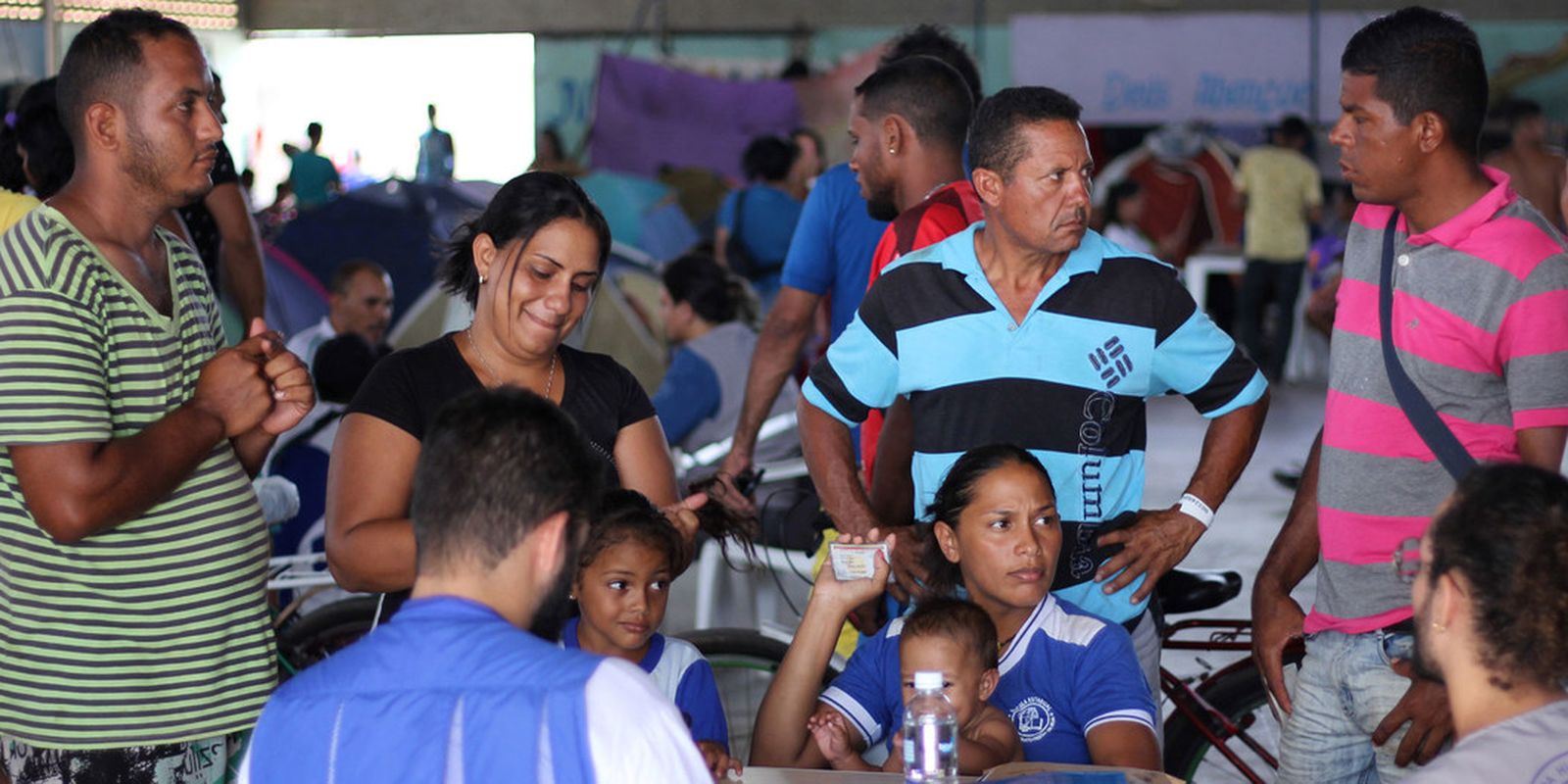
Audiovisual producer Benjamin Mast came to Brazil from Venezuela in 2016. At the time, there was already an economic crisis in his country and he came in search of better job opportunities. The migration crisis was not yet at the level it began to reach in 2017 with the daily increase in the flow of Venezuelans to Brazil, especially through Roraima.
Today, at 44 years old, Benjamin is settled in that state and currently has a production company where he works with his wife. The two have a 1-year-old daughter. Coming to Brazil did not have the same meaning as his compatriots who, at that time, were facing starvation due to the country’s economic conditions. Benjamin had already done some audiovisual work in Brazil and thought that here he could advance further in his field.
Jobs in Brazil began to emerge in 2014 and continued the following year, while they were scarce in their country due to the economic crisis. From there, migration was the right decision. “It was a very calm process. There wasn’t this migratory wave. It was very small, around 100 people arriving in Brazil”, he stated in an interview with Brazil Agency.
Mast said he is completely against the United States (US) invasion and is heartbroken. “It’s very sad for me to feel that my country is going to become a colony. Trump said he will manage Venezuela and there is no international legal status for that”, he reported.
The pain of feeling that the country was bombed, with the entire process of violating rights, grows even more when we see that a portion of the population is happy with the invasion. “For me, it is difficult to say this to all Venezuelans. There is a divided issue with this crisis that Maduro caused,” he said, recognizing that the imposed economic blockades also contributed to the situation that Venezuela was facing.
“The oil industry – many things also caused this – was the combination of the country’s bad political and economic situation on the part of Maduro and the government, with US economic and political sanctions,” he added.
For Mast, the image of the military throwing bombs and still seeing the reaction of some people celebrating as if this were the only way out – becoming a colony – is very strong.
“Not even having the self-love to try to change things from within. I think we are going to see a very polarized Venezuela, very unstable politically because it has a power vacuum”, he stated, concluding that it was also very strong to see Nicolás Maduro being transported to the United States to be indicted there.
“There are many accusations against Maduro and the Venezuelan government, but being taken there as a criminal is very strong.”
The future with US intervention is also not promising, according to the producer, because the administration promised by President Donald Trump will not change Venezuela’s social issues. Mast said that in this case the beneficiaries will be the American oil and economic oligarchies. “I’m very afraid of this power vacuum and of becoming a colony. History tells us that a country dominated by North Americans never goes well”, he observed.
“The lack of sovereignty will have a very high price not only for Venezuela, but for Latin America in general, this unjustified and illegal invasion,” he said, predicting a lot of violence in the country because of polarization.
Today, Livia Esmeralda Vargas González is a professor at the Federal University of Latin American Integration (Unila) in Foz do Iguaçu, Paraná. She arrived in Brazil in 2016 after winning a PhD scholarship in history at the Federal University of Ouro Preto, in Minas Gerais, which began in 2017. She completed her doctorate in five years, but she was not the only one. During the same period, he also completed a doctorate in philosophy. “The Venezuelan crisis led to a temporary stay for a doctorate becoming a migratory crossing,” he told Brazil Agency.
The fact that she carried out these studies in Brazil, including on the history of Venezuela – which her colleagues were unable to carry out in the country – made the migration process more difficult for Livia, also because she was far from her family who was facing the crisis in her country.
“Having to deal with this wound, this pain and follow the critical situation from afar in economic, social, political and emotional terms has been a journey that oscillates between gratitude towards Brazil that welcomes me and the pain of my family far away”, he revealed.
The difficult times during PhDs became lighter last year. In August, her son Aquiles Léon, aged 21, came to live with her in Foz do Iguaçu. After going through a selection process for Latin American and Caribbean students, the son won a place at Unila for the energy engineering course. The teacher recognizes that despite being in good condition, it is not easy for Achilles to go through the migration process.
Livia recalled that in Venezuela she was an associate professor of the sociology course at the country’s main university, and salary conditions were precarious. “The living and subsistence conditions of my colleagues are sad, regrettable, deplorable”, he observed, adding that he admired many of them, who became references for the academic production they produced.
To support themselves, according to Lívia, some of them have to do other services such as deliveries or any type of work to survive, so the time to research is practically non-existent. The possibilities she achieved as a teacher and researcher in Brazil would be impossible in Venezuela. “Not just as a researcher, but as a writer. Here in Brazil I was also able to open a window as a poet and writer”, she said.
Invasion
The professor repudiates the invasion carried out by the USA and calls the situation that deepens the trauma of the Venezuelan population appalling. Not to mention the precedent it sets both for your country and for Latin America and the world.
“It means the materialization of an act of practical intervention and recolonization of my country. It is something that does not exist in the republican history of Venezuela, after the Army commanded by [Simón] Bolivar will take the Spanish empire out of the country”, he criticized.
“I feel deeply sad. It’s a pain that I can’t even name the level of and that further reinforces our catastrophe, a situation of years of fractures, the last year of a process of repressive policies against the internal population.”
In this post-invasion moment, once again she worries about her family. “My father is there, my mother, my family, my friends are looking at how to guarantee today’s food. There is no energy, no access to basic things. What will it be like in this uncertain environment, where you don’t know if you will be bombed again”, she asks, emotionally, when reporting that she was planning for her father to come in February for a visit. “That’s no longer possible. It hurts me. I was emotional to say that I can’t hug and be with them.”
Cooking
When she came to Brazil with her husband and two children in 2015, Maria Elias was an IT technician. The family lived and had a store in Güigüe, in the state of Carabobo, Venezuela, and managed to support themselves until the economic crisis advanced. The solution was to come to Brazil. “If we stayed there, we knew what was going to happen. When we left there, there was a 50% chance of it going right and a 50% chance of going wrong. We decided on the 50% chance of it going right,” he said, in an interview with Brazil Agencyremembering that the positive part of coming was getting places for their children in public schools in Rio.
For her and her husband, the difficulties were the Portuguese language, Brazilian culture and insertion into the job market. The solution was to dedicate himself to cooking to earn a living, which was related to his ancestry.
“It was very difficult to start and, therefore, we differentiated our cuisine as Lebanese and got our first order at a snack bar close to where we lived”, he reported, also revealing that the owners became the family’s best friends and helped them every time they had questions.
With the success in sales, in 2016, they began to be hired to host dinners in homes and, after a year, they expanded the menu. “We realized that people also wanted Italian food and we switched to Arabic and Mediterranean cuisine. And more work, thank God.”
Maria also has relatives in Venezuela and worries about the situation. She welcomed Maduro’s departure from power, but sees the local political situation as still very confusing. “There are many things to assimilate, we don’t know what is true and what is a lie,” he said, citing the complexity of the moment with the political division the country is experiencing.
“We have to maintain, at least for now, the Chavista government to see what will happen and then hold free elections. We need to clean up. We have to hope for clean elections, but we don’t know when and if that will happen”, he indicated, highlighting that it is unknown what Donald Trump thinks.
“What matters is that Venezuela is reborn and returns to being productive as it always was,” he concluded.