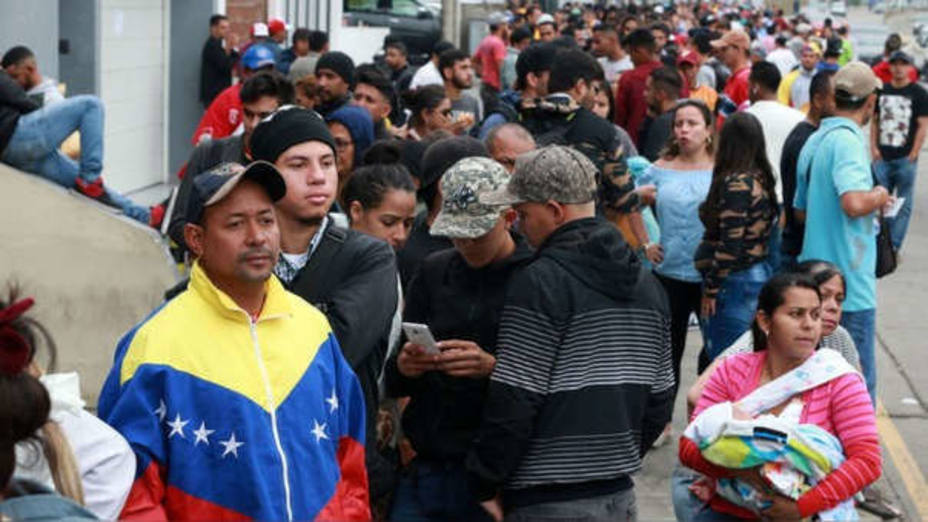
This year’s Christmas in Venezuela will be marked by a feeling of isolationeither. The geopolitical fence around the country has tightened in recent weeks, turning the longing for family reunion into an obstacle course for thousands of migrants. As the world celebrates, many Venezuelans abroadthe reality is that of a country to which they cannot return.
The trigger for this new chapter of collective loneliness escalated with tensions with Washington in late November. The warning from the Federal Aviation Administration of the USA (FAA) on the risks of flying in the region was sealed by a ruling by President Donald Trump. “Consider the airspace above and aroundr of Venezuela closed in its entirety.”
That phrase unleashed a domino effect that further isolated the South American nation. Regional and European airlines canceled routes or lost their operating permits, leaving the dreams of thousands of people on the ground who, After years of absence, they had planned their return for the holidays.
Truncated illusion
Airline disconnection has devastating emotional consequences. For Sol, who has lived in Buenos Aires for more than a decade, Isolation means that his 7-year-old daughter will not be able to hug her grandmother in Caracas, he told CNN. The cancellation of their flight, just four days before departure, shattered an illusion built for months.
The pain is felt on both sides of the distance. In Caracas, Sol’s mother had put up the Christmas tree, something she had not done for years after a family loss, motivated solely by the hope of welcoming her granddaughters. That tree now testifies to the absence imposed by the political situation.
Meanwhile, an engineer in Argentina saw his first return trip frustrated since emigrating in 2019, a plan designed to unite those who are outside with those who are still inside. “It was a family plan: those of us who are abroad were going to travel, meet in Caracas with those who are there and have a family reunion. In June I bought my ticket,” he said about the logistical effort that came to nothing.
From Italy, the story of Alessia Starita, 76, reflects the resistance who He hoped to receive 2026 with his six brothers in Venezuela, Despite the news about the suspensions of European airlines, hope was the last thing he lost. “We refused to unpack and waited until the last few days, but reality prevailed,” he told cnn.
On the edge of the abyss
With airspace practically closed and options reduced to complex land journeys through Colombia, the predominant feeling among the diaspora is uncertainty. The current crisis is not an isolated event, but a brutal reminder of the instability that governs their lives.
For Venezuelans trying to maintain ties to their land, planning a trip became an act of faith that It often ends in frustration. Sol accurately summarizes the collective feeling of a nation whose citizens live with the permanent anguish of not knowing if they will be able to return home. “We have been in an extreme situation many times and we have the permanent feeling that something is going to happen. It is always being on the edge of the abyss.”