Opposition deputies questioned that the 2026 Budget does not include items for increasing the “nominal and real” salary of workers. The ruling party Jesús Faría stated that “there are enormous difficulties but this budget and the Debt Law adjust perfectly to the realities and needs of our people this year as in previous years.” Next Thursday there will be the second discussion of the bill for Venezuela to denounce the Rome Statute, which governs the operation of the ICC.
The National Assembly sanctioned this Tuesday, December 9, by a qualified majority in control of the ruling party, the Budget and Debt Laws for the financial year 2026.
After a consultation by First Vice President Pedro Infante, which lasted around three minutes, the budget was approved after the approval of the ruling parliamentarians. Next, and after interventions by deputies Luis Eduardo Martínez (AD) and Jesús Faría (PSUV), the special Debt Law was also approved. Both will be sent to Nicolás Maduro for promulgation in the Official Gazette.
On December 4, Vice President Delcy Rodríguez presented both projects before the Venezuelan parliament. For the fiscal year 2026, 5,022,968,785,870 bolivars were requested, equivalent in dollars to 19,941,911,965. This represents a 12% decline in dollars for what was budgeted in 2025.
While the debt for next year amounts to 531 thousand 959 million 968 thousand 271 bolivars, prioritizing 12 projects of the Ministry of Electric Energy, seven for Defense, four from the Water portfolio and three belonging to Public Works.
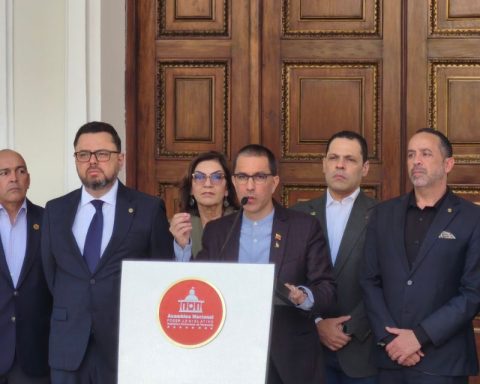
In a brief participation, deputy Faría said that “in a tendentious manner” the opposition deputies “make the same claim as last year”, after an intervention by Óscar Ronderos (AD) where he claimed – on behalf of the opposition – the lack of a budget item for the increase in the “nominal and real” salary of workers.
The former minister stated that Venezuela faces a scenario of “political, diplomatic, economic and military aggression” by the United States, although “growth” has been achieved in various sectors, an increase in tax collection and “an increase for workers of at least 25%.”
“The workers of this country can be absolutely sure that here we have a revolutionary and socialist government whose first concern is to address this debt with the workers that has been created by an exogenous factor, by imperialist aggression,” said Faría.
Regarding indebtedness, deputy Luis Eduardo Martínez questioned that to a large extent it includes projects requested in previous years that, he said, have not been able to be executed due to the “economic siege.”
Financing these projects “would be unviable and is unviable as long as foreign unilateral economic sanctions are maintained,” Martínez insisted.
Jesús Faría replied that the “blockade” dates back to 2017 and economic growth has been recorded since 2023. “It is impossible for an economy to have that growth with an unviable budget… There are enormous difficulties and, despite these difficulties, we make investments in the social and productive area, we create the stimuli and we have these scenarios of productive strength.”
“There are enormous difficulties but this budget and the Debt Law adjust perfectly to the realities and needs of our people this year as in previous years,” he stated.
“We got out of that pod”
The Venezuelan parliament also presented and debated the “bill in defense of Palestine and humanity”, as they renamed the norm to repeal the Rome Statute, an instrument that governs the functioning of the International Criminal Court and approved in the first discussion. last week.
The public consultation on this project began just one day before at an activity in Caracas, according to a press release of the National Assembly.
The president of the National Assembly, Jorge Rodríguez, began his intervention by questioning “what the hell is the International Criminal Court for?” and the lack of response from this international court regarding the policy of economic sanctions against Venezuela by the United States, a country that it assured is the “owner” of the ICC.
He recalled that the Venezuelan authorities received prosecutor Karim Khan in Venezuelan territory, approved two memoranda of understanding, while the National Assembly approved eight laws “on the recommendation” of the ICC Prosecutor’s Office.
«The only request that Venezuela made… is that a case be opened in the International Criminal Court, which is known there as Venezuela II, to study the devastating effects of unilateral coercive measures on the Venezuelan population. What was your response? “They opened the case and shelved it,” he said.
According to the president of the AN, renaming the norm that will allow the Venezuelan State to denounce the Rome Statute is a “measure of solidarity for the Palestinian people and the people of Gaza”, while ironizing the “coincidence” that the majority of cases and investigations are concentrated in Africa, Russia, China, Venezuela and Iran.
«That blessed International Criminal Court only serves to attack us, if we stay there it is to re-victimize ourselves… Others want to continue being hypocrites, not us. We get out of that pod. Let others continue to believe that Gaza has already been fixed… We want to insist on denouncing the greatest genocide that has occurred on this planet in the last 70 years,” he asserted.
At the end of his speech he said that next Thursday the second discussion of the bill will take place.
On the other hand, he briefly referred to the Nobel Peace Prize that will be awarded to opposition leader María Corina Machado on Wednesday, December 1, in Oslo (Norway). “Poor Nobel Prize that they give it to a person who calls for the invasion of Venezuela… who celebrates the bombing of innocent people in the Caribbean.”
*Journalism in Venezuela is carried out in a hostile environment for the press with dozens of legal instruments in place to punish the word, especially the laws “against hate”, “against fascism” and “against the blockade.” This content was written taking into consideration the threats and limits that, consequently, have been imposed on the dissemination of information from within the country.
Post Views: 104