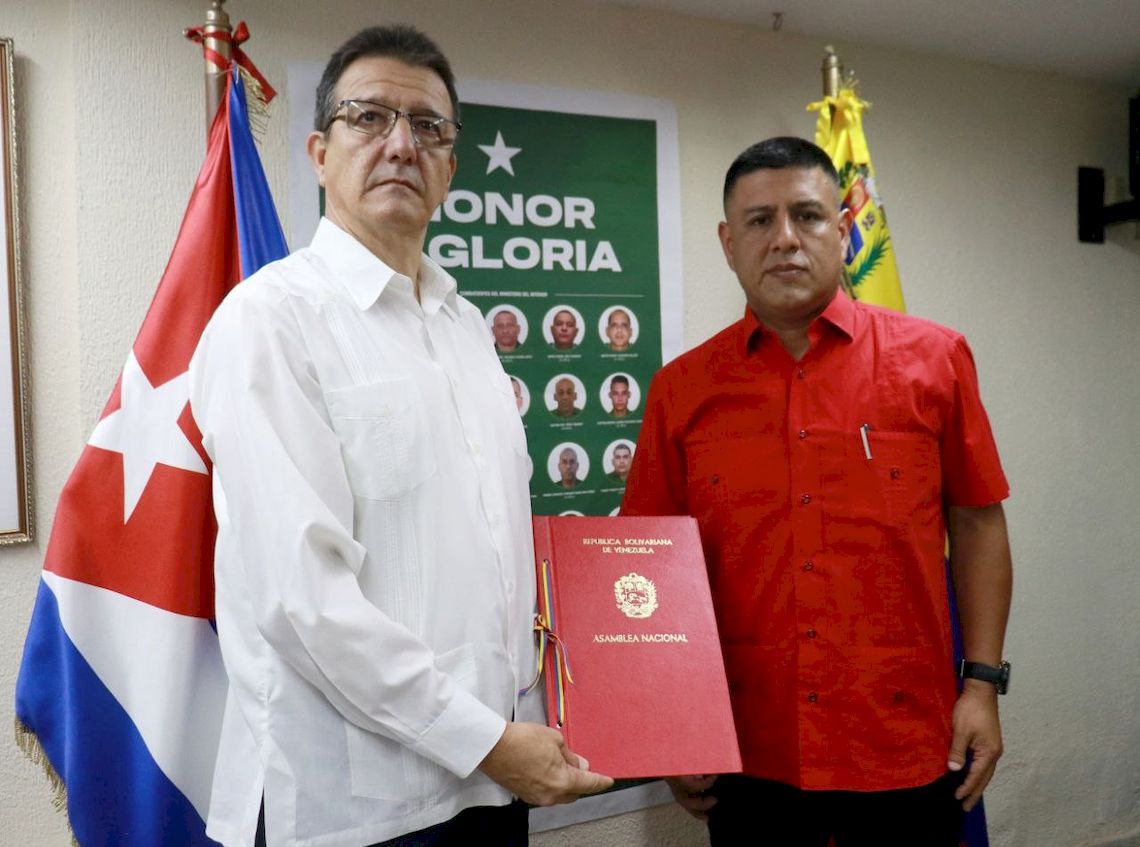
The National Assembly of Venezuelawith a Chavista majority, delivered this Monday to the Cuban Embassy in Caracas an agreement in which it declares “heroes and martyrs” the 32 Cuban soldiers killed in the United States attacks on January 3.
This occurred at the same time that the opposition parliamentary group demanded the release of all political prisoners as a condition to talk about democratic transition in the country.
The first vice president of the National Assembly, Pedro Infante, delivered the document to the island’s ambassador in Caracas, Jorge Luis Mayo Fernández.
“We pay tribute to the murdered Cuban brothers and their families. All our recognition and gratitude,” Infante expressed on the social network.
The agreement, approved unanimously on January 8, declares “heroes and martyrs” to the victims of the attacks in Caracas and surrounding regions, in which 47 members of the Bolivarian National Armed Forces (FANB) also died, according to official figures. The Minister of Defense, Vladimir Padrino López, explained that nine of the deceased were military women and that more than 112 people were injured.
In Cuba, the posthumous tributes concluded on Friday with the burial of the 32 soldiers in cemeteries in their places of residence. Four were buried in the Colón Necropolis, in Havana, in a ceremony led by President Miguel Díaz-Canel.
Cuba before the US: lessons and anti-lessons from the intervention in Venezuela
The relationship with Cuba
During the delivery of the document to the Cuban side, Infante described the brotherly relationship between both countries as “unbreakable.”
“This tribute is also a message to the world: the union between Venezuela and Cuba is not broken even in the most difficult moments,” he assured, amid strong pressure from Washington for Caracas to break with Havana and other strategic partners, such as China and Russia.
The parliamentary gesture reinforces, at least on a symbolic level, the political alliance between Cuba and Venezuela, which is maintained for the moment despite the capture of President Nicolás Maduro and his wife, Cilia Flores, during the US military operation.
In its statement, the Venezuelan National Assembly also urged other parliaments and governments to reject the use of force and support international law.
Today’s Venezuela: scenarios and pressures for the Cuban economy
Opposition demands for political prisoners
While Chavismo paid tribute to the fallen Cubans, the opposition Libertad faction, headed by Henrique Capriles, demanded the release of all political prisoners as a condition to talk about transition.
“The vast majority of Venezuelans expect that this will be a real change, that the country will begin to move forward in terms of recovering its democracy,” Capriles said at a press conference.
The opposition leader and former presidential candidate warned that “we cannot talk about transition or profound changes until we talk about personal freedoms.”
According to the NGO Foro Penal, Venezuela currently has 777 political prisoners, despite the 143 releases announced since January 8. “We are still waiting for total release,” stressed Alfredo Romero, president of the organization.
Capriles insisted that “the country must be stabilized” and that re-institutionalization involves a new National Electoral Council. “The end of the film is precisely that popular sovereignty is expressed and respected,” he added, cited by journalistic reports.
Foro Penal clarified that releases do not imply full freedom, since many released people face prohibitions on leaving the country or speaking before the media. Relatives of detainees remain outside several prisons demanding the release of their relatives.
Following the July 2024 presidential election, more than 2,400 people were detained on charges of terrorism and vandalism. Although the majority were released, NGOs denounce repression and assure that many of those imprisoned are innocent.
Venezuela and the US move towards reopening embassies while Delcy Rodríguez reorganizes her cabinet
Recomposition of the post-Maduro cabinet continues its course
In parallel, interim president Delcy Rodríguez announced new appointments to her cabinet, including Nuramy Gutiérrez as Minister of Health and Calixto Ortega as president of the International Center for Productive Investment.
Rodríguez has nine appointments since he assumed power on January 5, two days after Maduro’s capture.
The interim president has sought rapprochement with Washington, with energy agreements and the partial release of political prisoners. “This new designation will allow us to continue attracting national and international investments for the national productive system,” said Rodríguez.
This Monday, the Government of Venezuela rejected new information disseminated by international agencies that, according to it, seek to discredit the president in charge by involving her in international drug trafficking.
Through the official account in
The US completes its first sale of Venezuelan oil for 500 million dollars
Energy agreements with the US and return of migrants
Capriles and other opposition deputies requested information about the new energy agreements reached with the United States. “We would like to know the scope of the energy issue, the new agreements that are being proposed in the country,” said the opponent, who estimated inflation at 630%.
The Central Bank of Venezuela has not published official figures since October 2024. Capriles proposed giving a bonus of $150 to each public employee and pensioner, whose minimum monthly salary is below one dollar.
Meanwhile, the Ministry of the Interior reported that a plane with 235 Venezuelans deported from Arizona, United States, landed this Monday in Caracas, as part of the “Great Mission Return to the Homeland.” This is the 100th flight of this program, created by Maduro before his capture. Another flight with 199 migrants arrived on Saturday.
The Rodríguez government highlighted the operation as a “milestone” and reaffirmed its commitment to Venezuelans abroad who wish to return.
Cabello, the strong man, says they will continue to govern
In the midst of this panorama, the general secretary of the United Socialist Party of Venezuela (PSUV), Diosdado Cabello, called for a “great mobilization” in Caracas for January 23, a date that commemorates the fall of the dictatorship of Marcos Pérez Jiménez in 1958.
“Today is 17 days since the kidnapping of the president’s brother and his companion Cilia Flores. Kidnapped, subjected to a prisoner of war situation,” recalled Cabello, who is the Minister of Popular Power of Interior Relations, Justice and Peace and who is credited with controlling the so-called collectives, groups of armed bikers that support the Government.
Considered the strong man of Chavismo, Cabello assured that “everyone is focused, as their first objective, on the release of the president and Cilia,” imprisoned in a maximum security and rigor prison in New York.
“Everything happens there. We are not going to stop, we are going to continue governing,” he asserted.