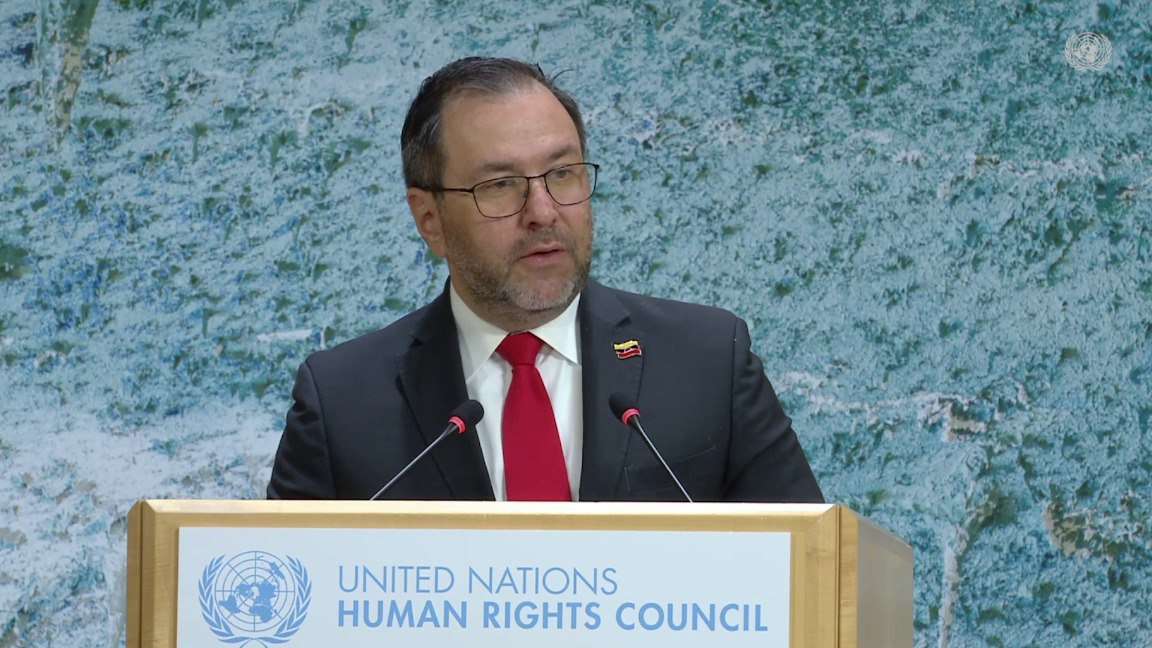
During the 61st UN Human Rights Council, Foreign Minister Yván Gil denounced that Venezuela faces a “multiform aggression.” On behalf of President Nicolás Maduro and the acting president Delcy Rodríguez, the diplomat warned about the politicization of the multilateral system; Likewise, he ratified Caracas’ willingness to engage in diplomatic dialogue with the United States.
Gil stated that the image of Venezuela as an offending State was built on biased reports. According to the minister, this strategy was not a legal debate, but a political operation that led to the freezing of national assets and the criminalization of migration.
Regarding citizens abroad, the chancellor described the practices of xenophobia as shameful. He also denounced the existence of degrading detention centers and forced transfers. “All this happened before the eyes of the world and the international bureaucracy,” he said.
Gil stressed that “the central message that we bring today is that human rights cannot be an instrument of political war against sovereign nations.”
Dialogue with the US and national reconciliation
Despite the siege, the chancellor reiterated his willingness to resolve differences with Washington through diplomacy.
He contrasted this position with the US military action and what he described as the “arbitrary kidnapping” of the national president and Representative Cilia Flores, on January 3.
On the internal level, Gil highlighted the Amnesty Law approved by the National Assembly. He assured that this instrument seeks peace and forgiveness, reaffirming that the country resolves its issues under its own constitutional framework.


Against “selective geopolitics”
The central message of the delegation was the rejection of selectivity. Gil questioned the disproportionate scrutiny of certain nations while ignoring, for example, the devastation of the Palestinian people.
In this sense, he reported on the resumption of cooperation with the Office of the United Nations High Commissioner for Human Rights (OHCHR). The step will allow for reopening spaces for technical dialogue based on respect for sovereignty.
He warned that, if human rights are used as a pressure tool, the organization will lose its moral essence and legitimacy.
Peace with sovereignty and cessation of sanctions
In closing his speech, Gil emphasized that Venezuela has chosen the path of peace with sovereignty and cooperation based on the legal equality of States. He demanded, with a firm voice, the cessation of unilateral coercive measures, pointing out that these have violated the economic and social rights of millions of Venezuelans.
“Venezuela will continue to defend its independence and the rights of its people. It will do so with diplomacy, with words and with the conviction that peace is the supreme good,” concluded the chancellor.
Finally, the diplomat urged the Council to look at itself critically and correct its deviations. He advocated for a global agenda that does not avoid major tragedies or apply political selectivity that weakens multilateralism.