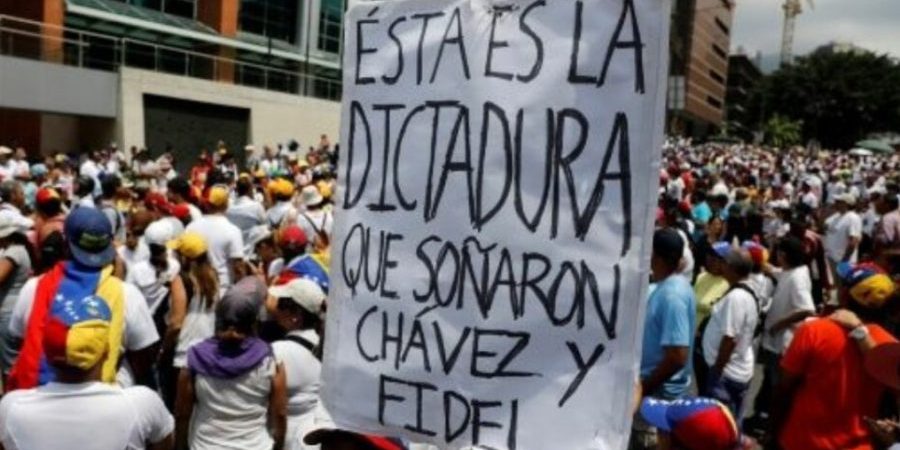
Castroism and Chavismo—separated from that—are not like any other dictatorship where the visible head is the HEAD, in capital letters. Fidel Castro taught Hugo Chávez the importance of idiotizing the masses and impoverishing them to better control them.
HAVANA, Cuba.- Since what happened in Venezuela, the Internet has overflowed with theories and hypotheses about what happened and what will happenpositive and negative analyzes of the military operation, comparisons with the Cuban context, omens, present and future expectations, slogans and bravado (the latter on the side of the dictatorship, which once again tries to “turn setbacks into victory”, but in the style of “Cheo Malanga”, that comic character that perhaps older Cubans still remember, played by the actor Enrique Arredondowhose handsomeness was pure boast).
Each one has gone with the version of the events that has most convinced them or that suits their interests, as well as the forecasts, from the most furious optimism to the most extreme pessimism, but there are very few who have shown themselves indifferent to the events, and the fact is that it does not matter which path it follows, but what happened this January 3 will condition many political processes in the world, and Cuba, even with its singularities and anachronisms, will not be the exception. More so when the presence of Cuban troops in Venezuela makes it part of the problem, of the evolution and of the solution.
I confess that as I read the most sincere and least biased analyzes that I have found here and there, the more doubts I accumulate (even when they have warned on the regime’s TV that “doubting is treason”) and the less I dare to risk an opinion that would inevitably be conditioned, furthermore, by my desire for whatever happens in Cuba to end, as long as we are ever a normal country and not this thing that is not a farm or a military camp but just that, a “thing”, much more similar to a prison for the mentally retarded than to an asylum (where among crazy people and pretenders sometimes even one manages to glimpse some shred of sanity).
I believe that this sad and discouraging reality that conditions all the political, economic and social processes that develop within it is the only thing that I do not doubt. It is only from there that I manage to more or less understand the incomprehensible. For example, there is no economy as such but rather a “thing” that tries to resemble it; that there is no president but “that” that causes us so much shame if it opens its mouth or if it remains silent, in short, it is a good resource to dig to infinity and beyond in this “thing” that seems like a country but that long ago stopped being one.
It is, furthermore, starting from that only certainty that I risk maintaining that, with the Cuban regime, as well as with the Venezuelan one, like a wedge of the same stick, it is not prudent—or even possible—to try lasting political solutions that start from a budget of normality that does not exist in both dictatorships.
I believe, from the opinions and debates that I have reviewed, that a good part of the analysts of the current situation in Venezuela share that assumption when they warn that replacing Nicolás Maduro with Delcy Rodríguez – keeping Diosdado Cabello, Vladimir Padrino López and Nicolasito Maduro Guerra in their positions – would be more or less the same as eliminating Miguel Díaz-Canel and putting Manuel Marrero Cruz or Salvador Valdés Mesa in their place, keeping the Castro military leadership intact with or without Raúl Castro, a “historical” one like Ramiro Valdés and even a “super heir” like Raúl Guillermo Rodríguez Castro.
As much as they are willing to save their skin by being receptive to the “enemy” and sending them signals of openness, not only in those changes agreed upon under pressure would the injustice of not seeing Castro’s leaders pay for the crimes accumulated for more than half a century remain latent. The repression would be legitimized and, to make matters worse, the repressors would be rewarded.
By projecting or superimposing Venezuela’s current scenario onto our own, we could better appreciate how disappointed we would be in a similar situation, as well as the frustration that invades many Venezuelans.
Castroism and Chavismo—separated from that—are not like any other dictatorship where the visible head is the HEAD, in capital letters. Fidel Castro taught Hugo Chávez the importance of idiotizing the masses and impoverishing them to better control them. And he taught him the secret of turning “normality” into a privilege for an elite that, once without leadership—that is, beheaded—would only have the opportunity to perpetuate itself in power by managing those grassroots elements well, at the same time that it maintains the repressive apparatus, parasitizing the economy as a priority entity.
Madurismo is nothing other than Chavismo without Chávez, just as “continuity” is Castroism without Fidel Castro. Both are really a headless body in which the visible head is pure decoration, and where it is not possible to clearly see who moves the internal mechanisms to make it seem real. Thus, once the head (or what we assume is a head) is cut off, it is not wise to give those who make up the body time to replace it with another equally artificial one, and that is Delcy Rodriguez. And also Miguel Díaz-Canel. As well as any replacement in the “lines of succession” designed by Castroism and Chavismo.
Seen this way, at the point where we are now, without Nicolás Maduro, but still with Chavismo (and therefore with Castroism), it is not possible to predict anything good in matters of freedom and democratization. Neither for Venezuela nor for Cuba. That “normality” to which some of us aspire may even end up being replaced by a “normalization” of authoritarian regimes, under the crude pretext that there is no political alternative to them, even when the weakening, dispersion and lack of leadership that some reproach opposition groups for, in a dictatorship like the Cuban one, is largely a consequence of the hypertrophied repressive system, focused on preventing anything outside or within themselves from being able to organize as another important political force.