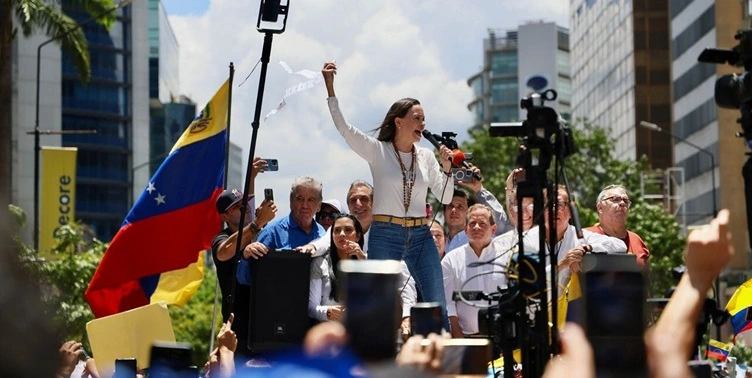
The Cuban dictator Miguel Díaz-Canel Bermúdez, and the former strongman of Bolivia, Evo Morales, among others, have expressed their displeasure for this award
HAVANA.- Curiously, when it was announced that the opposition Maria Corina Machado was awarded the Nobel Peace Prize 2025the regime of Nicolás Maduro requested a meeting of the United Nations Security Council to warn about the alleged danger that his country faces in the face of a hypothetical military aggression by the United States.
Regardless of this new ploy by Chavismo, for some time Caracas had been wielding the specter of an external enemy to try to make public opinion, both national and foreign, forget the theft of the presidential elections carried out by Maduro last July.
We must not forget that the Venezuelan dictator never presented the minutes certifying his victory against the opponent Edmundo González and that his disputed electoral victory was never recognized by a large part of the international community. Even the leftist Luis Inacio Lula da Silva vetoed Venezuela’s entry as an observer country of the BRICS due to the scandalous Chavista “triumph” in those elections.
Now, as expected, the award obtained by María Corina Machado has caused deep discomfort among the carnivorous left in the region. The Cuban dictator Miguel Díaz-Canel Bermúdez, and the former strongman of Bolivia, Evo Morales, among others, have expressed their displeasure at this award. On the other hand, democracy-loving forces have welcomed the award, and expressed the hope that this recognition will serve to further isolate the Maduro regime and accelerate Venezuela’s transition to the concert of nations that respect freedoms and the rule of law.
It is significant that those who are now kicking with rage over the prize awarded to the Venezuelan opposition did not raise their voices to criticize the Nobel Peace Prizes awarded in the past to the Argentine Adolfo Pérez Esquivel and the Guatemalan Rigoberta Menchú.
These winners were fierce critics of the international right, but they turned a blind eye to the excesses of left-wing governments. These characters were of the rank of Díaz-Canel, Evo Morales and others of the same type.
In 2005 the book was published in Havana Sartre, Cuba, Sartre, which includes, among other topics, the visit that the prominent French philosopher and writer made to Cuba in 1960. Although Sartre came to the island with a feeling of sympathy towards the young Cuban revolution, it was inevitable that his acuity and genius allowed him to appreciate the utilitarian vein that Castroism extracted from its rivalry with the United States.
On that occasion the author of The Nausea He expressed that “If the United States did not exist, perhaps the Cuban Revolution would invent them: they are the ones that preserve its freshness and originality” (Contemporary Image editions, page 226).
Although it is a very original observation, made by a highly respected personality at an international level and the bearer of very accurate analyses, it is very likely that the Castro regime had already incorporated it into its arsenal in that early year of 1960. And later, of course, it was present in the discourse and actions of the other authoritarian regimes that appeared in the region.
The Chavista regime, logically, learned its lesson, and has incorporated the dispute with the United States as the core of its international policy. This is how they keep their population mobilized and indoctrinated, in addition to classifying their opponents as agents of a foreign power.
In this context, they describe the well-deserved Nobel Peace Prize awarded to María Corina Machado as part of an international “conspiracy” to overthrow the Bolivarian revolution.