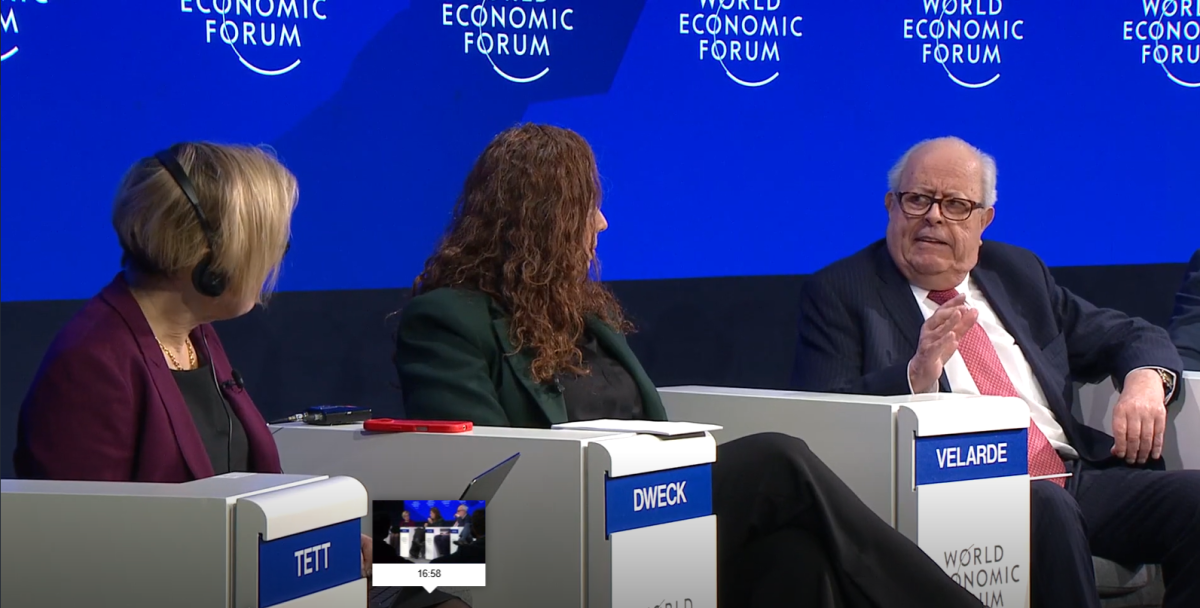
The president of the Central Reserve Bank, Julio Velarde, was invited to participate as a speaker at the World Economic Forum (WEF), in Davos, Switzerland, a summit that brings together the financial elite to debate the global future.
During the panel “Latin America and its growth trajectory,” the moderator and Financial Times columnist, Gillian Tett, praised the management of our central banker, stating that “he has done a truly remarkable job.”
“You have received much recognition across the continent for maintaining an impressive level of monetary stability, even in the midst of extraordinary political and economic turbulence. Many wonder how you have achieved that,” Tett said.
Tett then asked him how he frames the challenge of generating certainty in uncertain times and what he considers key to encouraging investment. Faced with the audience’s expectations, Velarde responded with a dose of realism that marked distance from flattery:
“I’m not so sure I completely agree with what you said,” Velarde replied, cooling the enthusiasm at the table. For the highest representative of the monetary authority, the Peruvian performance that he described with a modest “not so good, but not so bad” is not an individual miracle, but the result of having respected the rules of the game for decades.
Velarde stressed that, while in other latitudes uncertainty arises from sudden changes in tariffs or taxes, Peru has maintained the same tax framework for companies since 1992.
The anchor
According to Velarde’s vision, the anchor against the political storm or the key to resilience does not reside in a political figure, but in the autonomy of macroeconomic institutions:
“We have had nine presidents and the exchange rate has hardly moved. Despite the political volatility, our growth has not been that bad,” he stated, making it clear that the BCR’s institutionality acts as an anchor that survives the crises in the Government Palace.
Velarde assured that, although there were some changes in 2016 in tax matters, in essence, they have been maintained. He highlighted that our economy is quite open, the average tariff is 0.8% and that Peruvians trust in the rule of law and respect the treaties we have signed.
“We have a free trade agreement with the United States, approved by Congress, and which in principle should only be modified by the US Congress. However, we have seen the imposition of new tariffs,” said Velarde, criticizing the US protectionist stance.
Current situation
Likewise, Velarde maintained that the current macroeconomic situation of the region is much better compared to that of the seventies, eighties and even the beginning of the nineties in which macroeconomic instability stood out due to large fiscal deficits, inflation, among other problems.
For this reason, he stated that, although the current macroeconomic situation “is not ideal”, it is not “that bad” either, which is why he recommended continuing to build solid institutions in our country, so that the State reaches every corner with a better civil service and can provide better education.
“Some countries that once had some of the best educational systems in the world today obtain very low results in these international evaluations. I firmly believe that, if you have a well-educated population, in the end you will achieve prosperity,” he concluded.
RECOMMENDED VIDEO