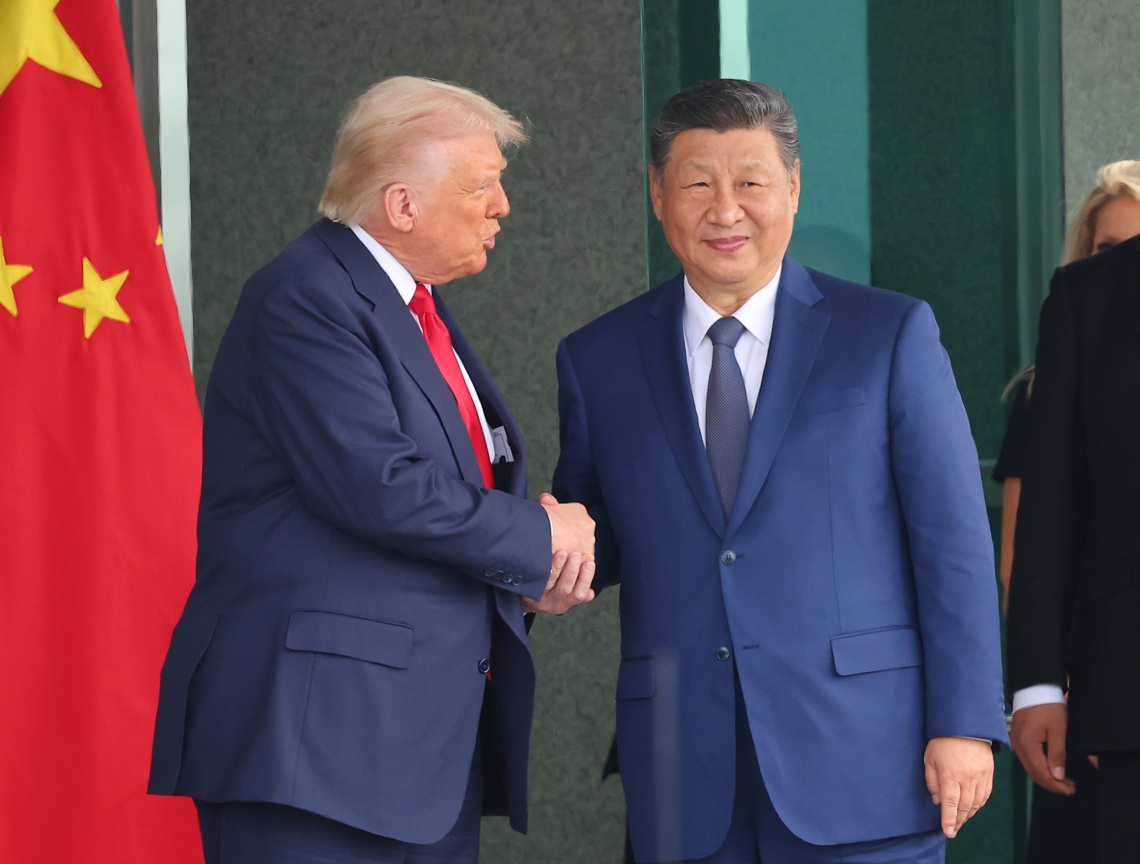
In a meeting that marks a new chapter in relations between the two largest economies in the world, the presidents of the United States, donald trumpand China’s Xi Jinping, held a crucial meeting this Thursday in the port city of Busan, South Korea.
The objective of the meeting was to move towards an agreement that reduces trade tensions and address sensitive issues such as Taiwan, TikTok and global security, and as announced after its conclusion, both leaders reached points of consensus.
At the end of the meeting, Trump said he will reduce the specific tariffs he imposed on China in retaliation for fentanyl trafficking from 20% to 10%, which in total would lower US tariffs on the Asian giant by up to 47%. according to the agency EFE.
The Republican said that Xi pledged to “work very hard” to strengthen control over fentanyl trafficking and to get China to resume purchasing “huge quantities of soybeans” from the United States, which were suspended due to the trade war.
In addition, he said that there would be no more Chinese restrictions on exports of the so-called rare earths and detailed that he spoke with Xi about the sale of chips from the American giant Nvidia to China, although without agreeing on anything specific.
Subsequently, it has also emerged that both countries will suspend the port taxes they imposed on each other for one year.
China and the United States will suspend the port taxes they imposed on each other for one year, after the meeting held in South Korea by Xi Jinping and Donald Trump.https://t.co/1Ig7IZHuE9 pic.twitter.com/AizfAVvLiH
— EFE News (@EFEnoticias) October 30, 2025
Initial cordiality
The face-to-face, the first since Trump returned to power, began after 11:00 local time at Gimhae Air Base.
Both leaders shook hands in front of the cameras, flanked by the flags of their respective countries. “We will have a very successful meeting, I have no doubt,” Trump said with a smile. “But President Xi is a very tough negotiator, that’s not good,” he joked.
Already in the meeting room, accompanied by his delegations, Trump praised his counterpart: “It is a great honor to be with a friend of so long. We are going to have some conversations; we already agree on many things, but President Xi is a great leader of a great country and I think we are going to have a great relationship.”
Xi Jinping responded in a cordial tone: “It is normal for the world’s two major economies to have friction from time to time,” he said. He also thanked Trump for his role in the ceasefire in Gaza and in resolving the conflict between Thailand and Cambodia.
Paving the way to the summit
The meeting takes place a few days after representatives of both countries reached a “preliminary agreement” in Kuala Lumpur in the fifth round of negotiations since April.
Washington previously applied tariffs of 30% on Chinese products, while Beijing maintains 10% on American products, figures that have dropped from the peaks of 145% and 125% recorded at the beginning of the tariff war initiated by Trump.
The US president has expressed his intention to reduce tariffs on China, arguing that “they can help Washington with the fentanyl situation”, a synthetic opioid that, according to the US, is produced by Mexican cartels from chemical precursors from China.
Minutes before the meeting, Trump surprised by announcing on Truth Social that he had ordered the War Department to begin nuclear weapons tests “on equal terms” with countries like Russia and China, a statement that raises concerns about a possible new arms escalation.
Outside the venue, dozens of Chinese students living in South Korea showed their support for Xi by carrying flags. According to local media, three anti-Chinese protesters were arrested nearby.
Taiwan, China’s rebellious island
One of the most delicate issues on the agenda was Taiwan. Trump had announced that he did not plan to directly address the situation on the island with Xi, although according to international media the Taiwanese government was closely monitoring his possible mention in the development of the summit.
“We are closely following the dialogue between the leaders of the two powers,” declared Taiwanese Foreign Minister Lin Chia-lung. “There is close cooperation with the US in security, economy, technology and culture, and we maintain a fluid communication channel.”
Lin also supported the statements of Taiwanese President William Lai, who called for firm opposition to Beijing’s attempts at “annexation and promotion of unification.” “What they call ‘promoting unification’ is, in reality, an attempt to change the status quo in the Taiwan Strait. We must continue to defend the peace and security of the island,” he said.
However, once the meeting was over, Trump said that although he discussed “many things in detail” with Xi during their “long meeting,” the topic of Taiwan “never came up” in the dialogue. This keeps the uncertainty alive in this regard and cools Taiwanese hope for US pressure on Beijing’s claims on the island.
In the meeting between Trump and Xi, the first since the G20 in Osaka in 2019, the future of TikTok in the US was also expected to be discussed, whose presence has been the subject of debate for national security reasons alleged by the White House.
However, that issue does not seem to have had any prominence either according to the initial reports.
The international community has remained attentive to the development and results of this summit, which could redefine the economic and geopolitical balance in a globalized world that Trump is shaking with his chaotic protectionist policies.