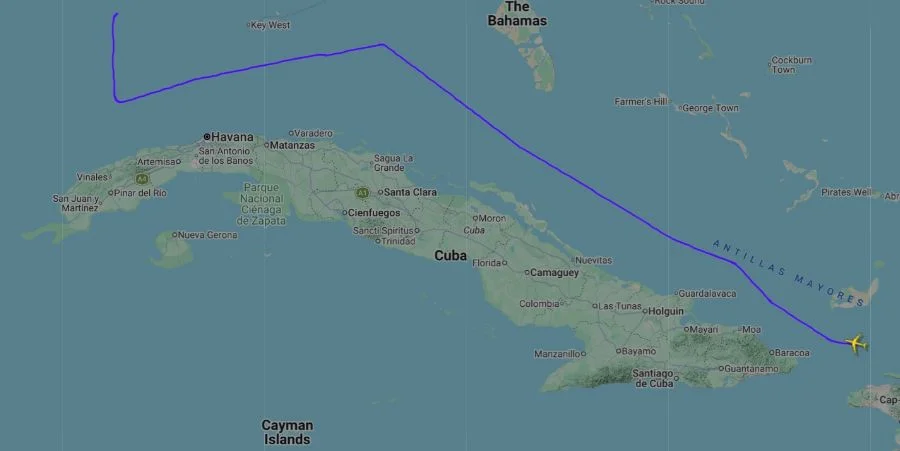
MIAMI, United States. – An RC-135V/W Rivet Joint reconnaissance aircraft, one of the main electronic espionage platforms of the United States Air Force, made a flight this Wednesday off the northern coast of Cuba, according to data from the aerial monitoring platform FlightRadar24 reviewed by CubaNet.
The trajectory visible on the map shows the aircraft moving parallel to the northern coast of the Island, from east to west, before turning north and returning towards Florida, without entering Cuban airspace. The route reproduced in FlightRadar24 It starts at 6:33 in the afternoon.
The aircraft is identified as a Boeing RC-135V Rivet Joint, tail number 64-14841. It flew at an approximate altitude of 31,500 feet and at a speed close to 400 knots over waters near Cuba.
It is not the first time recently that this type of aircraft operates in the vicinity of the Island. At the end of January, users of FlightRadar24 reported another flight of an RC-135 that took off from Homestead Reserve Air Base, in southern Floridaand that during part of its journey it turned off its transponder, which prevented its entire route from being followed through civil tracking systems.
The RC-135V/W Rivet Joint is a specialized signals intelligence (SIGINT) aircraft, designed to intercept and analyze communications and electronic emissions, such as radars and air defense systems.
According to an official technical sheet of the United States Air Force, this platform provides intelligence collection, analysis and dissemination capabilities in near real time, and allows its crew to detect, identify and geolocate electromagnetic signals in wide areas of operation.
According to that same information, the plane can transport more than 30 people, including pilots, electronic warfare officers, intelligence operators and technical personnel. The RC-135 fleet has been employed by the United States in every major military conflict since the Vietnam War, and its internal systems — including antennas, sensors and processing equipment — are mostly classified.
The estimated autonomy of the RC-135 Rivet Joint is about 5,500 kilometers, although it has in-flight refueling capacity, which allows it to considerably extend the duration of its missions, according to official information from the US Air Force.